Opening Hook
Cole Wehrle does not make normal board games. The designer behind Root and Oath has built a career on creating experiences that feel less like games and more like political simulations wrapped in gorgeous cardboard. Arcs is his most ambitious work yet, a space opera that distills the rise and fall of galactic empires into a tight, card-driven strategy game that plays in under two hours. It is the kind of game where you spend your first play confused, your second play enlightened, and every play after that marveling at how much strategic depth is packed into such an elegant system. We have played Arcs more than a dozen times now, and it has fundamentally changed what we expect from a strategy board game.
Overview
Arcs is a strategy board game for two to four players designed by Cole Wehrle and published by Leder Games, the studio behind Root and Oath. The game presents a galactic setting where players control factions vying for dominance across a cluster of star systems. What makes Arcs unique is its dual nature: it works as a standalone base game that plays as a competitive strategy game in sixty to ninety minutes, and it also includes a campaign mode called "The Blighted Reach" that transforms the experience into a multi-session epic where player decisions carry over between games and the galaxy itself evolves. Arcs was one of the most successful Kickstarter board game campaigns in recent memory, and its retail release has cemented its place as one of the most talked-about designs of the year. Wehrle has described it as his attempt to make a game about the sweep of history, the way empires rise and fall and the stories that emerge from that process, and that ambition is evident in every element of the design.
Gameplay and Mechanics
The beating heart of Arcs is its card system, and it is brilliant. Each round, the lead player plays a card from their hand, which determines both the action type (build, move, battle, tax, or influence) and the suit. Every subsequent player must then either follow the lead by playing a card of the same suit or pivot by playing a card of a different suit at a cost. This trick-taking-inspired mechanism creates a constant push and pull between executing your own plans and reacting to what others are doing. Do you follow the lead and take a strong version of an action you did not plan for, or do you pivot to do what you actually need at a weaker strength? Every card play is a decision that reverberates across the entire table.
The action types themselves are straightforward. Move lets you reposition your ships and agents across the map. Build lets you place cities, starports, and ships. Tax generates resources from systems you control. Battle initiates combat, which is resolved through a dice system that is just random enough to create tension without feeling capricious. Influence lets you manipulate the political landscape through agents and court cards. What elevates these simple actions is the way the card system constrains and shapes them. You never have full freedom to do exactly what you want, and the best players are the ones who can adapt their strategy to the cards they draw while still maintaining a coherent long-term plan.
The ambition system is what gives Arcs its narrative arc. Each chapter of the game has a set of ambition cards that define what is being scored: most buildings, most captured resources, most controlled systems, and so on. Players can declare and escalate ambitions, creating a dynamic scoring system where what matters changes from chapter to chapter. One game might see military dominance rewarded; the next might favor economic consolidation. This system means that Arcs never settles into a single dominant strategy, and the political maneuvering around ambition declarations adds a layer of metagame that pure area-control games lack.
The campaign mode, "The Blighted Reach," is where Arcs transforms from an excellent game into something genuinely special. Over a series of sessions, players take on fate cards that give them unique abilities, objectives, and narrative arcs. The galaxy changes between sessions: systems become blighted, new factions emerge, alliances shift. Decisions made in one session create consequences that ripple through subsequent games. It is not a legacy game in the destructive sense, but it captures that same feeling of a world evolving in response to player choices. We found ourselves thinking about our Arcs campaign between sessions, strategizing and scheming in a way that very few board games inspire.
Presentation
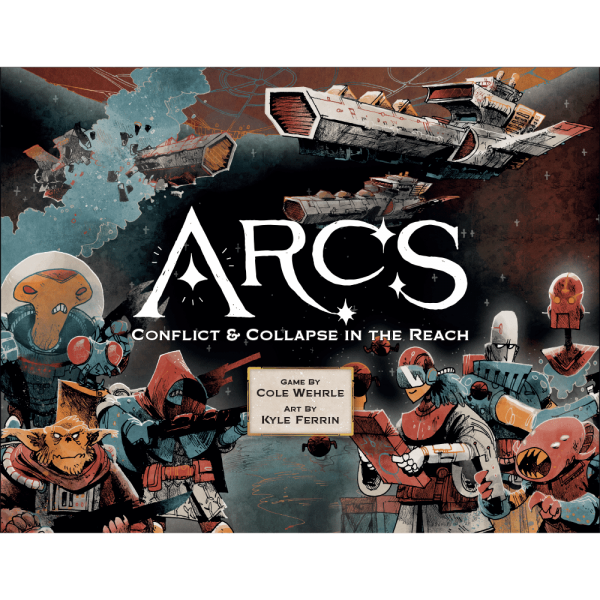
Leder Games has developed a distinctive visual identity through Kyle Ferrin's illustrations, and Arcs continues that tradition while establishing its own aesthetic. The art direction leans into retro science fiction, with a muted color palette that evokes seventies sci-fi novel covers. The map is clean and functional, with clear iconography that makes board state easy to read even in complex mid-game situations. The faction pieces are simple wooden components, ships and agents and buildings, that are easy to distinguish and pleasant to handle.
The card design is particularly strong. Each card features thematic art that reinforces the galactic setting, and the layout clearly communicates suit, number, and any special abilities. The court cards, which represent political figures and institutions, have flavor text that adds narrative texture to the mechanical experience. The box includes player aids that are essential for first-time players but become unnecessary after a few sessions, which is the mark of a well-designed reference.
The rulebook is where Arcs stumbles slightly. Wehrle's games tend to have rules that are simple in isolation but complex in interaction, and the written rules do not always convey the intuitive flow of play as clearly as they could. We found that watching a teach video before reading the rules made a significant difference in comprehension. The campaign rules add another layer of complexity, and some of the fate card interactions require careful interpretation. Leder Games has published errata and FAQ documents, and the online community is active in clarifying edge cases, but we wish the rulebook itself were more self-sufficient.
Content and Value
At roughly fifty dollars for the base game, Arcs is priced competitively for the experience it offers. The standalone base game provides strong replayability through the variable ambition system and the inherent unpredictability of card-driven play. No two games of Arcs play the same way, because the cards you draw and the ambitions that emerge create unique strategic landscapes every session. The campaign expansion adds enormous value, offering a multi-session experience that extends the game's shelf life considerably.
The base game alone is worth the investment for groups that enjoy tight, interactive strategy games. The campaign is recommended for groups that can commit to multiple sessions with the same players, and it elevates the experience from excellent to extraordinary. The component quality is solid for the price, and the game's relatively compact box size means it does not demand excessive shelf space. For strategy game enthusiasts, this is one of the best value propositions on the market.
What Works and What Doesn't
Arcs works brilliantly as a strategy game that creates emergent narratives. The card-led mechanic is one of the most inventive action-selection systems we have ever seen in a board game, creating constant tension and forcing adaptation. The ambition system ensures that every game has a unique strategic landscape. The campaign mode is a masterpiece of evolving, persistent gameplay that rewards long-term thinking and commitment. The asymmetric factions, introduced through campaign fate cards, are fascinating and create wildly different play experiences.
Where Arcs struggles is in its accessibility. The learning curve is real, and the first game is almost inevitably a learning exercise rather than a satisfying strategic experience. The game ideally wants three or four players, as the two-player experience, while functional, loses much of the political tension and table talk that make the multiplayer game sing. The campaign mode requires a group willing to commit to multiple sessions, which is a significant ask. And while the rulebook has improved through errata, it remains a weak point in an otherwise stellar package.
Pros
- Brilliant card-led mechanic creates constant tactical tension
- Campaign mode is a masterpiece of evolving persistent gameplay
- Asymmetric factions through fate cards are fascinating to explore
- Tight strategic decisions with minimal downtime between turns
Cons
- Steep learning curve with a rough first-play experience
- Requires 3-4 players ideally to reach its full potential
- Campaign requires commitment from a consistent group
- Rulebook could be clearer in conveying the flow of play
Final Verdict
Arcs is Cole Wehrle at the peak of his powers. It is a game that takes the card-driven war game tradition and distills it into something accessible enough to play in ninety minutes while retaining the strategic depth and emergent storytelling that makes the genre compelling. The base game is an excellent, highly replayable strategy experience. The campaign transforms it into one of the most memorable board gaming experiences we have had in years. It demands a certain kind of player, one willing to invest in learning its systems and committed enough to see a campaign through, but for those players, Arcs delivers an experience that no other game on the market can match. This is the kind of game that reminds you why you fell in love with board gaming in the first place. It is bold, inventive, and utterly magnificent.