Opening Hook
It is a feast year in the village, and the wheat is piling high. You have just drafted a perfect combination of recipe cards — a hearty dark rye that will score big, a smooth pilsner that needs only two more grain tokens, and a utility card that lets you convert surplus hops into points. Your opponent is watching you with narrowed eyes, because they know that next year will be a famine year, and whatever cards you do not use now will be passed directly into their hands. This is the central tension of Beer and Bread: every good year makes the next bad year worse for you, and the game's elegant feast-famine cycle ensures that no advantage lasts. Designer Scott Almes has packed a remarkable amount of strategic depth into a tiny box that plays in thirty minutes, and while it will not replace your favorite complex two-player game, it will absolutely earn a permanent spot in your travel bag.
Overview
Published by Deep Print Games with striking art direction and compact production, Beer and Bread is a two-player card game about life in a small medieval village where the two primary concerns are, unsurprisingly, brewing beer and baking bread. Each player represents a village working through six rounds of alternating feast and famine years. During feast years, resources are abundant and players draft cards from a shared pool, building their production capabilities. During famine years, resources are scarce and players must rely on what they have accumulated, passing their unused cards to their opponent. At the end of six rounds, players score points based on the beer and bread they have produced — but here is the scoring twist that makes the whole design sing: only your lower-scoring category counts. If you produce magnificent bread but mediocre beer, your final score is based on the beer. This forces balanced production and prevents players from simply specializing in one category.
Almes is a designer known for creating big experiences in small packages — he is the mind behind Tiny Epic Galaxies and other titles that compress ambitious designs into compact formats. Beer and Bread might be his most refined work, a game where every card interaction and timing decision matters, and where the small number of components belies the complexity of the choices you face. Deep Print Games, a boutique publisher with a growing reputation for unique two-player experiences, provides the perfect home for this design, surrounding it with warm, inviting artwork that evokes rustic European village life.
Gameplay and Mechanics
The game unfolds over six rounds — three feast years and three famine years, alternating in sequence. Each round, players have a hand of cards and take turns playing one card at a time, alternating back and forth until all cards are played or discarded. The cards serve multiple purposes: some are recipe cards that produce beer or bread when fulfilled with resources, some are action cards that let you gather resources or manipulate your position, and some serve as raw ingredients that can be spent to fuel other cards. The multi-use nature of the cards is where much of the strategic depth resides. That grain card in your hand could be played as a resource to help complete a bread recipe, or it could be used for its action ability to steal a resource from your opponent, or it might be more valuable simply held in reserve for a future round.
The feast-famine cycle is the game's signature mechanic. During feast years, both players draw from a shared card display, drafting cards one at a time in alternating fashion. Resources are plentiful, and the mood is expansive — you are building your engine, collecting recipes, stockpiling ingredients. During famine years, the dynamic shifts dramatically. No new cards enter the game. Instead, players must work with whatever they already have, and crucially, any cards remaining in your hand at the end of a famine round are passed to your opponent. This creates a delicious tension during feast years: you want to draft powerful cards, but you also know that anything you cannot use before the next famine will potentially empower your rival.
The card drafting during feast years is simple but engaging. A display of cards is laid out and players alternate selecting from it, building their hands for both immediate use and future rounds. The information is mostly open — you can see what your opponent is taking and infer their plans — which creates opportunities for hate-drafting, where you take a card not because you need it but because your opponent does. This is a small game, and those small acts of denial can have outsized consequences.
Resource management is straightforward. You collect grain, hops, and other ingredients through card abilities and spend them to complete recipes. Completed recipes produce beer or bread tokens of varying values, which accumulate across the entire game. The scoring rule — only your lower category counts — means you cannot simply ignore beer to focus on bread or vice versa. You need to maintain balance, and the card draft does not always cooperate with your plans. Sometimes the feast year offers an abundance of bread recipes and almost no beer options, forcing you to adapt your strategy on the fly. This flexibility requirement elevates Beer and Bread above simple optimization puzzles.
The passing mechanism during famine years deserves special attention because it is where the game's most interesting decisions live. You want to use as many cards as possible before the famine ends, but some cards are more valuable held in reserve for future rounds. Deciding what to keep and what to pass requires you to evaluate not just your own position but your opponent's needs. Passing them a card that perfectly completes their highest-value recipe is devastating. Holding onto a card you do not need just to deny them the resource is sometimes the right play but costs you tempo. These tradeoffs are simple to understand but genuinely difficult to master, which is the hallmark of excellent game design.
Presentation
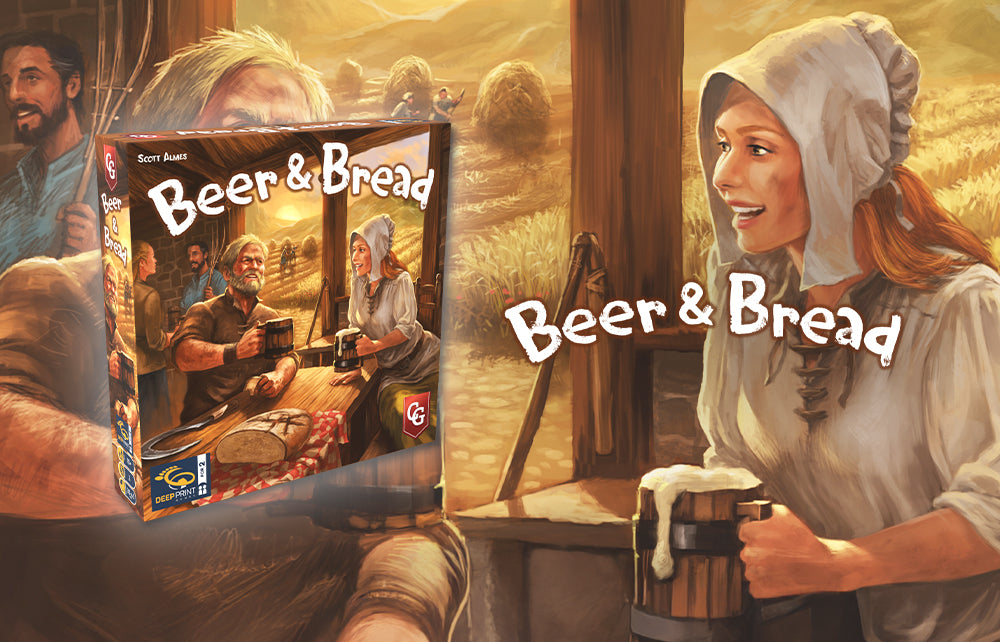
Beer and Bread is a beautiful little game. The card art, illustrated in a warm, storybook style, depicts pastoral scenes of village life — golden wheat fields, steaming bread ovens, frothy tankards of ale, and cheerful villagers going about their work. The color palette is rich and inviting, heavy on warm ambers, earthy browns, and deep golds that perfectly evoke the theme. It is the kind of game that looks charming on a cafe table or a pub counter, which feels entirely intentional given the subject matter.
The component quality is solid for the price point. The cards have a linen finish that feels good in hand and should hold up to repeated shuffling. The resource tokens are sturdy cardboard, clearly differentiated by shape and color. The box is compact — roughly the size of a large paperback — making it genuinely portable. The rulebook is well-organized with clear examples, though the scoring system trips up most new players on first reading. The concept of only counting your lower category is simple once understood but counterintuitive enough that it bears repeating during the teach. We recommend emphasizing it before the first card is played, because it fundamentally shapes every decision in the game.
Content and Value
At approximately thirty dollars, Beer and Bread occupies a reasonable price point for a dedicated two-player card game. The box contains everything you need for a complete experience, with no expansions required or currently available. Each game plays in thirty to forty-five minutes, and the first few plays will likely run toward the longer end as players internalize the feast-famine rhythm and the scoring implications of their choices. Once both players are experienced, games tighten up to a brisk thirty minutes, making it easy to play multiple rounds in a single sitting.
The replayability question is where Beer and Bread shows some limitations. The card pool is relatively small, and after a dozen or so plays, experienced players will have seen every card multiple times and developed strong intuitions about optimal play patterns. The game does not include variant rules, alternate card sets, or modular content that might extend its shelf life. This is not necessarily a flaw — many excellent two-player games have a natural lifespan, and Beer and Bread provides plenty of enjoyment within its window — but it is worth setting expectations accordingly. If you are looking for a two-player game that will sustain hundreds of plays, something with more strategic depth like Targi or Watergate may serve you better. If you want something lighter and more portable that will delight for a couple dozen sessions and then gracefully retire, Beer and Bread fits that role perfectly.
The game also functions well as a gateway title for couples or friends who are new to the hobby. The rules are simple enough to teach in five minutes, the theme is universally appealing, and the game length never outstays its welcome. We have used Beer and Bread successfully as an introduction to card drafting and resource management concepts, and it has consistently earned positive reactions from non-gamers who might be intimidated by more complex two-player titles.
What Works and What Doesn't
What works is the elegance. The feast-famine cycle is a genuinely inspired mechanic that creates natural dramatic arcs within every game. Feast years feel expansive and hopeful. Famine years feel tense and desperate. The transition between them generates strategic friction that is far more interesting than the simple card interactions might suggest on first glance. The balanced scoring rule forces players out of their comfort zones and rewards adaptability over rigid planning. And the passing mechanism during famine years creates moments of agonizing decision-making that punch well above the game's weight class.
What does not quite work is the ceiling. After extensive play, Beer and Bread reveals its limits. The card variety is not large enough to prevent the game from feeling samey once both players have fully explored the strategic space. Some combinations of cards are clearly stronger than others, and experienced players will gravitate toward the same high-value recipes, reducing the sense of discovery that makes early plays so enjoyable. The two-player restriction, while fundamental to the design, also limits the game's versatility — you cannot pull this out at a game night with three or more people, which means it competes for shelf space against a crowded field of excellent two-player options.
Pros
- Elegant feast/famine cycle
- Quick and satisfying
- Beautiful card art
- Good strategic depth for its weight
Cons
- Only plays two
- Can feel repetitive
- Limited card variety
- Scoring can be confusing at first
Final Verdict
Beer and Bread is a small game with a big heart. Scott Almes has distilled the essence of resource management and strategic card play into a compact, portable package that consistently delivers satisfying thirty-minute experiences. The feast-famine cycle is the kind of mechanic that makes you wonder why nobody thought of it sooner — simple, thematic, and rich with consequences. The presentation is warm and inviting, the rules are accessible, and the balanced scoring system ensures that every game demands thoughtful, adaptive play. It is not the deepest two-player game available, and it will not sustain the kind of obsessive replay that titles like Star Realms or Jaipur enjoy. But for what it aims to be — a charming, strategic card game about the simple pleasures of baking bread and brewing beer — it succeeds admirably. We recommend it enthusiastically for couples looking for a date-night game, for travelers who want strategic depth in a pocket-sized box, and for anyone who believes that the best things in life are, indeed, beer and bread.