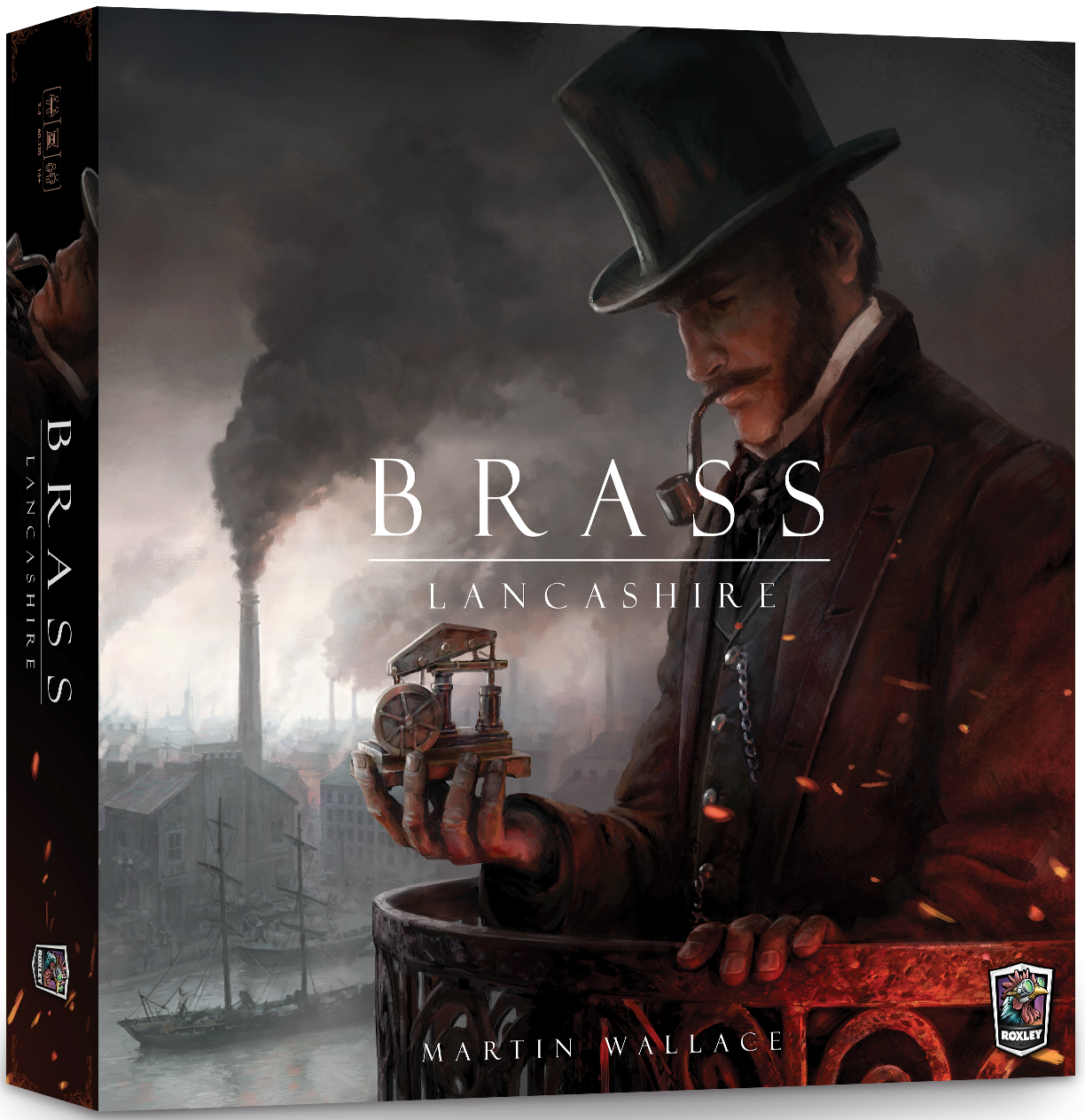
The Industrial Revolution, Perfected
Some board games entertain you. Others challenge you. And then there are the rare few that fundamentally reshape your understanding of what a board game can be. Brass: Lancashire belongs firmly in that last category. Martin Wallace's magnum opus, originally released in 2007 and given a breathtaking deluxe treatment by Roxley Games, is not just one of the best economic strategy games ever designed — it is one of the best games, full stop. The 2025 deluxe edition elevates an already legendary design with production values that match the ambition of its mechanics, and we are here to tell you that if you have even a passing interest in heavy strategy games, this belongs on your shelf. Period.
Overview
Brass: Lancashire is a two to four player economic strategy game set during the Industrial Revolution in Lancashire, England. Players assume the roles of entrepreneurs competing to build the most successful industrial empire across two distinct eras: the Canal Era and the Rail Era. Over the course of roughly ninety to one hundred twenty minutes, you will build cotton mills, coal mines, iron works, ports, and shipyards, connecting them via canals and later railways to create a network of industry that scores victory points based on the value of your developed buildings and the links between them.
The game was originally published as simply "Brass" before its sibling title, Brass: Birmingham, arrived. While Birmingham is often considered the more accessible of the two, Lancashire remains the purer design — leaner, meaner, and more ruthlessly focused on its core economic puzzle. The Roxley deluxe edition, which has been steadily reprinted to meet demand, features iron-clad poker chips for money, detailed clay industry tiles, a gorgeous double-layered game board, and card stock that feels like it could survive the actual Industrial Revolution. It is, without exaggeration, one of the most beautiful heavy games ever produced.
Gameplay and Mechanics
Brass: Lancashire operates on a card-driven action system that is deceptively simple in its structure but staggeringly deep in its implications. Each turn, you play one card from your hand to perform one of several actions: build an industry tile, build a canal or rail link, develop (remove a lower-level industry tile from your player mat to access higher-level ones), sell cotton, or take a loan. That is essentially the entire action menu. Five possible actions. And yet the decision space that emerges from these five options is oceanic.
The genius of Brass lies in how everything interconnects. Building a cotton mill is pointless unless you can sell its output, which requires a connection to a port or access to an external market that may or may not be available. Building a coal mine generates coal that sits on the board as a shared resource — anyone connected to it can use it, meaning your investments directly benefit your opponents unless you plan carefully. Iron works similarly, producing iron that flows along connection networks to wherever it is needed. You are not operating in isolation; you are part of a shared economic ecosystem where every action ripples outward.
The dual-era structure is what elevates Brass from excellent to transcendent. At the end of the Canal Era, all level-one industry tiles and all canal links are removed from the board. Wiped clean. Your carefully constructed network is partially dismantled, and the Rail Era begins with new opportunities and new constraints. This creates an extraordinary strategic tension: do you invest heavily in the Canal Era for immediate points, or do you position yourself for the Rail Era where higher-level industries score dramatically more? The answer, of course, is both, and figuring out the right balance is a puzzle that reveals new layers with every play.
The loan mechanism deserves special mention. Taking loans in Brass is not a sign of desperation — it is a strategic tool. Money is deliberately tight, and knowing when to leverage debt to fund a critical build is a skill that separates good players from great ones. But loans reduce your income, creating a long-term cost for short-term gain. Managing your income track, your cash flow, and your card hand simultaneously is a juggling act that is immensely satisfying when you pull it off and brutally punishing when you miscalculate.
The card system adds a layer of tactical constraint that prevents the game from becoming a pure optimization exercise. You can only build in locations matching the cards in your hand, or you can spend any card to build in a location where you already have presence. This means hand management is crucial — sometimes the best strategic play is impossible because you lack the right card, forcing you to adapt, pivot, and find creative alternatives. It is this constant tension between strategic ambition and tactical reality that makes Brass endlessly replayable.
Presentation
The Roxley deluxe edition is a triumph of board game production. The board itself is a work of art — a stylized map of Lancashire with period-appropriate aesthetics, printed on a thick double-layered board where tiles slot into recessed spaces with satisfying precision. The iron-clad poker chips used for money are hefty and satisfying to stack, spend, and collect. The industry tiles are thick cardboard with clear iconography, and the player mats are similarly double-layered to keep tiles organized during play.
The art direction strikes a perfect balance between historical authenticity and visual clarity. Everything is readable at a glance once you learn the iconography, which takes perhaps one full game to internalize. The rulebook is well-structured, though the game's complexity means newcomers should expect to reference it frequently during their first play. We strongly recommend watching a tutorial video before attempting to learn from the rulebook alone — not because the rulebook is bad, but because Brass has enough interlocking systems that seeing them in action is worth a thousand words of explanation.
At eighty dollars, the deluxe edition is a significant investment. But when you consider the quality of the components and the depth of the game they contain, the price-to-value ratio is actually remarkable. These are components you will be handling for years, possibly decades, and they are built to last.
Content and Value
Replayability is where Brass: Lancashire truly justifies its price tag. This is not a game you play ten times and shelve. It is a game you play fifty times and feel like you are still scratching the surface. The card-driven variability ensures no two games play out identically, and the strategic depth means you will be refining your approach for years. The interaction between players — the shared resource networks, the competition for build locations, the race to develop industries before opponents — creates a different dynamic at every player count.
At two players, Brass is a tense duel with maximum control and minimal chaos. At three, it opens up with more competition for key locations. At four, it becomes a crowded, aggressive struggle where reading your opponents and timing your moves is paramount. Each player count feels like a different game, and all are excellent. If we are forced to choose, three players is the sweet spot, offering the best balance of interaction, planning, and game length.
The game does not include solo play, nor does it need it. Brass is fundamentally about human interaction — reading opponents, exploiting their networks, timing your moves against theirs. Any solo variant would strip away the game's soul.
What Works and What Doesn't
What works is nearly everything. The economic engine is brilliantly designed, the dual-era structure is genius, the shared resource system creates meaningful interaction without direct conflict, and the production quality is exceptional. Brass: Lancashire is a design that rewards patience, study, and repeated play in a way that few games can match.
What doesn't work is accessibility. This is a heavy game by any standard, and it will alienate players who are not prepared for its complexity. The first play is almost guaranteed to be confusing, and the game does not reveal its brilliance until you understand its systems well enough to plan multiple turns ahead. Analysis paralysis is a real risk at higher player counts, particularly with players who want to optimize every decision. And the price point, while justified, is a barrier for casual buyers. This is a game you need to be committed to — it will not reward a single curious play the way lighter games can.
Final Verdict
Brass: Lancashire (Deluxe Edition) is a masterpiece. There is no qualification needed, no asterisk, no "for its genre" hedge. It is one of the finest board games ever designed, presented in one of the finest productions ever made. Martin Wallace created something extraordinary when he first designed Brass, and Roxley's deluxe treatment has given that design the physical form it always deserved. If you are a strategy gamer looking for a game that will challenge and reward you for years to come, if you want a game that treats you like an intelligent adult and asks you to think deeply about interconnected systems, Brass: Lancashire demands your attention. It is not for everyone — it is heavy, it is demanding, and it requires commitment. But for those willing to meet it on its terms, it offers an experience that is simply unmatched in modern board gaming. We cannot recommend it highly enough.
Pros
- Masterclass in economic strategy with extraordinary depth
- Stunning deluxe components including iron-clad poker chips
- Incredibly deep replayability across hundreds of plays
- Elegant dual-era structure creates brilliant tension
Cons
- Very heavy for newcomers with a steep learning curve
- Analysis paralysis is common at higher player counts
- Requires multiple plays to truly appreciate its depth
- Price point of ~$80 is steep for uncertain buyers