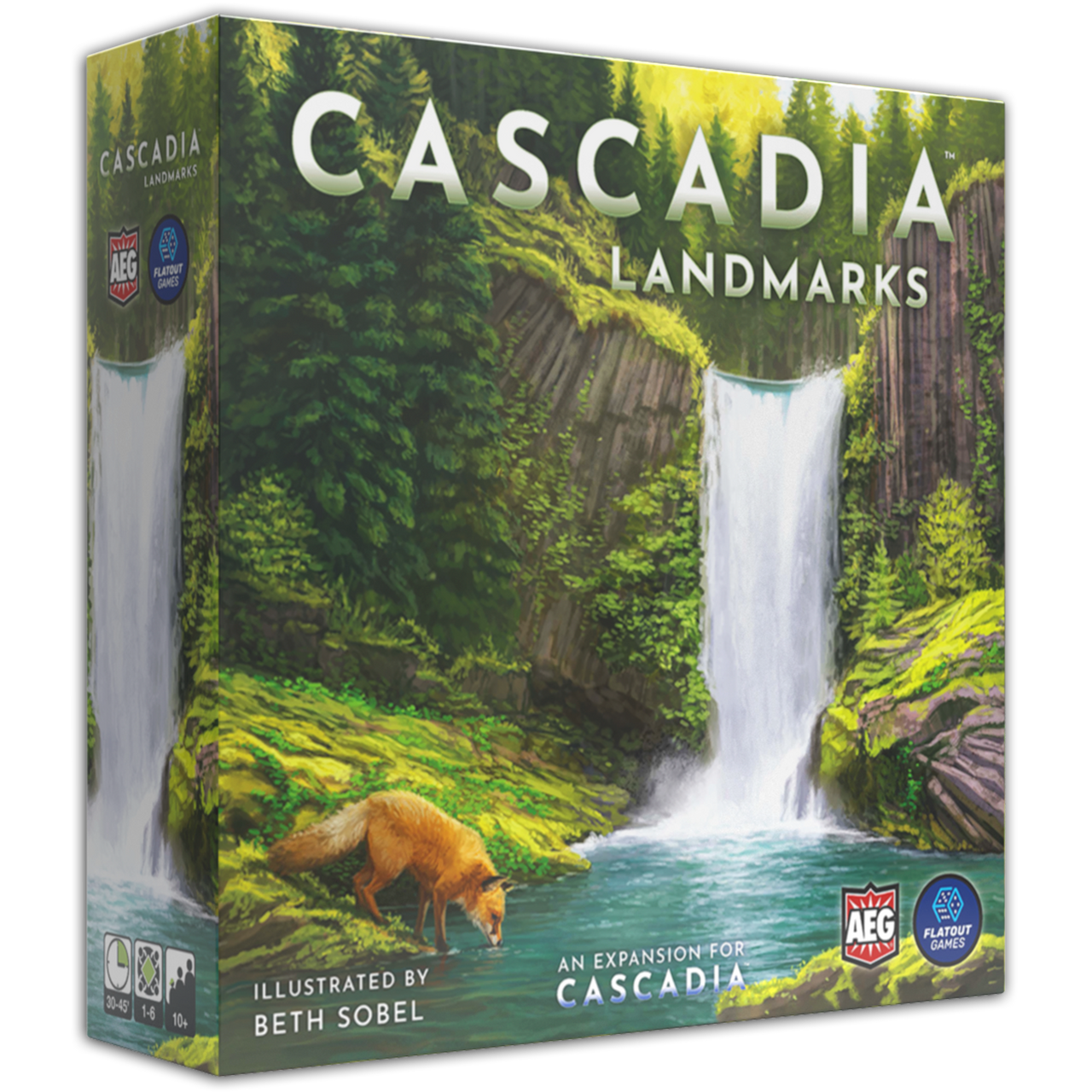
Returning to the Pacific Northwest
Cascadia was one of the definitive board game success stories of the early 2020s. Randy Flynn's tile-laying puzzle captured hearts with its approachable design, beautiful nature theme, and that perfect balance between accessibility and meaningful decision-making that defines the best family-weight games. It won the Spiel des Jahres in 2022, sold over a million copies, and earned a permanent place on countless shelves. So when Flatout Games announced Cascadia: Landmarks — a standalone expansion that builds on the original's foundation while introducing new mechanisms and an increased player count — the question was inevitable: does one of the hobby's modern classics need more? After extensive time with Landmarks, we can say the answer is a qualified yes, though the qualification matters.
Overview
Cascadia: Landmarks is a standalone game for one to six players, designed once again by Randy Flynn and published by Flatout Games in partnership with AEG. It retains the core loop that made the original beloved — draft habitat tiles and wildlife tokens, build a personal ecosystem, score points based on how well your wildlife matches scoring card conditions — while introducing the titular landmark tokens and a handful of supporting additions. The landmark tokens are three-dimensional wooden pieces representing natural features like waterfalls, mountain peaks, and ancient trees, placed onto your habitat to score bonus points based on surrounding conditions.
The game also expands the maximum player count from four to six, includes new wildlife scoring cards for added variety, and introduces a handful of new habitat tile types. Crucially, it is fully standalone — you do not need the original Cascadia to play — but it is also compatible with the base game's components, allowing you to mix and match as you see fit. At approximately thirty dollars, it is priced as a full game rather than a small-box expansion.
Gameplay and Mechanics
If you have played Cascadia, the core experience here will be immediately familiar. On your turn, you select one pair from the central display — a habitat tile paired with a wildlife token — and add both to your personal ecosystem. Habitat tiles are hexagonal and feature one or two terrain types (mountains, wetlands, rivers, forests, or prairies), while wildlife tokens represent bears, elk, salmon, hawks, and foxes. At game end, you score points for the largest contiguous groups of each terrain type, plus bonus points based on how your wildlife tokens match the patterns on the active scoring cards.
The landmark tokens are the primary new mechanism, and they integrate smoothly into this framework. When you complete certain conditions during play — typically creating a contiguous group of a specific terrain type that reaches a threshold size — you earn a landmark token and place it onto one of your habitat tiles. Each landmark scores points based on its specific conditions: a waterfall landmark, for example, might score points for each adjacent river tile, while a mountain peak might score based on the total elevation of surrounding mountain groups. These landmarks add a satisfying new layer of goals to pursue without fundamentally changing the game's flow.
In practice, landmarks introduce what we would describe as a medium-impact addition. They give you new targets to aim for beyond the standard wildlife scoring cards and terrain majority goals, which is genuinely welcome. The decision of where to place a landmark on your ecosystem matters — you want to maximize its scoring adjacency bonus — and sometimes pursuing a landmark forces you to make habitat placement decisions you otherwise would not. This adds a tangible new dimension of spatial planning to the puzzle.
However, the landmarks also slow the game down, particularly for players who are prone to analysis paralysis. The original Cascadia flowed beautifully because decisions, while meaningful, were constrained enough to keep turns brisk. Adding landmarks creates one more thing to evaluate on every turn — am I close to triggering a landmark? Where would I place it? Is it worth adjusting my plans to pursue one? For experienced players, this evaluation becomes quick and intuitive. For newer players or larger groups, it can add noticeable friction to what was previously a seamless experience.
The new wildlife scoring cards are a more straightforward win. They introduce fresh patterns and conditions that give veteran players new puzzles to solve, and they mix seamlessly with the original game's scoring cards if you combine the two sets. The increased player count to six is functional, though we found that five and six players stretch the game's downtime to the point where the breezy, meditative quality of Cascadia begins to fray. At six players, you are sometimes waiting long enough between turns that the connection to your strategic plans weakens. Three to four remains the ideal range.
Presentation
Flatout Games has maintained the visual standard set by the original. The habitat tiles are gorgeous, featuring the same detailed nature artwork that made Cascadia such an attractive table presence. The wooden landmark tokens are a nice touch — chunky, well-produced, and visually distinct enough to read easily across the table. The wildlife tokens remain the same high-quality wooden discs with printed designs, and the overall component quality is excellent for the price point.
The rulebook is clear and well-organized, with separate sections for players learning Landmarks as their first Cascadia experience and for veterans adding it to their existing knowledge. This dual-track approach is thoughtful and effective. One practical complaint: the box insert does not comfortably accommodate components from both Landmarks and the original game if you want to combine them. Given that mixing the two is an explicitly supported option, this oversight is frustrating. You will need bags or a third-party organizer if you want a combined set.
The art direction remains one of the best in the family-game space. The Pacific Northwest nature theme is rendered with warmth and detail, and the table presence of a completed ecosystem — now dotted with three-dimensional landmark tokens — is genuinely beautiful. It remains one of those games that non-gamers stop to admire when they see it in progress.
Content and Value
At roughly thirty dollars, Cascadia: Landmarks offers good value as a standalone product. If you do not own the original Cascadia, this is arguably the better buy — you get everything the original offers plus the landmark mechanism, new scoring cards, and support for up to six players. It is a strictly superior package for newcomers.
For existing Cascadia owners, the calculation is more nuanced. The landmarks are a nice addition but not a transformative one. The new scoring cards add welcome variety but are a modest increment. The increased player count is useful for specific social situations but is not where the game shines. If Cascadia is a game you play frequently and love deeply, Landmarks adds enough new texture to justify its price. If Cascadia is a game you enjoy occasionally and are content with, Landmarks is a pleasant enhancement but not an essential purchase.
The solo mode carries over from the original with landmark-specific objectives added. It functions fine as a puzzle exercise, offering a reasonable challenge and a satisfying scoring threshold to pursue. Solo players who enjoyed the original's solo mode will find more to like here, though it remains a secondary way to experience the game.
What Works and What Doesn't
What works is the core proposition: this is still Cascadia, and Cascadia is still wonderful. The landmark tokens add a meaningful new layer without overwhelming the design's elegant simplicity. The new scoring cards provide genuine variety. The standalone nature of the product makes it an excellent entry point for new players. And the production quality remains excellent across every component.
What doesn't work as well is the pacing impact at higher player counts, the underwhelming box insert for combined play, and the sense that, for veteran players, the additions are incremental rather than revelatory. If you were hoping Landmarks would add significant strategic depth to Cascadia, you will find its contributions more modest than anticipated. The landmarks are a nice spice, not a new main course.
Final Verdict
Cascadia: Landmarks is a thoughtful, well-produced expansion of one of the hobby's best family games. It does not reinvent the wheel, nor does it try to. What it does is give Cascadia players more reasons to return to the Pacific Northwest, with landmark tokens that add satisfying new goals and scoring cards that freshen the puzzle. For newcomers, it is the definitive version of the Cascadia experience. For veterans, it is a welcome but non-essential addition that enhances without transforming. We recommend it warmly to anyone who loves the original and wants a reason to bring it back to the table, and even more warmly to anyone who has never played Cascadia and wants the best possible entry point. It earns its place on the shelf, even if it does so quietly rather than with a grand declaration.
Pros
- Landmarks add meaningful new spatial decisions
- Increased player count to 6 adds social flexibility
- Retains the original's elegant core loop
- New wildlife scoring cards provide welcome variety
Cons
- Not essential if you already own the base game
- Landmarks can slow gameplay with additional decisions
- Box insert doesn't accommodate combined components
- Additions are minimal for experienced strategy players