Saving the World Has Never Felt This Good at the Table
We have played a lot of cooperative board games over the years. We have cured diseases in Pandemic, escaped sinking islands in Forbidden Island, and fought back eldritch horrors in Arkham Horror. But we have never played a cooperative game that left us feeling quite like Daybreak does. When you win a game of Daybreak, you do not just feel the satisfaction of beating a mechanical puzzle. You feel something closer to hope. Real, tangible hope that maybe, just maybe, the climate crisis is a problem humanity can actually solve. That is an extraordinary thing for a box of cardboard and cards to accomplish, and it is why Daybreak deserves your attention even if you think you are done with cooperative games.
Overview
Daybreak is the creation of Matt Leacock, the legendary designer behind Pandemic, working alongside Matteo Menapace. Published by CMYK, the game casts one to four players as major world powers working together to decarbonize the global economy before climate tipping points push the planet past the point of no return. Each player represents a different world region with unique strengths and challenges, playing cards that represent real technologies, policies, and social movements that exist today or are in active development.
The game was developed in consultation with actual climate scientists, and it shows. Every card in the deck corresponds to a real solution, from offshore wind farms and carbon capture technology to urban density policies and regenerative agriculture. The result is a game that is simultaneously a compelling strategic puzzle and an accessible education about the tools humanity already has to fight climate change. It retails for around sixty dollars and plays in sixty to ninety minutes, making it a solid mid-weight cooperative experience that sits comfortably alongside other Leacock designs in terms of accessibility and play time.
Gameplay and Mechanics
At its core, Daybreak is an engine-building cooperative game. Each player starts with a tableau representing their region's energy grid, which is initially dominated by fossil fuel sources. Over the course of the game, you play cards from your hand to replace dirty energy with clean alternatives, implement policies that reduce emissions, and build resilience against the climate crises that will inevitably arrive. The central tension is beautifully elegant: every round, the planet warms, and the consequences of that warming create cascading problems that threaten to overwhelm your collective progress.
The card play is where Daybreak truly shines. Each card has a cost, measured in the political and economic capital your region can spend each turn. Some cards provide immediate effects, like instantly retiring a coal plant. Others are permanent installations that generate ongoing benefits, like a solar farm that produces clean energy every round. The most interesting cards are the ones that interact with other players' tableaus, encouraging genuine collaboration rather than parallel solitaire. You might play a technology transfer card that lets another player adopt one of your clean energy innovations, or a diplomatic card that reduces global emissions across all regions simultaneously.
The crisis system is what gives Daybreak its dramatic arc. Each round, crisis cards are drawn that represent real consequences of climate change: extreme weather events, sea level rise, food shortages, and climate migration. These crises hit different regions differently, and managing them requires coordinated effort. A devastating drought in one region might require another player to divert resources to humanitarian aid, delaying their own decarbonization efforts. This creates agonizing decisions about short-term crisis management versus long-term systemic change, which feels uncomfortably relevant to the real-world challenge.
The win condition is straightforward but demanding: reduce global emissions to zero and draw down enough atmospheric carbon to stabilize the climate before the crisis track overwhelms you. It is harder than it sounds, and our early games ended in defeat more often than not. But each loss teaches you something about the interconnected systems at play, and the gradual improvement in your collective strategy feels deeply satisfying.
Presentation
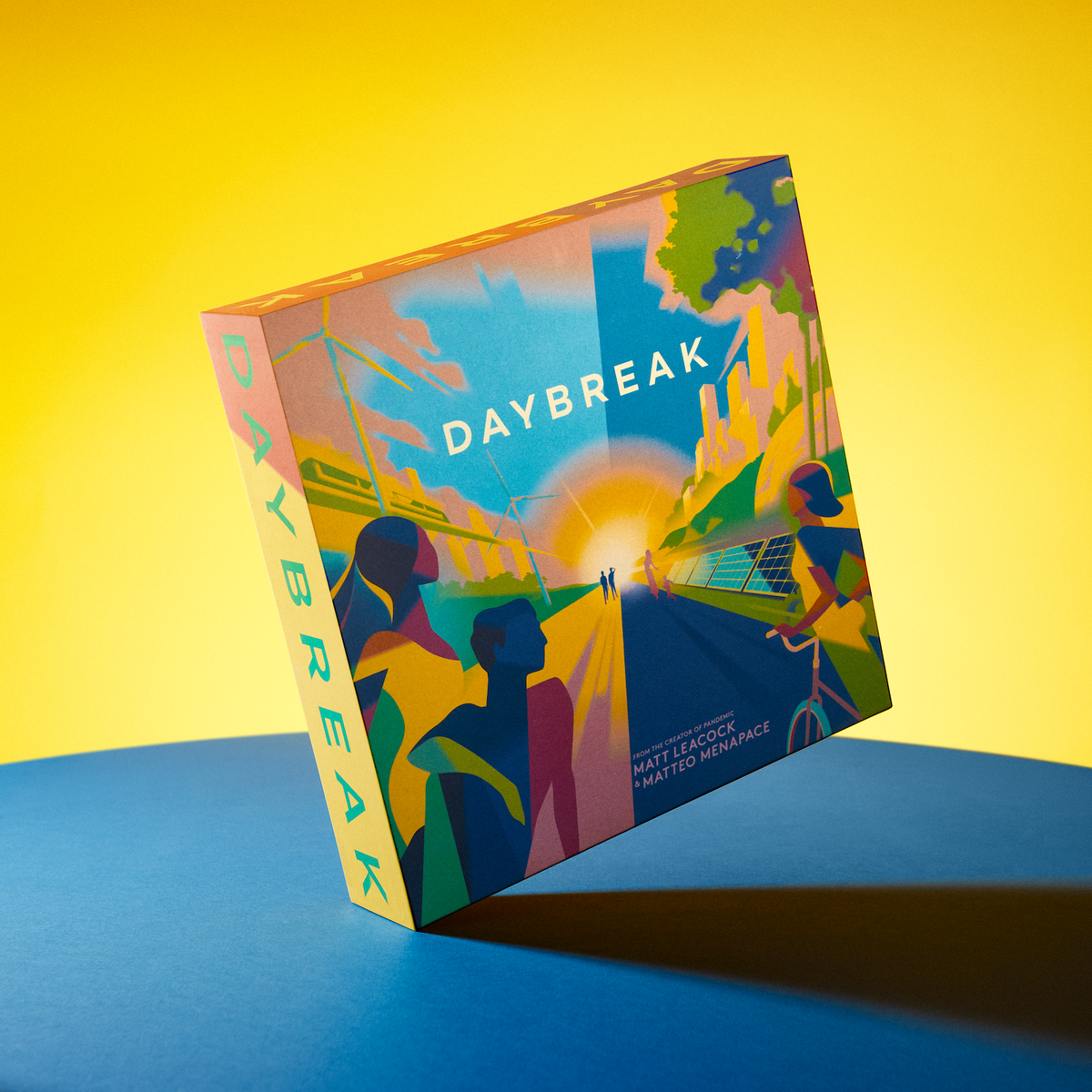
Daybreak is a gorgeous game. The art direction favors warm, hopeful imagery over the doom and gloom you might expect from a game about climate change. The board is clean and readable, with clear iconography that communicates game state at a glance. The card art depicts real technologies and solutions in an aspirational style that makes solar panels and wind turbines look genuinely exciting. It is a deliberate design choice that reinforces the game's core message: this is not a game about inevitable catastrophe, it is a game about solutions.
The component quality is strong. The cards are well-made with a satisfying finish, the tokens are chunky and easy to handle, and the player boards are thick and durable. The emission cubes that you gradually remove from your energy grid provide a deeply satisfying tactile experience as you literally decarbonize your region piece by piece. The rulebook is well-organized with plenty of examples, though we found the first game required some referencing back to clarify edge cases around crisis resolution. CMYK has done an excellent job with production values throughout.
Content and Value
At sixty dollars, Daybreak is priced at the upper end of mid-weight cooperative games, and we think the price is justified by the quality of the components and the depth of the experience. The game includes multiple difficulty levels, and the hardest settings will challenge even experienced cooperative gaming groups. The different region powers create meaningful asymmetry that encourages you to try different player counts and combinations.
Our concern with replayability is that once your group has found a winning strategy at a given difficulty level, the game can start to feel like you are executing a known plan rather than discovering new solutions. The card variety helps mitigate this, as different draws create different tactical puzzles, but the strategic arc of the game tends to follow similar patterns. We found that the sweet spot was playing Daybreak in bursts, returning to it every few weeks rather than burning through repeated sessions. The game also works surprisingly well as an introduction for non-gamers, particularly those who care about environmental issues, which gives it a unique role in many collections.
What Works and What Doesn't
Pros
- Meaningful real-world theme
- Elegant cooperative design
- Educational without being preachy
- Satisfying card engine
Cons
- Can feel overwhelming initially
- Alpha player problem persists
- Replayability concerns
- Theme may not appeal to everyone
What works best about Daybreak is how seamlessly it weaves education into entertainment. You will learn about real climate solutions without ever feeling like you are being lectured. The cooperative design is elegant, with genuine interdependence between players that creates memorable moments of collective triumph and shared despair. The engine-building arc of watching your dirty energy grid transform into a clean powerhouse is deeply satisfying on both a mechanical and thematic level.
The alpha player problem, however, is real. Because all information is open and the game is fully cooperative, a dominant personality can easily take over decision-making for the entire table. Leacock has acknowledged this challenge in his designs before, and Daybreak does not fully solve it. The game can also feel overwhelming in your first play, with a lot of information to process and systems to track. And honestly, some players simply will not want to spend their game night thinking about climate change. That is a valid preference, and Daybreak is not going to convert anyone who would rather slay dragons.
Final Verdict
Daybreak is one of the most thoughtful and well-designed cooperative games we have played in years. Matt Leacock and Matteo Menapace have created something that transcends the typical tabletop experience, delivering a game that is mechanically satisfying, visually beautiful, and genuinely meaningful. It is not perfect, and the alpha player problem and replayability concerns prevent it from reaching the absolute top tier. But for groups that value thematic depth and want a cooperative game that leaves them feeling inspired rather than exhausted, Daybreak is an exceptional choice. We walked away from our sessions not just thinking about optimal card plays, but about the real-world solutions those cards represent. That is a remarkable achievement, and it earns Daybreak our strong recommendation.