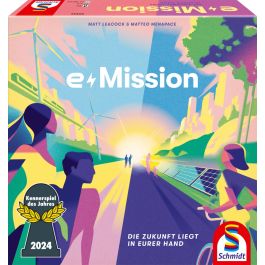
When Climate Science Meets the Sand Timer
There is a moment in every game of E-Mission where the table goes quiet. Not the comfortable silence of deep strategic thought, but the panicked silence of four people simultaneously realizing they have thirty seconds left on the timer and absolutely no idea how to prevent catastrophic flooding in South Asia. It is a gut-punch moment, and it is designed to be one. E-Mission is not interested in being a pleasant evening's entertainment. It is interested in making you feel the weight and urgency of the climate crisis in your bones, and on that front, it succeeds almost too well. Whether that makes it a great board game is a more complicated question.
Overview
E-Mission is designed by Matt Leacock, who clearly has climate change on his mind these days. Published by Z-Man Games, this cooperative game puts one to four players in charge of global climate policy during a series of United Nations-style summits. Unlike Leacock's other climate-themed design Daybreak, which is a relatively relaxed engine-building experience, E-Mission introduces a real-time element that fundamentally changes the emotional texture of the experience. Players must negotiate, plan, and execute their strategies against a ticking sand timer, simulating the real-world urgency of international climate negotiations.
The game was developed in partnership with the Potsdam Institute for Climate Impact Research, and the underlying climate model is based on actual scientific data. When the game tells you that certain policy combinations will limit warming to 1.5 degrees Celsius, that is not arbitrary game design. It is modeled on real projections. This commitment to scientific accuracy gives E-Mission a gravitas that few board games can claim, though it also creates tension between its educational mission and its entertainment value. Priced at around forty-five dollars for a sixty-minute experience, it occupies an interesting space in the market.
Gameplay and Mechanics
E-Mission unfolds over a series of rounds, each representing a global climate summit. At the beginning of each round, players receive a hand of policy cards representing different approaches to reducing emissions: renewable energy investments, transportation reforms, agricultural changes, carbon pricing mechanisms, and more. Each card has a cost, an effect on global emissions, and sometimes a secondary effect on other game systems like biodiversity or public health.
The real-time negotiation phase is the heart of the experience. When the sand timer flips, players must simultaneously discuss their options, decide which policies to implement, and coordinate their efforts across different sectors. You cannot just play your best cards independently because many of the most powerful effects require multiple players to commit resources in the same round. A global renewable energy initiative might need one player to fund research, another to build infrastructure, and a third to implement supportive regulations. Coordinating all of this while the sand drains is genuinely stressful in a way that simulates the messy reality of international cooperation.
After each negotiation phase, the game resolves the consequences of your choices and the ongoing effects of climate change. Temperature rises, sea levels change, extreme weather events occur, and the results cascade through interconnected systems in ways that feel alarmingly realistic. If you neglected biodiversity in favor of pure emissions reduction, you might find that ecosystem collapse undermines your agricultural productivity, creating food crises that demand emergency resources. The systems are deeply interlinked, and understanding those connections is key to developing effective long-term strategies.
Between summits, event cards introduce real-world complications: political instability, economic recessions, technological breakthroughs, and social movements that can help or hinder your efforts. These events keep the game unpredictable and reinforce the sense that climate policy does not exist in a vacuum. You are constantly adapting to a shifting landscape of challenges and opportunities, which keeps the experience dynamic even as the core loop of negotiate, play cards, resolve consequences repeats.
The game includes a companion app that tracks the climate model and provides real-time feedback on your collective progress. While not strictly necessary for play, the app adds a layer of immersion by visualizing temperature projections and showing how your decisions map to real-world outcomes. It is a thoughtful addition, though it does add setup complexity and requires everyone to be comfortable with app-assisted gaming.
Presentation
E-Mission's presentation is functional rather than beautiful. The graphic design is clean and informative, prioritizing readability over aesthetic flourish. Cards are well-organized with clear iconography, and the game board provides an effective visual summary of the global climate state. But compared to the lush art direction of Daybreak, E-Mission feels more like a policy document than a piece of art. The color palette is muted and serious, the illustrations are more diagrammatic than evocative, and the overall visual impression is one of earnest professionalism.
Component quality is adequate but not exceptional. The cards are standard weight, the tokens are basic cardboard, and the sand timer is a standard hourglass. Nothing feels cheap, but nothing feels premium either. The rulebook is well-written but dense, reflecting the complexity of the underlying systems. We found that the first game required significant rules referencing, and it took a full playthrough before our group felt comfortable with all the interconnected mechanics. The companion app helps bridge some of these gaps with tutorials and guided play, which we appreciate.
Content and Value
At forty-five dollars, E-Mission offers a complete experience that most groups will play three to five times before they feel they have explored its possibility space. The game includes multiple difficulty levels and scenario variations that change the starting conditions and available policy cards, which adds some variety. However, once your group has developed a strong understanding of the climate model and optimal negotiation strategies, the real-time element loses some of its urgency. The first few games are thrilling precisely because you do not know what you are doing. Once you do, the timer feels more like an arbitrary constraint than a meaningful source of tension.
The educational value, however, extends well beyond the game itself. We found ourselves looking up the real-world technologies and policies referenced on the cards, discussing climate science at the dinner table long after the game was packed away. If you approach E-Mission as a conversation starter and learning tool that happens to have game mechanics attached, its value proposition improves considerably. For families with older children, educators, or anyone interested in climate policy, E-Mission provides a unique entry point into complex subject matter.
What Works and What Doesn't
Pros
- Powerful thematic experience
- Real-time element creates urgency
- Backed by real climate science
- Great discussion starter
Cons
- More experience than game
- Limited replay value
- Real-time can stress some players
- Component quality is average
E-Mission excels at creating an emotional experience that no other board game we have played can match. The combination of real science, real-time pressure, and cooperative negotiation produces moments of genuine tension, frustration, and elation that feel meaningful in a way that goes beyond winning or losing a game. It is a remarkable achievement in thematic design.
But as a pure game, E-Mission has limitations. The real-time element, while thematically brilliant, can be genuinely stressful for players who do not enjoy time pressure. The replay value is limited once you understand the underlying systems. And the presentation, while functional, does not inspire the kind of excitement that makes you eager to get the game back to the table. E-Mission is more of an experience than a game, and your enjoyment will depend heavily on how much you value that distinction.
Final Verdict
E-Mission is a bold and admirable design that prioritizes impact over entertainment. It delivers a cooperative experience rooted in real science that will make you think differently about climate policy, and the real-time negotiation mechanic creates a sense of urgency that no turn-based game can replicate. As a conversation starter, an educational tool, and a thematic experience, it is excellent. As a game you will want to play every week, it falls short. We recommend E-Mission for groups that value meaningful themes and are comfortable with high-pressure cooperative experiences, but we would suggest pairing it with something lighter for the rest of your game night. It is the kind of game you are glad you played, even if it is not the kind of game you reach for most often.