Opening Hook
We have a confession: when Earth first landed on our table, we were skeptical. The market for nature-themed engine-building card games already had a dominant occupant in Wingspan, and we suspected this was another attempt to ride that particular wave of feathered coattails. We were wrong. Earth is not a Wingspan clone, and reducing it to one does a disservice to what designer Maxime Tardif has accomplished here. This is a card game with a genuine identity of its own, one that trades Wingspan's gentle elegance for a deeper, more combotastic engine that will have you grinning every time your tableau fires off a chain reaction you did not see coming three turns ago. It is beautiful, it is satisfying, and it absolutely earns its place on any collection shelf, even one that already holds Wingspan.
Overview
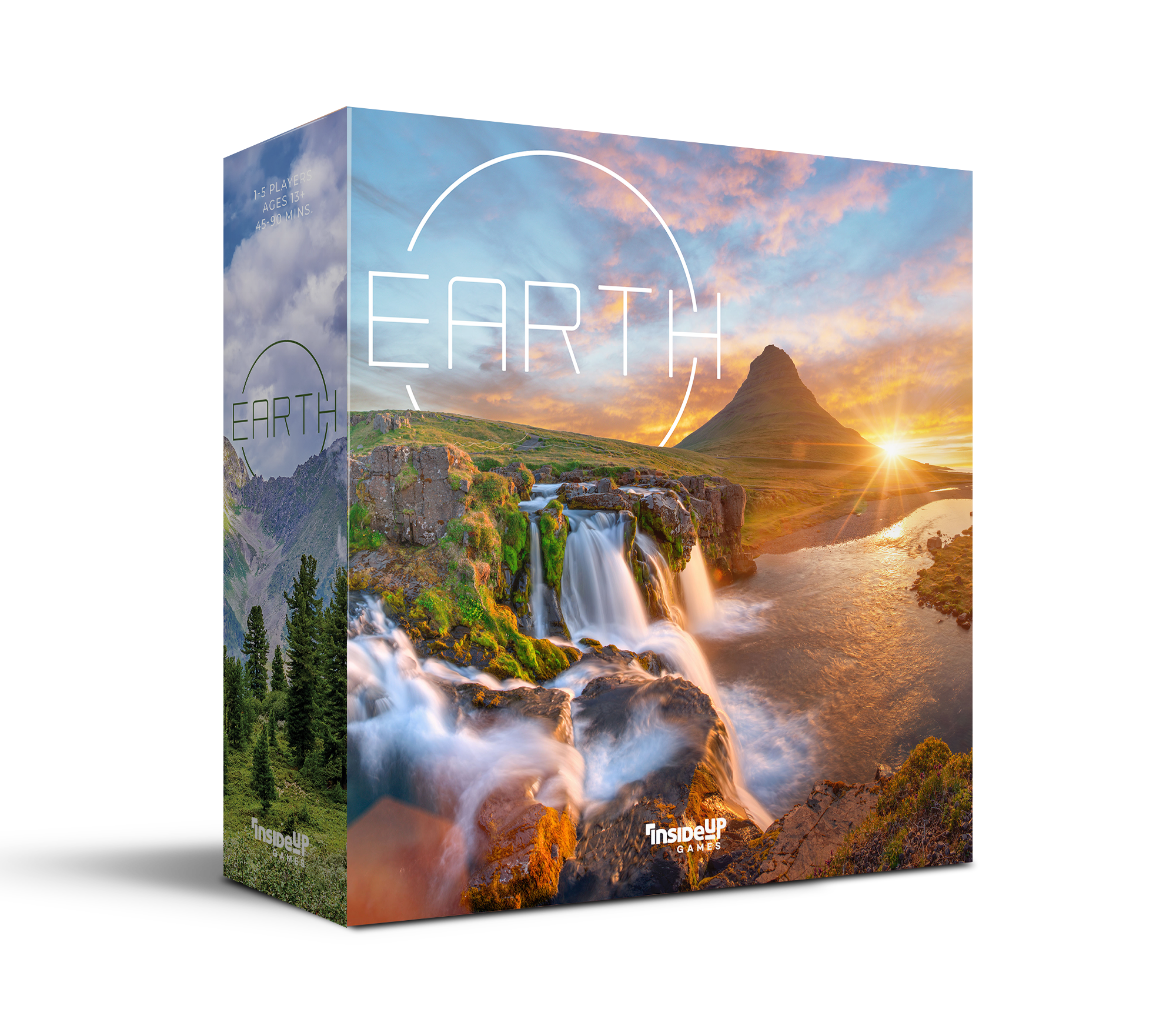
Earth is a card-driven engine-building game designed by Maxime Tardif and published by Inside Up Games. It supports one to five players and plays in roughly forty-five to ninety minutes depending on player count and experience. The game casts you as a steward of a natural ecosystem, planting flora cards into a four-by-four tableau grid while managing soil and other resources. Each card represents a real-world plant species, from towering sequoias to humble mosses, and the game's educational bent is one of its more charming qualities. Earth launched to significant buzz in the hobby community, quickly climbing the BoardGameGeek rankings and drawing comparisons to Wingspan, Terraforming Mars, and other tableau-building favorites. It arrived at a moment when the hobby was hungry for games that combined beautiful production with genuine strategic depth, and it delivered on both counts.
Gameplay and Mechanics
The core loop of Earth is deceptively simple. On your turn, you choose one of four actions: plant a card from your hand into your tableau, draw cards (called composting), gain soil resources, or water your plants to place growth tokens. Here is where it gets interesting: when you choose an action, every other player also performs a weaker version of that same action. This shared-action mechanism keeps everyone engaged on every turn, eliminates downtime almost entirely, and creates a fascinating tension between doing what is best for your own engine and trying not to gift your opponents the action they desperately need.
The tableau itself is the heart of the game. You build a four-by-four grid of flora cards, and many of these cards have abilities that trigger when specific actions are taken. Plant a card, and every flora in your tableau with a green activation icon fires its ability. Water your plants, and every card with a blue icon activates. As your tableau grows, these chain reactions become increasingly elaborate. A single plant action in the late game might trigger eight or nine card abilities in sequence, generating soil, drawing cards, composting resources, and placing growth tokens in a cascade that feels enormously rewarding to execute.
The combo potential is where Earth truly shines and where it distinguishes itself from Wingspan. While Wingspan's engine building is relatively linear, Earth's grid-based tableau opens up spatial considerations. Some cards care about adjacency. Others care about what row or column they occupy. Fauna objective cards, shared between all players, reward specific configurations like having a certain number of cards with canopy icons or accumulating growth tokens on trees. Island and climate cards, dealt at the start of the game, give each player a unique starting condition and scoring direction. The result is a game where every session feels different, and the strategic puzzle of building an efficient, high-scoring tableau never gets stale.
The solo mode deserves special mention. It uses a card-driven automa called Gaia that is easy to run and provides a legitimate challenge. We have played dozens of solo games of Earth and find it one of the best solo experiences in the hobby. The app-free, low-maintenance automa is a model that other designers should study.
Presentation
Earth is a gorgeous game. The card art features detailed, realistic illustrations of hundreds of real plant species, each one a miniature botanical print that you genuinely want to stop and admire. The art direction is cohesive and striking, using rich greens, warm earth tones, and clean layouts that make even the most text-heavy cards easy to parse at a glance. The card stock is solid, the soil tokens have a satisfying heft, and the growth tokens are chunky and tactile. The overall production feels premium without being ostentatious.
The rulebook is well-organized and clearly written, with plenty of examples and a comprehensive FAQ section. We had very few rules questions after our first read-through, which is a testament to the design's clarity. The iconography is intuitive once you learn the five or six core symbols, and the player aids are genuinely useful rather than decorative. If there is a visual complaint, it is that late-game tableaux can become cluttered. With sixteen cards, growth tokens, and soil scattered across your grid, the table presence gets messy. This is a minor gripe, but it is worth noting for players who value clean, organized play spaces.
Content and Value
At around forty dollars, Earth is an exceptional value proposition. The base game includes over three hundred unique flora cards, dozens of fauna objectives, island cards, and climate cards. The combination of these elements means that replayability is practically infinite. We have played Earth well over thirty times and are still encountering card combinations we have never seen before. The shared-action mechanism means that game length scales well with player count; even at five players, the game rarely overstays its welcome because you are always doing something on every turn.
The game has also received expansion content that adds new card types and mechanisms without bloating the core experience. For the price, you are getting one of the deepest card games on the market, one that can serve as a gateway for newer gamers drawn in by the beautiful art and accessible turn structure, while also satisfying experienced players who want to dive deep into engine optimization. The solo mode alone adds tremendous value for solo gamers.
What Works and What Doesn't
Earth works best as a satisfying engine-building puzzle. The combo potential is addictive, the shared-action mechanism is elegant, the art is stunning, and the solo mode is top-tier. It plays quickly enough to fit into a weeknight session while offering enough depth to reward repeated plays. The variable setup ensures no two games feel the same, and the educational element of learning about real plant species is a charming bonus that elevates the theme.
Where Earth falls short is in player interaction. Beyond the shared-action mechanism and the race for fauna objectives, you are largely playing a multiplayer solitaire game. You rarely care about what your opponents are building, and there is no way to directly interfere with their plans. For some players, this is a feature; for others, it is a dealbreaker. The theme, while beautifully rendered, can also feel somewhat abstract in play. You are placing cards and triggering abilities, and the connection between the mechanical actions and the idea of cultivating an ecosystem is tenuous. Finally, the sheer number of unique cards can overwhelm newer players who struggle to evaluate options when they do not yet understand the game's economy.
Pros
- Beautiful card art featuring hundreds of real plant species
- Deep combo potential that rewards creative engine building
- Quick turns with shared-action mechanism keep everyone engaged
- Great solo mode with well-designed automa opponent
Cons
- Limited player interaction beyond shared actions and objective races
- Card variety can overwhelm newcomers evaluating their options
- Tableau can get visually cluttered in the late game
- Theme feels somewhat detached from the mechanical experience
Final Verdict
Earth is an excellent card game that stands confidently on its own merits. It is not Wingspan with plants, and it is not trying to be. The combo-driven engine building is deeper and more rewarding, the shared-action mechanism is a smart design choice that keeps pace brisk, and the visual presentation is among the best in the hobby. It lacks meaningful player interaction, and the theme can feel more decorative than immersive, but these are trade-offs rather than flaws. If you enjoy building elaborate card engines and watching them fire off satisfying chain reactions, Earth is one of the best games in the genre. At its price point, with its replayability and its exceptional solo mode, it is an easy recommendation for engine-building enthusiasts and nature lovers alike. Plant it in your collection and watch it grow.