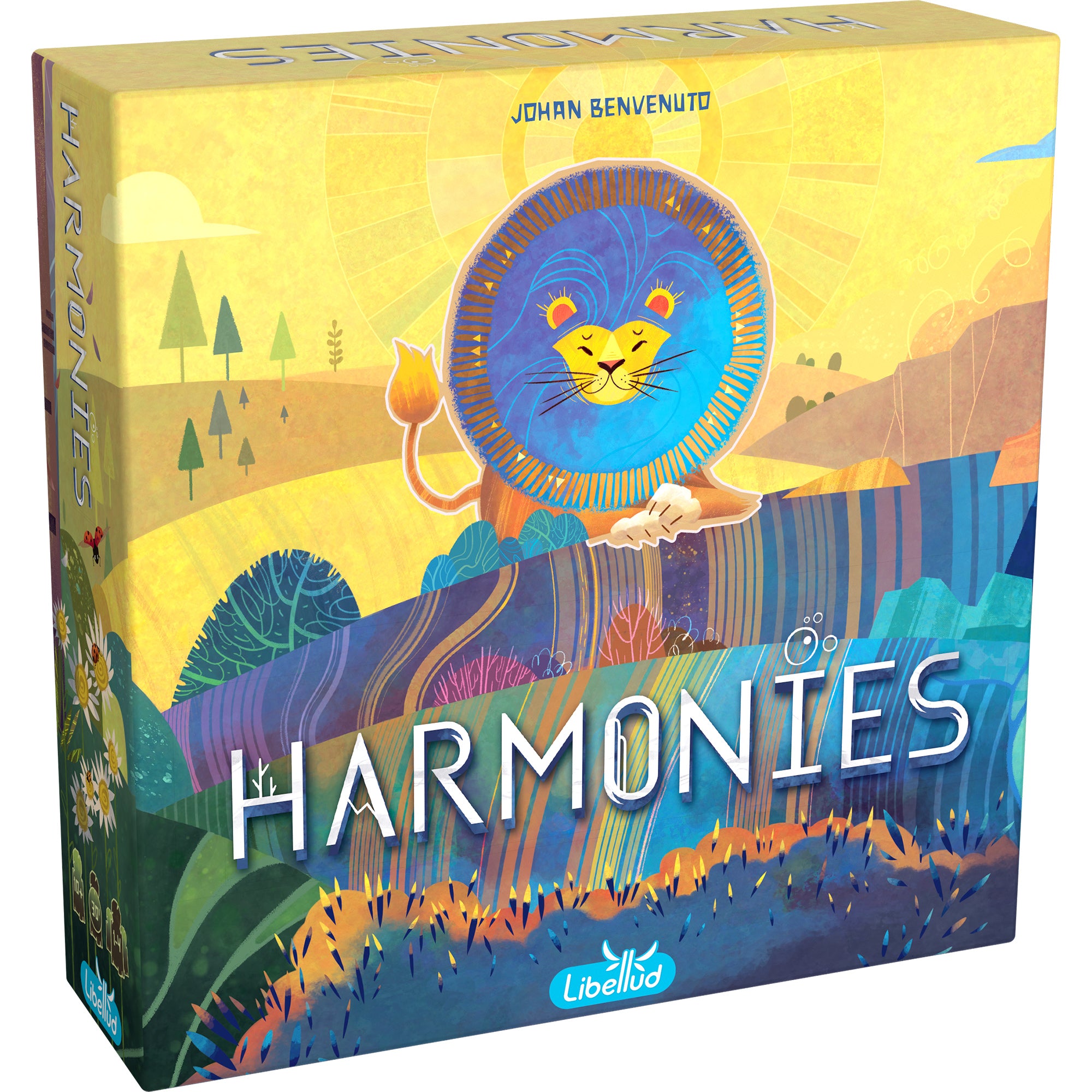
A Landscape Worth Building
There are games that demand your full attention, that grip you with tension and refuse to let go until someone emerges victorious from the wreckage. And then there are games like Harmonies, which invite you to sit down, take a breath, and build something beautiful. Johan Benvenuto's creation for Libellud is the tabletop equivalent of a zen garden — a meditative, quietly absorbing experience that prioritizes aesthetic satisfaction over cutthroat competition. It is a game that makes you feel good while you play it, and in an industry increasingly dominated by complexity and confrontation, that is worth celebrating. But the question lingers: is feeling good enough to keep you coming back?
Overview
Harmonies is an abstract pattern-building game for one to four players, designed by Johan Benvenuto and published by Libellud, the studio best known for the gorgeous Dixit series. Released to strong buzz in 2024 and continuing to find its audience well into 2025, it tasks players with constructing three-dimensional landscapes on personal player boards using colorful tokens that represent different terrain types. Over the course of a brisk twenty to thirty minutes, you draft tokens from a shared central display and place them onto a hex-grid board, attempting to match the patterns shown on animal habitat cards. Each completed pattern scores points and places a charming animal meeple onto your landscape. The player who constructs the most harmonious ecosystem wins.
The game sits comfortably in the family-weight category, accessible enough for newcomers while offering just enough spatial puzzle challenge to keep experienced gamers engaged for at least a handful of plays. It has drawn deserved comparisons to Azul and Cascadia, though its three-dimensional stacking element gives it a tactile identity all its own.
Gameplay and Mechanics
At its core, Harmonies is a drafting and spatial placement puzzle. On your turn, you select a group of three tokens from the central supply — a rotating display of colored pieces arranged on a small shared board — and place them one at a time onto your personal landscape grid. The tokens come in five colors representing terrain types: green for forests, blue for water, brown for mountains, yellow for fields, and gray for stone. Crucially, tokens can stack on top of each other, creating elevation on your board. This three-dimensional element is where Harmonies distinguishes itself from the many tile-laying games that populate the modern hobby.
Your goal is to arrange these tokens to match the specific patterns printed on your animal habitat cards. Each card depicts a particular configuration of colors and heights. A bird card, for example, might require a green token stacked two levels high with blue tokens adjacent at the base. A bear might need a specific arrangement of brown and green at ground level. When you complete a pattern, you claim the card and place an adorable animal meeple onto the corresponding spot on your board. At game end, completed habitats score points, and any incomplete patterns or wasted tokens score nothing.
The drafting mechanism is elegant in its simplicity. The central display is arranged so that tokens are grouped in specific configurations, forcing you to take sets that may not perfectly align with your plans. This is where the game's primary tension lives — you want green and blue, but the available groupings only offer green with brown and yellow. Do you take what you need and find a use for the extras, or do you pivot your entire strategy? It is a gentle form of tension, never agonizing, but consistently present.
We found that the stacking mechanic is genuinely clever. Building upward creates a satisfying sense of construction, and the spatial reasoning required to plan three-dimensionally adds a layer of puzzle-solving that flat tile-laying games lack. Watching your landscape grow from a flat hex grid into a miniature terrain model is deeply satisfying, and the moment when you place that final token to complete a particularly tricky animal pattern delivers a genuine spark of joy.
However, the strategic ceiling reveals itself fairly quickly. After five or six plays, the decision space starts to feel familiar. The drafting offers limited opportunities for hate-drafting or reading opponents, and the pattern-matching, while pleasant, follows predictable rhythms. This is not necessarily a flaw — Harmonies is clearly designed as a lighter experience — but players hoping for escalating depth will find diminishing returns.
Presentation
This is where Harmonies truly shines. Libellud has a well-earned reputation for visual excellence, and this game delivers on that pedigree in every respect. The colored tokens are chunky, satisfying to handle, and vibrantly hued. The animal meeples are delightfully sculpted — tiny bears, foxes, birds, and fish that bring genuine character to your completed landscape. By game's end, your personal board looks like a miniature diorama, a colorful terrain dotted with wildlife that you built yourself. It is genuinely Instagram-worthy, which matters more than purists might admit.
The card art is clean and instructive, making pattern requirements easy to parse at a glance. The rulebook is brief, well-illustrated, and gets players into the game within minutes. The box insert is functional if unremarkable, and everything fits back in neatly. Production quality across the board is excellent for the price point, and the table presence is remarkable for a game this small and quick. We have seen Harmonies draw curious onlookers at game nights more than almost any other title on the shelf.
Content and Value
At approximately thirty-five dollars, Harmonies offers a reasonable package. The base game includes a solid deck of animal habitat cards with enough variety to keep the first ten or so plays feeling fresh. The different card combinations mean your strategic priorities shift from game to game, and the drafting display ensures no two rounds play out identically. A solo mode is included, challenging you to score above a threshold, though it functions more as a puzzle exercise than a compelling standalone experience.
The game plays well at two and three players, where you have meaningful interaction with the draft pool and games clip along at a brisk pace. At four players, downtime increases slightly and the draft pool can feel chaotic, with less ability to plan ahead. At one player, the experience is functional but lacks the tension that makes the multiplayer game engaging. The sweet spot is firmly at two to three, where Harmonies is at its most elegant.
Replayability is moderate. The card variety provides enough variation for perhaps fifteen to twenty plays before the experience begins to feel repetitive. For a game at this price point and complexity level, that is a fair offering, though it falls short of evergreen status. An expansion adding new animal cards, special abilities, or asymmetric player powers could significantly extend the game's shelf life.
What Works and What Doesn't
What works is the total package of tactile pleasure, visual beauty, and accessible gameplay. Harmonies is the kind of game you pull out when someone says, "I want to play something relaxing." The three-dimensional building element is genuinely novel and satisfying, and the game teaches in under five minutes. It is a superb gateway game, a perfect palette cleanser between heavier titles, and an excellent choice for mixed-experience groups.
What doesn't work as well is long-term staying power. The limited strategic depth means experienced gamers will exhaust its novelty faster than they might hope. The solo mode feels like an afterthought, and the four-player experience, while functional, lacks the tight elegance of lower player counts. There is also a sameness to the gameplay arc — draft, place, complete patterns, repeat — that can make successive plays blur together.
Final Verdict
Harmonies is a beautifully produced, immediately accessible pattern-building game that delivers exactly what it promises: a calming, visually stunning tabletop experience. It will not challenge hardcore strategists or sustain hundreds of plays, and it was never designed to. What it does, it does with grace and charm. If you are looking for a game that creates genuine moments of aesthetic satisfaction, that teaches in minutes and plays in half an hour, and that leaves a gorgeous miniature landscape on the table when it is done, Harmonies deserves a spot in your collection. It is not trying to be the deepest game on your shelf — it is trying to be the most beautiful, and in that mission, it succeeds completely. We recommend it warmly for families, casual groups, and anyone who believes that sometimes the journey matters more than the destination.
Pros
- Gorgeous 3D landscapes that create stunning table presence
- Meditative gameplay perfect for winding down
- Quick to teach and play at under 30 minutes
- Great for all skill levels as a gateway game
Cons
- Limited strategic depth for experienced players
- Can feel samey over repeated sessions
- Solo mode is basic and lacks tension
- Player count sweet spot is only 2-3