Opening Hook
You are in third place approaching the final chicane of the Grand Prix. Your hand holds three speed cards and two heat cards that you desperately do not want to play. The corner has a speed limit of five, but you are doing eight. You could brake hard, shed the excess speed, and take the corner safely — or you could dump those heat cards into your engine, maintain your reckless pace, and pray that you have enough cooling left for the final straight. The player in first just spun out trying exactly this maneuver two turns ago. The player in second is riding your bumper. You play the cards, exceed the speed limit, pay the heat penalty, and slide through the corner by the narrowest possible margin. The table erupts. This is Heat: Pedal to the Metal, and it is the best racing board game ever made. We did not think that was a particularly competitive category before playing it. We were wrong.
Overview
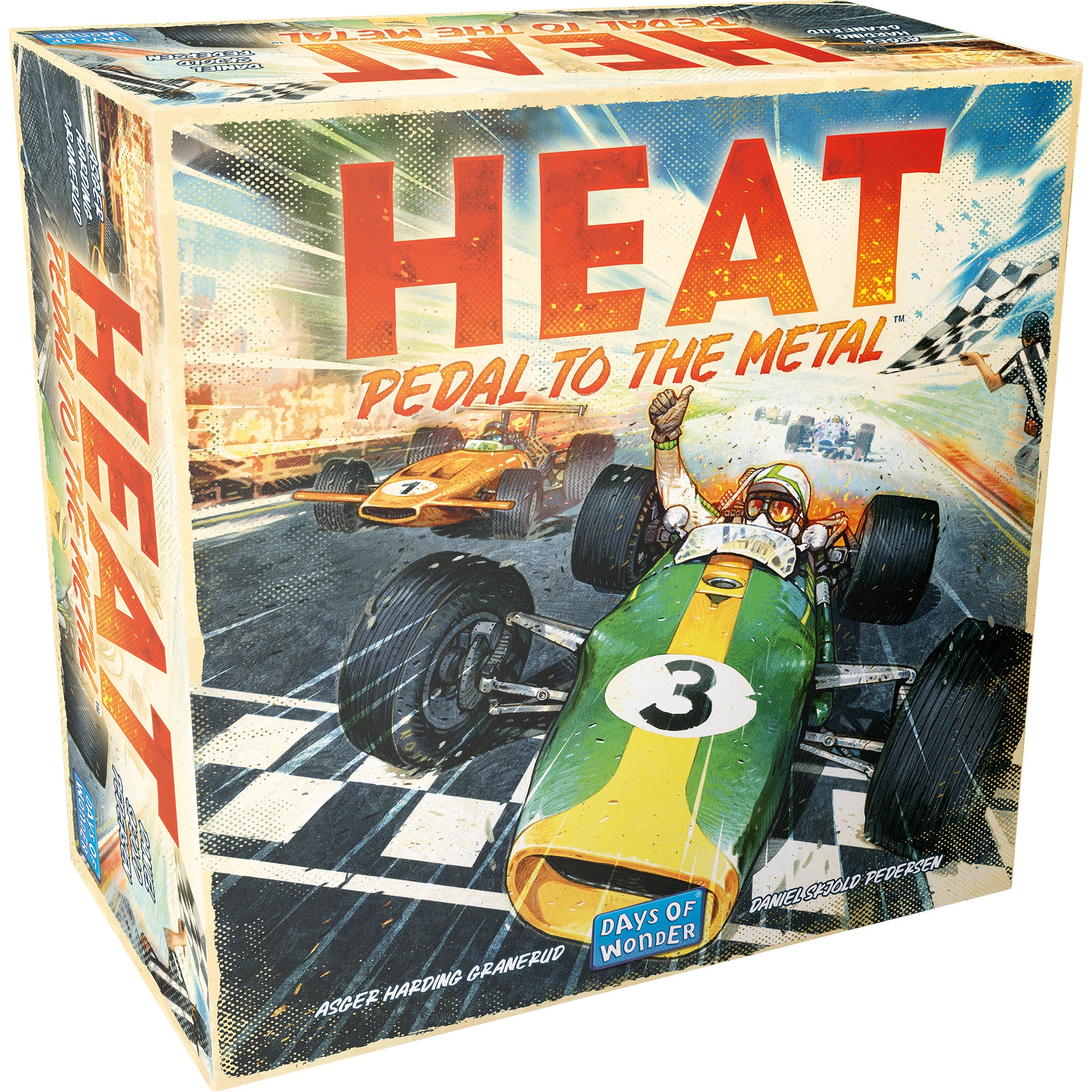
Designed by Asger Harding Granerud and Daniel Skjold Pedersen and published by Days of Wonder, Heat: Pedal to the Metal is a racing game set in the golden age of 1960s Grand Prix motorsport. One to six players each control a car competing in a multi-lap race around circuits inspired by classic Formula One tracks. The game uses a hand management system built around a brilliantly simple central mechanic: heat. Your engine generates heat when you push it hard — accelerating aggressively, exceeding corner speed limits, using boost abilities — and that heat enters your deck as dead cards that clog your hand and limit your future options. Manage your heat well, and you will have the speed and flexibility to make decisive moves when they matter. Let your engine overheat, and you will spend the final laps limping along with a hand full of useless cards while your opponents blow past you.
The game emerged from the same design team behind Flamme Rouge, a cycling racing game that earned a devoted following for its elegant simulation of peloton dynamics. Heat takes that pedigree and elevates it considerably, adding deeper decision-making, more dramatic moments, and a theme that drips with retro cool. Days of Wonder's commitment to the 1960s aesthetic is total, from the graphic design on the box to the shape of the car miniatures, and it gives the entire experience a sense of style that few board games achieve.
Gameplay and Mechanics
Each turn in Heat is disarmingly simple. You choose a gear — first through fourth — which determines how many cards you play from your hand. Higher gears let you play more cards, which means more movement, but also less control over exactly which cards you use. Then you play speed cards from your hand equal to your gear number, move your car the total value shown on those cards, and deal with any consequences. That is it. Draw back up to seven cards, and the next player goes. A full round takes minutes, even with six players, and the game rarely overstays its welcome.
The depth comes from the heat system. Your starting deck contains speed cards of various values and a small number of stress cards that add randomness when drawn. As the race progresses, heat cards accumulate in your deck. These cards have no speed value — they are dead weight. When you draw them, they occupy space in your hand that could have been a useful speed card. The more heat you have taken, the worse your draws become, creating a tangible sense of an engine straining under pressure. You can shed heat by coasting in lower gears or using cooldown spaces on certain tracks, but doing so costs you speed. The entire game is a negotiation between aggression and sustainability.
Corner speed limits are where the drama concentrates. Each corner on the track has a maximum speed — the total value of cards you can play while passing through it. Exceed that limit and you must pay the difference in heat cards from your personal supply. Run out of heat cards to pay with, and you spin out, losing significant time and position. The decision of whether to take a corner hot is the beating heart of Heat. Sometimes the math is clear: you have plenty of heat capacity and the penalty is small. But in the closing laps of a tight race, when your heat supply is dwindling and every card in your hand matters, those corner approaches become genuinely agonizing. We have watched players bury their faces in their hands while deciding whether to push through a hairpin at two over the limit, and the tension is electric.
The boost system adds another dimension. At any point, you can declare a boost, which lets you draw the top card of your deck and add its value to your movement — but you also take a heat card as payment. Boosting is pure push-your-luck: you might draw a high-value speed card and rocket forward, or you might draw a stress card or a low number and barely gain anything while still paying the heat penalty. In the final straight of a close race, boosting becomes a desperate gamble that can decide the winner, and the reveal of that drawn card is always a table moment.
The game also includes an excellent upgrade system for advanced play. Before each race, players can draft upgrade cards that modify their decks — adding powerful speed cards, efficient cooling abilities, or special actions that bend the rules. This draft adds strategic depth without increasing complexity dramatically, and it ensures that no two races play identically even on the same track. Additionally, a weather module introduces rain and track conditions that alter corner speeds and heat dynamics, adding another layer of tactical consideration for experienced groups.
Presentation
Days of Wonder is renowned for production quality, and Heat is no exception. The double-sided game board features beautifully illustrated tracks with clear, readable iconography. The car miniatures are colorful and distinct, making it easy to track positions at a glance. The cards are well-designed with period-appropriate graphic elements — the speed cards feature bold, retro typography, and the heat cards have a visceral red glow that makes their presence in your hand feel appropriately threatening. The player dashboards, which track your gear and heat supply, are functional and attractive, with satisfying gear-shift mechanisms that click between positions.
The 1960s motorsport theme is carried through every element of the design with impressive commitment. The rulebook is formatted like a vintage racing program. The box art evokes classic Grand Prix posters. Even the font choices feel authentic to the era. It is a cohesive aesthetic vision that elevates the entire experience and makes Heat one of the best-looking games on any shelf. The only presentation weakness is the setup time, which runs longer than you might expect for a game of this weight. Sorting speed cards, distributing heat tokens, preparing the upgrade draft, and placing cars on the starting grid takes about ten minutes — not prohibitive, but noticeable for a game that plays in thirty to sixty minutes.
Content and Value
The base box of Heat includes four double-sided track boards, providing eight distinct circuits at a retail price of approximately fifty dollars. That is a solid amount of content for the price, though dedicated groups will work through all eight tracks faster than you might expect. Each track plays differently — long straights reward aggressive heat spending, technical circuits demand conservative heat management, and mixed layouts create interesting strategic tension — but there is no denying that the base box leaves you wanting more variety once you have raced each track several times.
Fortunately, Days of Wonder has supported Heat with excellent expansion content. Additional track packs add new circuits with unique features, and the Heavy Rain expansion introduces weather mechanics that dramatically alter how existing tracks play. There is also a championship mode in the base box that links multiple races into a season, with points tallied across events. This mode adds meaningful long-term stakes and encourages players to think beyond individual race results. The solo mode, which pits you against AI opponents controlled by a simple card-driven system, is functional but basic — it captures the mechanical experience but lacks the social tension that makes multiplayer Heat special.
At its price point, Heat offers strong value for groups that enjoy its core loop. Each race takes thirty to sixty minutes depending on player count and track length, and the game scales smoothly from one-on-one duels to chaotic six-player affairs. We have found that four players represents the sweet spot — enough cars on the track to create interesting positional battles without the downtime that six players can introduce. But every player count we have tried has produced memorable moments, which is a testament to the fundamental strength of the design.
What Works and What Doesn't
What works is the feeling. Heat captures the sensation of racing — the risk calculation, the split-second decisions, the emotional swings of fortune — better than any board game we have played. The heat mechanic is a stroke of design genius, providing a tangible, escalating resource that makes every decision feel consequential without adding mechanical complexity. The game is easy to teach, quick to play, and generates stories that players recount for weeks afterward. It works brilliantly with families who want something more exciting than standard fare, and it works equally well with experienced gamers who appreciate the depth hidden beneath the accessible surface.
What does not quite work is the luck factor. Despite all the meaningful decisions Heat offers, the card draw can occasionally determine outcomes in ways that feel unearned. Drawing three heat cards in a crucial hand when you need speed is devastating and not something you can plan around. The stress cards, which add random movement values when drawn, can produce wildly swingy results that frustrate players who prefer deterministic strategy. These variance spikes are part of what makes Heat exciting — the unexpected comeback, the unlikely disaster — but they can also leave a sour taste when they decide a tightly contested race.
Pros
- Thrilling racing tension
- Elegant heat management mechanic
- Works great at all player counts
- Excellent expansion support
Cons
- Luck of the draw can frustrate
- Track variety in base box is limited
- Setup takes longer than expected
- AI opponents for solo are basic
Final Verdict
Heat: Pedal to the Metal does something we genuinely did not think was possible: it makes a racing board game feel like racing. Not an abstract simulation of racing. Not a mathematical optimization problem with a racing skin. Actual racing — the pit-of-your-stomach tension of approaching a corner too fast, the desperate gamble of a last-lap boost, the roar of triumph when you thread a gap that should not have existed. Granerud and Pedersen have designed a masterclass in accessible depth, wrapping genuinely meaningful decisions in a package that anyone can learn in five minutes. The 1960s Grand Prix theme is executed with style and commitment, the component quality is outstanding, and the heat mechanic is one of the cleverest resource management systems we have seen in years. If your gaming group has even a passing interest in racing, competition, or push-your-luck excitement, Heat belongs in your collection. It has permanently replaced every other racing game on our shelf, and we do not see that changing anytime soon.