Opening Hook
There are board games that simulate economies, and then there is Hegemony, a game that practically is an economy. We have played dozens of asymmetric strategy games over the years, but few have ever made us feel the genuine tension of class warfare quite like this one. Sitting across the table as the Working Class, watching the Capitalist class accumulate wealth while you struggle to keep your workers fed and employed, is not just a game mechanic — it is an experience that lingers long after the cardboard is packed away. Hegemony is the rare board game that manages to be both a riveting strategic contest and a genuine educational tool, and we are here to tell you that it earns every bit of its growing reputation in the hobby.
Overview
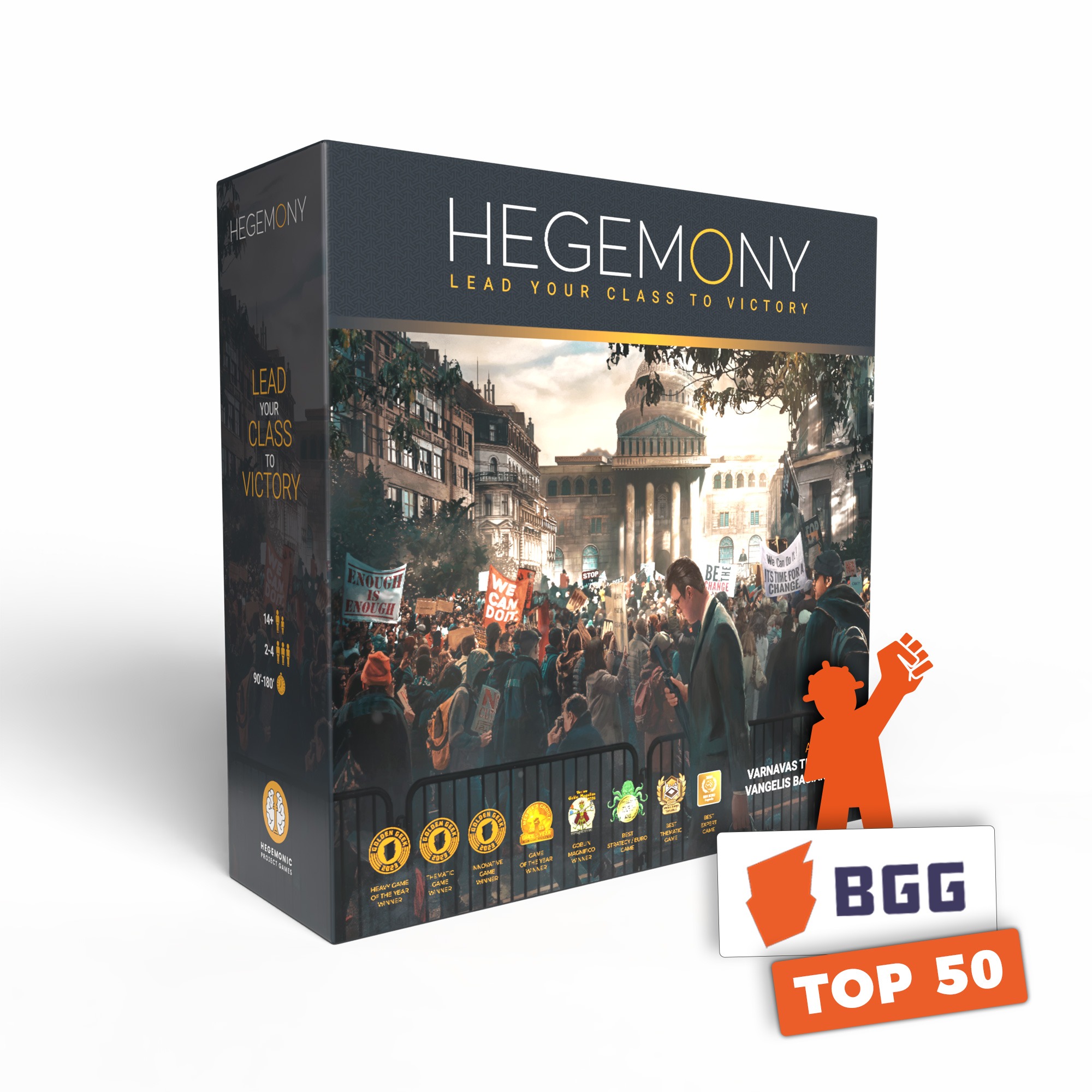
Designed by Varnavas Tikas and published by Hegemonic Project Games, Hegemony: Lead Your Class to Victory is a deeply asymmetric economic and political simulation for two to four players. Each player takes on the role of a different socioeconomic class — the Working Class, the Middle Class, the Capitalist Class, or the State — and pursues victory through fundamentally different means. The Working Class needs to keep wages high and workers employed. The Capitalists want to maximize profits and keep labor costs low. The Middle Class tries to build small businesses and navigate between the extremes. The State collects taxes, funds public services, and tries to keep the whole system from collapsing. If that sounds like a political science textbook, well, it kind of is — but it is also one of the most engaging and thought-provoking tabletop experiences you can have in 2025.
Originally funded through a wildly successful Kickstarter campaign, Hegemony has since made its way into retail and established itself as a modern classic in the heavy strategy space. It draws inspiration from real-world political and economic theory, and the game's mechanisms are directly tied to concepts like supply and demand, fiscal policy, taxation, and labor markets. This is not surface-level theming — every mechanism in the game exists because of a real-world parallel.
Gameplay & Mechanics
At its core, Hegemony plays out over five rounds, each representing a political term. During each round, players take turns playing action cards from their unique decks to perform class-specific actions. The Working Class assigns workers to companies, calls strikes, and pushes for higher wages through legislation. The Capitalist Class builds companies, sets wages, automates production, and lobbies for deregulation. The Middle Class runs small businesses, educates workers, and tries to carve out a niche between the two extremes. The State manages the national budget, funds healthcare and education, adjusts tax rates, and passes policies that affect everyone at the table.
What makes this work so brilliantly is that every action has a ripple effect across all players. When the Capitalist builds a new factory, it creates jobs that the Working Class needs — but at a wage the Capitalist sets. When the State raises taxes, it can fund better public services but squeezes corporate profits. When the Working Class calls a strike, production halts and everyone feels the impact. The interdependence between classes is not just thematic flavor — it is the beating heart of the entire game system.
The legislative phase at the end of each round is where Hegemony truly shines. Players propose and vote on real policy changes: minimum wage increases, tax brackets, immigration policy, healthcare funding, and more. These votes are not abstract — they directly modify the game's economic rules for the next round. A successful minimum wage increase literally raises the cost the Capitalist must pay per worker. Defunding education means fewer skilled workers available for the Middle Class's businesses. Every policy vote feels consequential because it genuinely is.
The asymmetry is handled masterfully. Each class has a completely different deck of action cards, a different player board, different resources to manage, and a different scoring rubric. Despite this complexity, the classes interlock so tightly that the game feels cohesive rather than like four different games happening simultaneously. Learning one class gives you insight into the others, but mastering any single class takes multiple plays.
Presentation
Hegemony's visual presentation is functional rather than flashy. The board is clean and well-organized, with clear iconography that becomes intuitive after a round or two. The card art leans toward a political poster aesthetic with bold colors and stylized imagery that fits the theme perfectly. Player boards are well-designed, with recessed areas for tracking resources and clear reminders of available actions. However, we must note that the component quality, while adequate, does not quite match the game's premium price point. The cardboard is serviceable, the cards are decent but not linen-finished in the base edition, and some of the tokens feel lighter than we would prefer for a game at this weight class.
The rulebook is comprehensive but dense. This is not a game you can learn from the rulebook in one sitting — plan for at least two thorough readings, ideally supplemented by video tutorials. That said, once you internalize the flow of play, the iconography and player aids do an excellent job of keeping things moving. The game also includes a simplified two-player variant and a solo mode, both of which work reasonably well but do not capture the full magic of the four-player experience.
Content & Value
At roughly seventy dollars, Hegemony is a significant investment, but the amount of game you get justifies the price. A single four-player session runs between ninety minutes and three hours depending on player experience, and the asymmetric design means you will want to play at least four times to experience each class. The replay value is enormous — not just because of the different classes, but because the emergent political dynamics change every game. One session might see a Worker-State alliance that crushes the Capitalists. The next might feature a Capitalist-Middle Class coalition that defunds public services and hoards wealth. The game creates genuine political narratives every single time.
Hegemonic Project Games has also released expansion content that adds new policy cards, scenario variants, and additional complexity layers for players who have mastered the base game. For groups that love deep, discussion-heavy strategy games, Hegemony offers potentially hundreds of hours of engagement before it starts to feel familiar.
What Works & What Doesn't
Pros
- Brilliantly asymmetric design
- Theme and mechanics intertwine perfectly
- Teaches real economic concepts
- Incredibly replayable
Cons
- Long teach time
- Can feel confrontational
- Requires exactly the right group
- Component quality could be better
The biggest barrier to Hegemony is not its complexity but its social requirements. This is a game that works best with exactly four players who are all willing to engage with political themes, negotiate in good faith, and commit to a lengthy session. With the wrong group — players who shy away from confrontation, or who are not willing to invest the time to learn — the experience falls flat. The teach time alone can exceed thirty minutes, and first games will invariably run long as players discover the interconnected systems. But when everything clicks, when four engaged players are debating policy and backstabbing each other through legislation, there is simply nothing else like it in the hobby.
Final Verdict
Hegemony: Lead Your Class to Victory is not just a great board game — it is an important one. In an era where board gaming trends toward lighter, more accessible experiences, Hegemony dares to be ambitious, complex, and unapologetically political. It rewards deep engagement, encourages genuine debate, and creates stories that you will be recounting for years. If you have a dedicated gaming group that craves asymmetric strategy with real thematic depth, Hegemony is an essential purchase. For everyone else, it is still worth experiencing at least once, ideally at a board game cafe or convention where you can see if it clicks. We walked away from our first game not just impressed by the design, but genuinely reconsidering how we think about economic systems. How many board games can say that?