The Most Fun You'll Have Being Robbed
There is a particular brand of cruelty in tabletop gaming that we find ourselves irresistibly drawn to. It is the kind of cruelty that makes you laugh out loud, shake your head in disbelief, and immediately demand a rematch. Mindbug: Beyond Evolution, the latest standalone expansion from designers Christian Kudahl and Skaff Elias, delivers that feeling in a tiny box that fits in your coat pocket. This is not a game about building the most powerful army or crafting the most efficient engine. This is a game about playing the most terrifying creature you can find and then watching in horror as your opponent casually steals it from you. If that concept makes you grin, keep reading. If it makes you angry, this one probably is not for you.
Overview
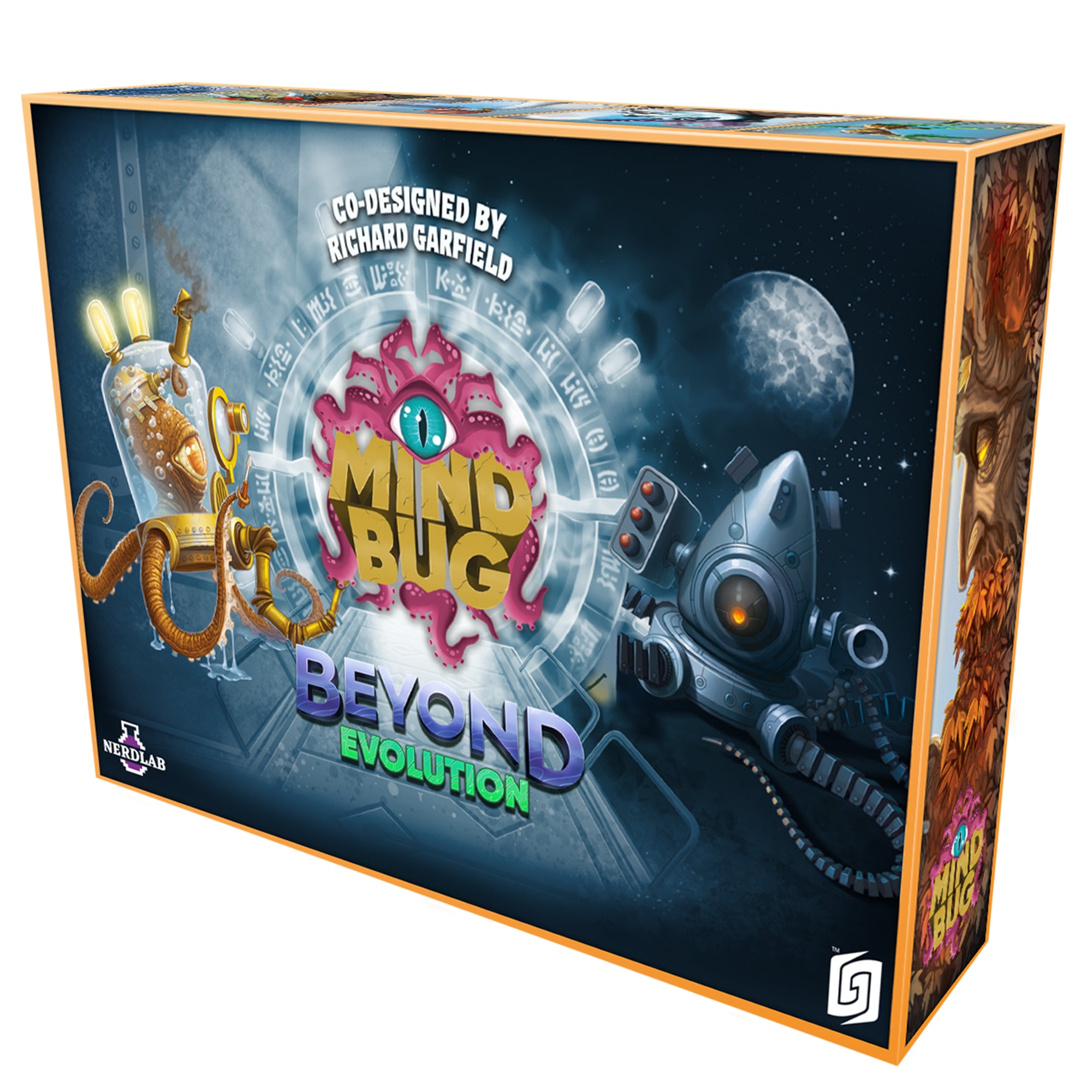
Mindbug first arrived on the scene as a Kickstarter darling, promising a micro card game experience designed by the co-creator of Magic: The Gathering's early expansions alongside Christian Kudahl. The core pitch was deceptively simple: each player has a hand of cards representing bizarre, powerful creatures. On your turn, you play a creature. Your opponent can either let it hit the table or use one of their two Mindbug tokens to steal it, placing it on their own side instead. That is the entire game in a nutshell, and Beyond Evolution expands on this foundation with a fresh set of creatures that push the boundaries of what the system can do.
Published by Nerdlab Games, Beyond Evolution functions as both a standalone experience and a set that can be shuffled into previous Mindbug sets. The game supports exactly two players, plays in fifteen to twenty-five minutes, and requires essentially zero setup time. You shuffle, deal, and go. For roughly twenty dollars, you get a complete game experience that you can teach to someone in under two minutes. The value proposition is strong, though the question is whether that simplicity comes at the cost of depth.
Gameplay and Mechanics
The genius of Mindbug lives and dies with its central mind-control mechanic, and we are pleased to report that it remains as sharp and psychologically thrilling as ever. Every single turn presents you with a genuine dilemma. You look at your hand of creatures, each with unique powers, attack values, and special abilities. You see a creature that would absolutely demolish your opponent's board state. You desperately want to play it. But the moment you do, your opponent might steal it with a Mindbug token, and now that devastating creature is pointed directly at your face.
This creates a layer of psychological warfare that is genuinely rare in games this small. Do you play your weaker creature first, baiting out a Mindbug token on something you do not care about? Do you play your strongest creature early, gambling that your opponent will not want to waste a token? Or do you hold your best cards, waiting for the moment when both Mindbug tokens have been spent and you can finally unleash your most powerful play without fear? Every decision branches into a web of second-guessing and counter-play that feels far more complex than the rules suggest.
Beyond Evolution introduces new creature abilities that interact with the Mindbug mechanic in fresh ways. Some creatures have effects that trigger when they are mind-controlled, punishing the theft. Others have abilities that reward you for having been stolen from, creating interesting consolation prizes. The new keyword abilities add wrinkles to combat and board positioning without complicating the fundamental elegance of the system. Creatures still attack each other or the opponent directly, and the first player to land three hits on their opponent wins.
Combat resolution is straightforward but satisfying. When a creature attacks, the defender chooses which of their creatures blocks, and the lower-power creature is destroyed. Ties destroy both. Special abilities can modify this in all sorts of chaotic ways, from creatures that deal damage when they die to ones that grow stronger with each kill. The interplay between abilities creates emergent situations that feel genuinely surprising, even after dozens of plays.
Presentation
Mindbug has always embraced a deliberately weird aesthetic, and Beyond Evolution continues that tradition. The creature art is grotesque, imaginative, and oddly charming, depicting bizarre evolutionary mutations that look like they crawled out of a fever dream. The card quality is decent for the price point, with a smooth linen finish that shuffles well enough, though we would not call it premium. The card text is clear and readable, with iconography that communicates abilities at a glance once you learn the basic symbols.
The box itself is small enough to toss in a bag without a second thought, which is one of Mindbug's greatest selling points. There is no insert to speak of because there does not need to be. The rulebook is a single folded sheet that explains everything you need to know in a few short paragraphs. We appreciate this minimalist approach because it matches the minimalist game design. Nothing about the presentation overpromises, and everything serves the quick, portable experience the game is aiming for. The Mindbug tokens themselves are simple cardboard chits, functional but unremarkable. We would love to see upgraded metal or acrylic tokens in a future deluxe edition.
Content and Value
For twenty dollars, Mindbug: Beyond Evolution delivers a complete two-player experience that you can carry anywhere and teach to anyone in minutes. The replayability comes from the randomness of the card draw and the psychological dynamics between different opponents rather than from a deep well of content. The base set contains enough creature variety to keep things interesting for dozens of plays, but we will be honest: if you are the type of player who needs constant novelty, you may start to feel the limits of the card pool after extended play sessions.
The good news is that Beyond Evolution is designed to be mixed with other Mindbug sets, and combining card pools dramatically increases the variety and unpredictability. If you already own the original Mindbug or other expansions, this set becomes an excellent addition that refreshes the experience considerably. As a standalone product, however, we think most players will get solid entertainment out of it for a few weeks before it becomes an occasional palate cleanser between heavier games. That is not a criticism so much as an honest assessment of what a twenty-dollar micro card game can deliver.
There is no solo mode, no campaign, and no additional content beyond the cards in the box. Mindbug knows what it is and does not try to be anything more. We respect that focus, even if it means the ceiling for engagement is lower than weightier titles.
What Works and What Doesn't
Pros
- Genius mind-control mechanic
- Incredibly portable
- Quick setup and play
- Highly replayable
Cons
- Luck dependent
- Limited card variety in base set
- Not for players who dislike take-that
- Strategic depth is shallow
The mind-control mechanic is genuinely one of the cleverest ideas in modern card game design. It turns every play into a calculated risk and transforms what could be a simple creature-combat game into a psychological duel. The portability and speed are massive selling points for anyone who wants a game they can play at a coffee shop, on a plane, or while waiting for the rest of the group to arrive for game night.
On the flip side, luck plays a significant role. Sometimes you draw a hand of creatures that simply do not synergize well, while your opponent draws a complementary set that steamrolls you regardless of skill. The take-that nature of the Mindbug mechanic can also frustrate players who prefer to build their own strategy without direct interference. And while the psychological layer adds depth, the underlying strategic decisions are not as complex as dedicated two-player card games like Radlands or Jaipur once you strip away the bluffing element.
Final Verdict
Mindbug: Beyond Evolution is a delightful little game that punches well above its weight class in terms of memorable moments per minute of play. The mind-control mechanic is still brilliant, the new creatures add genuine variety, and the price-to-fun ratio is hard to argue with. It is not trying to be a deep strategic experience, and players looking for that should look elsewhere. But as a fast, portable, psychologically engaging two-player duel, Mindbug remains one of the best options on the market. We recommend it enthusiastically for couples, travel gaming, and anyone who enjoys looking their friend in the eye and stealing their most prized creature with a smirk. Just be prepared for them to do the same to you.