History Written by the Players
There is a moment in every Oath campaign where something happens that no designer could have scripted. A trusted ally betrays the Chancellor at the worst possible moment. An exile stumbles upon a relic that reshapes the power balance overnight. A citizen sacrifices their position to install a new dynasty, and the world itself shifts to reflect that choice for every future session. These moments are not triggered by event cards or predetermined narrative beats — they emerge organically from the intersection of player decisions, game state, and Cole Wehrle's audacious design. Oath: Chronicles of Empire and Exile is not just a board game; it is a history engine, and there is nothing else quite like it in the hobby. It is also demanding, occasionally frustrating, and absolutely not for everyone. But for those who connect with its vision, it is extraordinary.
Overview
Oath is a one to six player strategy game designed by Cole Wehrle and published by Leder Games, the studio behind Root and the COIN-adjacent designs that have established Wehrle as one of the most important designers working today. First released in 2021 and continuing to find its audience through word of mouth and sustained acclaim, Oath occupies a unique space in the hobby: it is a legacy-adjacent game where the state of the world evolves from session to session, but nothing is ever permanently destroyed or altered. No stickers on the board, no torn-up cards. Instead, the game uses an ingenious chronicle system where the outcome of each session determines the starting conditions of the next — which cards are in the world deck, which sites are available, who holds power, and what oath defines the victory condition.
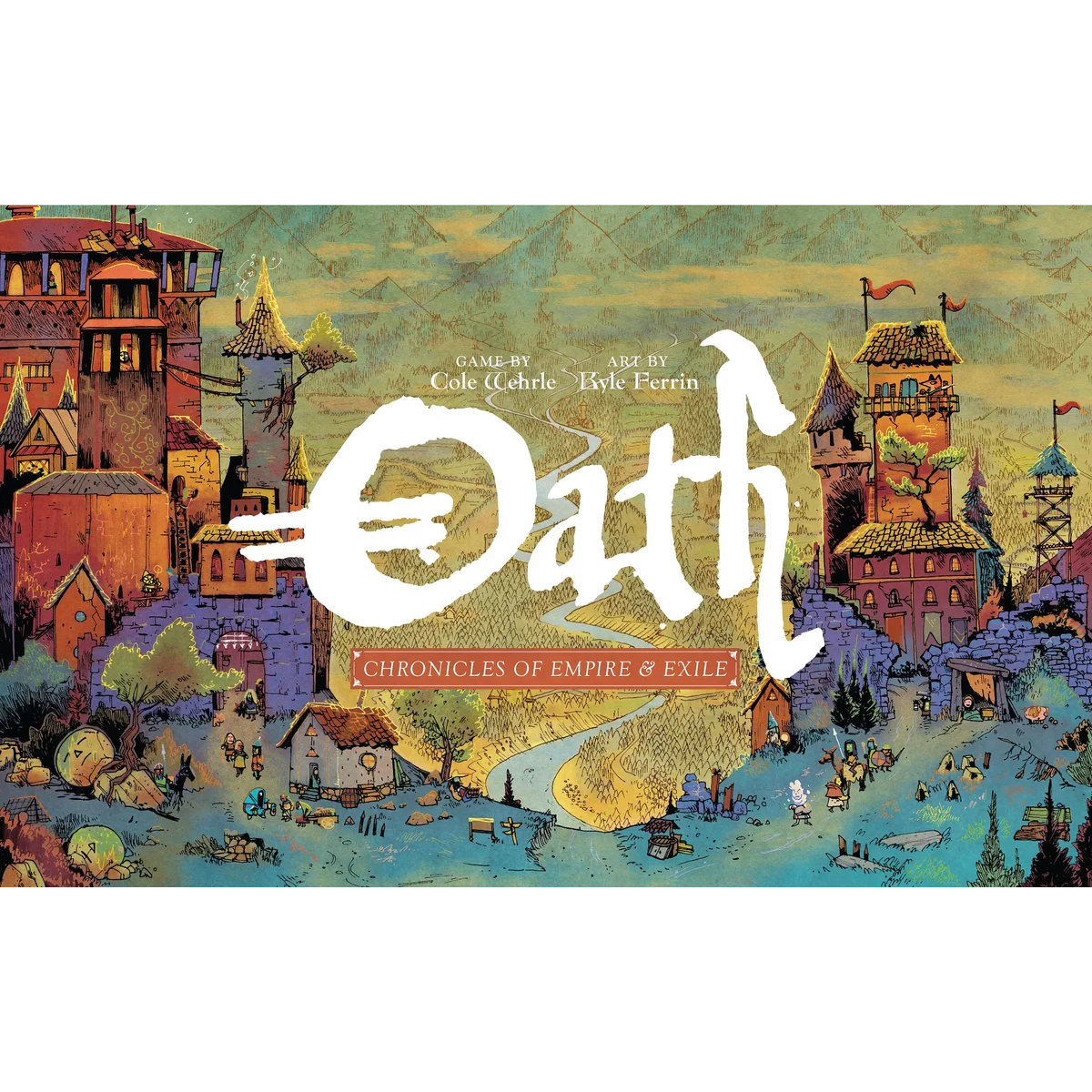
Each session plays out as a political struggle between the Chancellor (the current ruler, determined by the previous game's outcome) and a group of Exiles seeking to overthrow or subvert them. Citizens can ally with the Chancellor for shared victory, or break away at a critical moment to pursue their own agenda. The game combines area control, hand management, resource manipulation, and negotiation into a complex, interconnected system illustrated by the incomparable Kyle Ferrin, whose whimsical-yet-dark art style has become synonymous with Leder Games' identity.
Gameplay and Mechanics
Oath's mechanical foundation is area control overlaid with an economic and political system that is both elegant and labyrinthine. On your turn, you take a series of actions — marching warbands across the map, campaigning against rivals, searching the world deck for powerful denizens and relics, playing cards to your advisers for ongoing abilities, or trading favor and secrets (the game's two currencies) with other players. Your goal depends on your role: the Chancellor wants to maintain power by fulfilling the current oath's conditions at the end of the game, while Exiles each pursue their own victory conditions, which can shift based on the relics and banners they discover.
The oath system is Oath's defining innovation. At the start of each campaign session, one of several oaths is active — Oath of Supremacy (control the most sites), Oath of the People (hold the most favor), Oath of Devotion (possess a specific relic), and others. This oath determines what the Chancellor must defend and what Exiles must pursue or subvert. Crucially, some victory conditions allow Exiles to win by fundamentally changing the oath itself, altering the game's win condition for all future sessions. When a player wins by declaring a new oath, the next session begins under entirely different political circumstances, potentially favoring different strategies, card combinations, and power structures.
The world deck is another stroke of genius. It contains a mix of denizen cards (characters and factions you can recruit as advisers) and site cards (locations that define the map's geography). Cards cycle in and out of the deck based on game events — cards played during a session may exit the deck, while new cards enter from a separate pool. Over multiple sessions, the composition of the world deck shifts, reflecting the "history" of your campaign. A game where commerce-focused factions dominated might see economic cards proliferate in future sessions, while a militaristic campaign might leave behind a world deck heavy with warbands and fortifications. This is emergent worldbuilding through gameplay, and it is genuinely thrilling when you notice the patterns forming across sessions.
The negotiation element is crucial and underappreciated. Oath is not a game where you can turtle in a corner and optimize. You need allies, and alliances in Oath are fluid, fragile, and fascinating. Citizens can benefit from the Chancellor's victory, but only if they trust the Chancellor to maintain their position. The Chancellor needs citizens to help defend against Exiles, but granting too much power to any single citizen risks creating a rival. And Exiles must balance cooperation against other Exiles with the knowledge that ultimately, only one player can win. The social dynamics this creates are extraordinary — real trust, real betrayal, real political maneuvering that emerges from the game's structure rather than being imposed by arbitrary rules.
Combat is resolved through a dice-rolling system that introduces controlled randomness. You roll custom dice when campaigning, with the number of dice determined by your warband strength. The results can be modified by cards and abilities, but there is always an element of uncertainty that prevents pure calculation from dominating. This randomness is intentional — Oath is a game about navigating uncertainty, reading situations, and adapting, not executing a perfect plan. Some players will find this liberating; others will find it infuriating.
Presentation
Kyle Ferrin's artwork is, as always, stunning. His illustration style — detailed, slightly grotesque, full of personality and hidden details — gives Oath a visual identity that is instantly recognizable and deeply atmospheric. The card art is gorgeous, the board is striking, and the overall table presence is impressive. The wooden components (warbands, favor tokens, secrets) are functional and attractively produced, though the sheer volume of pieces means setup and teardown take longer than you might expect.
The chronicle board — the tool used to record the game state between sessions — is well-designed and mostly intuitive, though it requires careful attention to ensure nothing is missed. The rulebook is comprehensive but dense, and we strongly recommend the official playthrough video or a teach from an experienced player for your first game. The learning curve is real: expect your first session to take significantly longer than subsequent ones, and expect rules questions to arise frequently. Leder Games has provided extensive support materials, including a "law of Oath" reference document that addresses edge cases, which is both a testament to the game's depth and a warning about its complexity.
The physical production is excellent, befitting the game's roughly one hundred dollar price tag. Everything feels premium, from the card stock to the screen-printed wooden pieces. The game demands a large table and rewards a dedicated play space where you can leave it set up between sessions — though this is not strictly necessary thanks to the chronicle system that captures game state in a portable format.
Content and Value
Oath's value proposition is entirely dependent on your play circumstances. If you have a regular group of three to five players who can commit to playing Oath repeatedly over weeks or months, the value is astronomical. The game gets better with every session as the world evolves, inside jokes develop, grudges form, and the chronicle accumulates history. Ten sessions deep, your copy of Oath becomes genuinely unique — a personalized artifact of your group's shared narrative. No other copy of the game in the world has the same history.
If you do not have a regular group, or if your group is unwilling to commit to multiple sessions with the same game, Oath's value drops precipitously. Individual sessions are interesting but can feel incomplete without the context of ongoing chronicle development. The game can be played as one-off sessions, but doing so strips away its most compelling feature and leaves you with a complex, somewhat unwieldy area control game that would not stand out on its own mechanical merits.
The solo mode, powered by an automated opponent system called the Clockwork Prince, is mechanically functional but misses the social dynamics that make Oath special. Similarly, two-player games work but lack the rich alliance and betrayal dynamics that emerge at three or more. The sweet spot is four to five players, where the political landscape is complex enough to generate meaningful drama without bogging down in excessive downtime.
What Works and What Doesn't
What works is the vision. Oath achieves something genuinely unprecedented in board gaming: a persistent, evolving world that changes based on player actions without destroying any components. The emergent narratives are real and powerful. The mechanical design supports political maneuvering, shifting alliances, and dramatic reversals in ways that feel organic rather than forced. Kyle Ferrin's art is breathtaking, and the production quality is top-tier. For the right group, Oath is a once-in-a-generation experience.
What doesn't work is accessibility and situational fairness. The first game is confusing for almost everyone, and the game does not reveal its brilliance until the second or third session. Kingmaking — where a player with no chance of winning determines who does win — is a real and recurrent issue that can frustrate competitive players. The rules overhead is significant, and even experienced players will reach for the rulebook regularly. And the game's requirement for a committed, regular group means it is simply inaccessible to a large portion of hobbyists.
Final Verdict
Oath: Chronicles of Empire and Exile is a brilliant, flawed, ambitious masterwork that demands more from its players than almost any other game on the market — and rewards them accordingly. Cole Wehrle has created something that transcends the boundaries of what board games typically achieve, delivering emergent storytelling and evolving worldbuilding through pure gameplay mechanics. It is not a game we can recommend universally; its complexity, its need for a dedicated group, and its tolerance for kingmaking and chaos will turn many players away. But for those who can meet its demands, Oath offers an experience that is genuinely unmatched. If you have the group, the patience, and the willingness to let the game teach you what it wants to be, Oath will reward you with stories you will tell for years. We believe it is one of the most important board games of the decade, even if it is not one of the most accessible.
Pros
- Genuinely evolving game state across sessions
- Emergent storytelling is incredible and unprecedented
- Kyle Ferrin's art is stunning throughout
- No two campaigns feel alike thanks to the chronicle system
Cons
- Requires a regular committed play group
- First game is confusing for nearly everyone
- Kingmaking can frustrate competitive players
- Rules overhead is significant and persistent