Opening Hook
There is a particular thrill that comes from discovering a board game that has no business being as good as it is. The White Castle arrived without the hype machine that accompanies titles from major publishers, a relatively modest Euro game from Spanish studio Devir that promised dice drafting in feudal Japan. It did not claim to revolutionize anything. It did not promise a hundred hours of campaign content or a groundbreaking new mechanic that would redefine the hobby. What it promised was an elegant, tightly designed strategy experience in about an hour, and that is exactly what it delivers with a precision and confidence that has made it one of our most-played games of the past year. In a hobby that increasingly trends toward sprawling, complex experiences, The White Castle is a reminder that restraint can be its own form of genius.
Overview
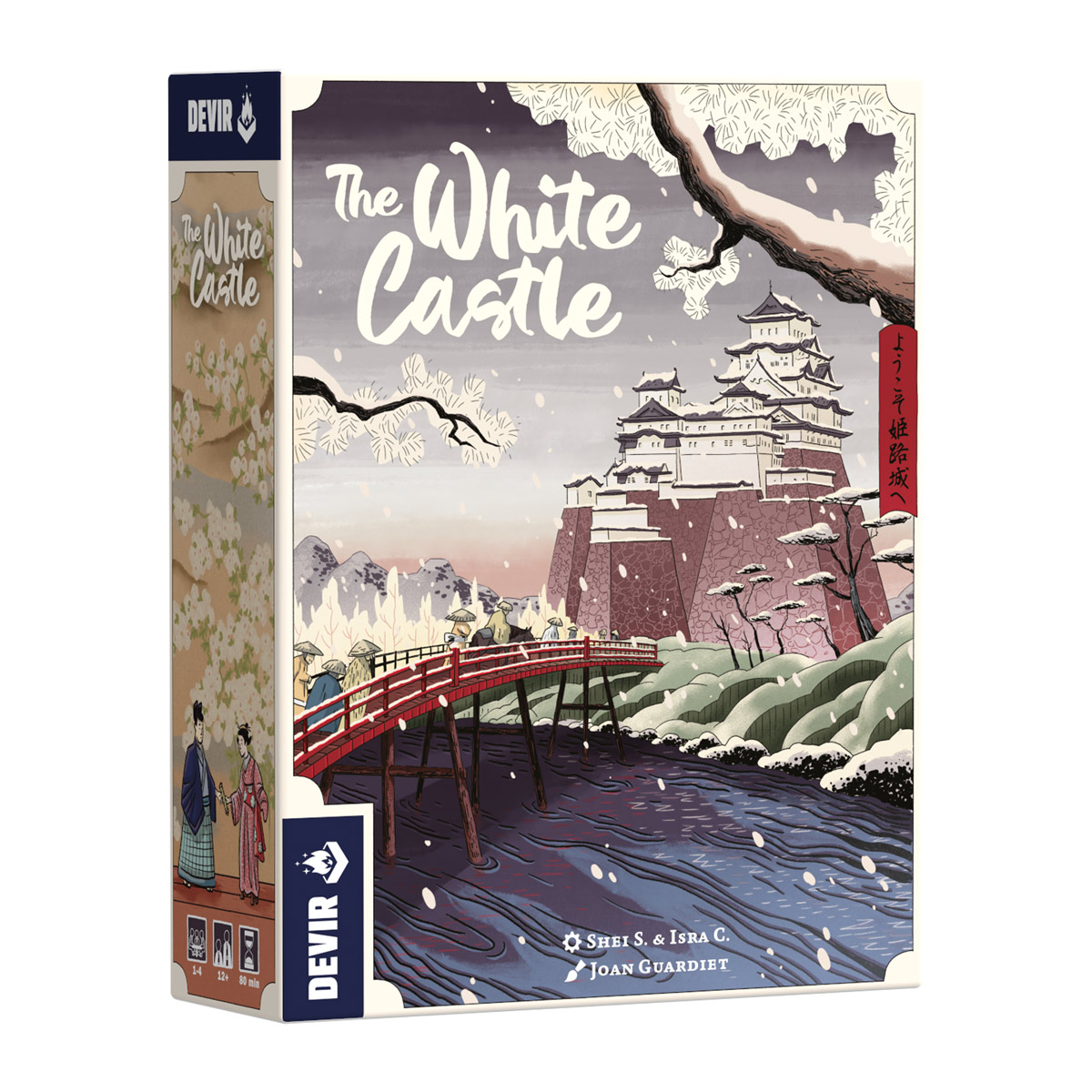
The White Castle is a one-to-four player Euro-style strategy game designed by Isra C. and Shei S. and published by Devir Games. The game is set in and around Himeji Castle, the famous White Heron Castle of feudal Japan, and tasks players with gaining influence by placing courtiers in the castle, cultivating gardens, training warriors, and managing resources across three rounds of dice-driven action selection. It won the 2024 As d'Or Grand Prix at the Cannes International Games Festival, beating a strong field that included several higher-profile releases, a victory that signaled the board gaming world's recognition of its exceptional design quality. The game plays in sixty to eighty minutes, scales cleanly from one to four players, and retails for approximately forty-five dollars, placing it in the accessible mid-weight Euro category that serves as the backbone of many gaming collections.
Gameplay and Mechanics
The central mechanism of The White Castle is dice drafting, but not in the way most games use dice. At the start of each round, a pool of dice is rolled and sorted into three bridges based on their color. On your turn, you select a die from one of the bridges and use it to take an action, but here is the twist that makes the system sing: the value of the die you take determines the cost or benefit of your action, and it is modified by how many dice of that same value remain on the bridge. Taking the last die of a particular value is cheap; taking one when several remain is expensive. This creates a dynamic, ever-shifting economy where the optimal choice changes with every die taken. You are never just choosing what to do; you are choosing when to do it, and the timing creates a depth of interaction that belies the game's modest complexity.
The actions available correspond to the three main areas of the game. You can send courtiers into Himeji Castle itself, placing your figures on increasingly valuable floors that grant powerful bonuses and end-game scoring. You can train warriors and deploy them to defensive positions around the castle, earning immediate rewards and contributing to area-majority scoring. Or you can cultivate gardens, advancing along a track that provides resources, special abilities, and significant point-scoring opportunities. Each action area has its own internal logic and strategic considerations, and the interplay between them creates a web of decisions that is simultaneously approachable and deeply satisfying.
The castle itself is a vertical puzzle. Each floor offers different bonuses and scoring conditions, and placing courtiers on higher floors requires meeting specific prerequisites, usually combinations of resources and previously placed courtiers. The castle's structure creates a natural progression: early-game placements on lower floors enable mid-game advancement to more lucrative positions, and late-game placements on the top floors can swing scores dramatically. The tactile satisfaction of ascending the castle, stacking your courtiers ever higher, gives the game a visual narrative arc that many abstract Euros lack.
Resource management in The White Castle is tight by design. You never have quite enough of what you need, and the tension between investing resources to gain long-term advantages and spending them to score immediate points is constant. Rice, iron, and mother-of-pearl serve as the game's currencies, each tied to specific action types and castle requirements. The resource economy is calibrated with remarkable precision: there is always something productive to do with your turn, but the optimal move is rarely obvious, which is the hallmark of great Euro game design. Card abilities provide asymmetric powers that give each player a slightly different strategic orientation, preventing the game from settling into a single dominant strategy.
The lantern track serves as a clever catch-up and timing mechanism. Certain actions advance your lantern marker, and reaching specific thresholds triggers bonuses or end-of-round scoring multipliers. The track creates another dimension of strategic consideration without adding mechanical complexity, a trick that The White Castle pulls off repeatedly throughout its design. Everything serves multiple purposes, every decision has ripple effects, and the whole system hangs together with the elegant inevitability of a well-constructed watch.
Presentation
The White Castle is a beautiful game, full stop. The board depicts Himeji Castle and its surrounding grounds in a stylized but respectful artistic interpretation that captures the serene grandeur of feudal Japanese architecture. The color palette is restrained and sophisticated, with soft whites, deep blues, and warm gold accents that make the board a pleasure to look at across dozens of plays. The dice are custom-engraved with thematic symbols, and the resource tokens are well-sized and easy to differentiate by both color and shape, an accessibility consideration that not enough games prioritize.
The courtier figures are simple wooden meeples in player colors, but their placement on the tiered castle board creates visual drama that elevates the table presence considerably. The card art maintains the game's overall aesthetic consistency, with illustrations that evoke ukiyo-e woodblock prints without descending into pastiche. The graphic design is clean and functional, with clear iconography that becomes second nature after a single play. The rulebook is well-organized, with a logical structure and ample illustrated examples that make teaching the game straightforward. Devir has included a solo mode with an automa opponent and a quick-play reference card for experienced players, both thoughtful inclusions that add value to the package.
The box size is refreshingly compact for a game of this strategic weight. In an era of unnecessarily oversized game boxes stuffed with plastic miniatures and foam inserts, The White Castle delivers a premium experience in a reasonably sized package that does not demand an entire shelf. The insert is functional without being elaborate, and setup and teardown take under five minutes, a practical consideration that directly impacts how often a game actually makes it to the table.
Content and Value
At forty-five dollars, The White Castle is excellent value for a strategy game of this caliber. The three-round structure and variable card setup ensure that no two games play identically, and the strategic depth is sufficient to reward dozens of plays before you feel you have fully explored the decision space. The solo mode, while not the primary draw, is well-implemented and provides a satisfying puzzle for solo gamers. The game scales smoothly from two to four players, with the two-player experience being particularly tight and interactive as dice become scarce more quickly.
The production quality exceeds expectations for the price point, with premium cardboard, well-printed cards, and custom dice that feel intentional rather than gimmicky. The game's relatively short play time, consistently under ninety minutes even with four players who are prone to analysis, means it fits into weeknight gaming sessions that heavier Euros cannot. This practicality is itself a form of value: a game that plays in an hour gets played far more often than one that demands an entire evening. For Euro game enthusiasts looking for a new staple in their rotation, The White Castle punches well above its weight class and earns its place alongside significantly more expensive and more elaborate designs.
What Works and What Doesn't
The White Castle works brilliantly as a study in elegant restraint. The dice-drafting mechanism is intuitive yet creates genuinely difficult decisions every turn. The three action areas are distinct enough to offer meaningful strategic diversity while remaining interconnected enough that ignoring any one of them feels like a mistake. The castle's vertical structure gives the game a visual and strategic arc that builds satisfying tension across its three rounds. The sixty-to-eighty-minute play time is perfectly calibrated to the depth on offer, leaving you wanting one more round without overstaying its welcome. The production quality is outstanding for the price.
Where The White Castle struggles is in thematic immersion. Despite the beautiful feudal Japan setting, the game is fundamentally an abstract optimization puzzle wearing a historical costume. The actions you take, placing cubes, advancing tracks, collecting resources, do not evoke the experience of navigating courtly politics or defending a castle in any visceral way. This is not unusual for Euro games, but players who need a strong thematic connection to stay engaged may find The White Castle's theme decorative rather than immersive. The game can also trigger analysis paralysis in players who struggle with optimizer's dilemma, as the interconnected scoring paths mean that evaluating every possible die choice can lead to lengthy turns. The player interaction is largely indirect, limited to denying dice and castle positions, which will disappoint gamers who prefer confrontational designs.
Pros
- Elegant dice-drafting mechanism with genuine depth
- Multiple paths to victory reward creative strategy
- Compact but deep with a perfect play time
- Stunning visual presentation and quality components
Cons
- Theme feels thin despite beautiful artwork
- Analysis paralysis prone with optimizer players
- Tight point salad can frustrate new players
- Limited direct player interaction
Final Verdict
The White Castle is a masterclass in Euro game design that proves you do not need a hundred miniatures, a four-hour play time, or a revolutionary gimmick to create a deeply satisfying strategic experience. Its dice-drafting system is one of the most elegant action-selection mechanisms we have encountered, creating a dynamic decision space that shifts with every choice made at the table. The multiple scoring paths reward creative thinking and strategic flexibility, and the sixty-to-eighty-minute play time ensures that the game is tight, focused, and respectful of your time. The production quality punches above its price point, the scaling is excellent across all player counts, and the game has a remarkable ability to leave you immediately wanting to play again, the highest compliment we can pay any board game. It won the As d'Or Grand Prix for a reason, and that reason becomes obvious within your first play. The White Castle is not the loudest game on the shelf, but it might be the smartest, and it has earned a permanent place in our collection. For any Euro game enthusiast who values elegance over extravagance and depth over duration, this is an essential acquisition.