Opening Hook
There is a moment about four sessions into Ticket to Ride: Legacy — Legends of the West where you open a sealed envelope, read the card inside, and the entire table goes quiet. Then someone laughs. Then someone else swears. Then everyone starts recalculating their strategy for the rest of the campaign, because the game just changed the rules underneath them in the most delightful way possible. We have played a lot of legacy games at Full Orbit Games — from the founding masterworks of Pandemic Legacy to the sprawling ambitions of Gloomhaven — and what impresses us most about this particular entry is how it takes the most accessible board game franchise on the planet and transforms it into something that generates these kinds of stories. This is the legacy game for everyone, and we mean that in the most complimentary way imaginable.
Overview
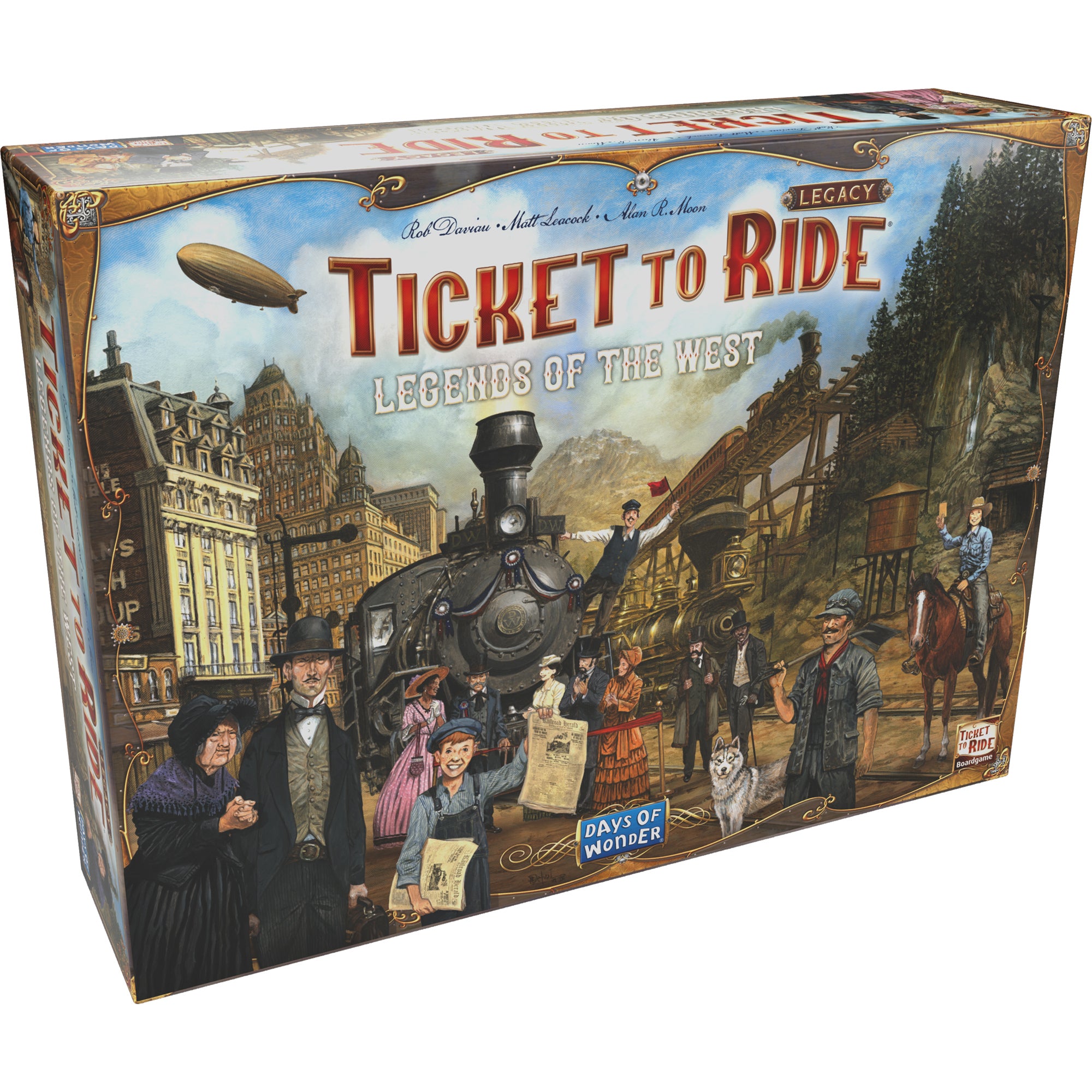
Designed by Rob Daviau, the godfather of legacy board gaming himself, alongside Matt Leacock, and published by Days of Wonder, Ticket to Ride: Legacy — Legends of the West takes the foundational route-building gameplay that has sold over ten million copies worldwide and wraps it in a campaign that spans twelve or more sessions. The setting is the American frontier during the westward expansion era, and players take on the roles of pioneers building rail connections across a growing, evolving map of the United States. Each session represents a new chapter in that story, introducing fresh mechanics, new destinations, unexpected twists, and permanent changes to the game board itself.
The brilliance of choosing Ticket to Ride as the foundation for a legacy experience cannot be overstated. This is a franchise that grandparents play with grandchildren, that non-gamers request at holiday gatherings, that serves as the gateway drug for an entire hobby. By grafting legacy mechanics onto these bones, Daviau and Leacock have created something that can introduce the concept of evolving, story-driven board gaming to an audience that might never pick up Pandemic Legacy Season One. It is an act of accessible design that deserves recognition regardless of how the game itself plays — and fortunately, it plays very well.
Gameplay and Mechanics
At its core, every session of Legends of the West begins with familiar Ticket to Ride mechanics. You draw train cards, claim routes by playing matching sets, and complete destination tickets that award points for connecting specific cities. If you have played any version of Ticket to Ride, you will be comfortable within minutes. The teach for new players takes about ten minutes for the first session, which is critical for a game that aims to bring legacy gaming to a wider audience. There is no thirty-page rulebook to wade through before your first play. You sit down, learn the basics, and start laying track.
What makes the legacy layer work so well is how gradually it introduces complexity. The first two sessions feel almost identical to standard Ticket to Ride, establishing a baseline of comfort and familiarity. Then, session by session, the campaign begins layering on new elements. Some sessions introduce new types of route cards with special abilities. Others reveal hidden sections of the map that were previously unavailable. Sealed packets contain new rules, new components, and narrative twists that fundamentally alter the strategic landscape. We do not want to spoil any specific revelations — the joy of discovery is the entire point — but we can say that the designers have a genuine talent for pacing these surprises.
The campaign structure also introduces a persistent scoring system that tracks each player's progress across all sessions. Individual sessions still have winners and losers, but there is a cumulative score that determines the overall campaign champion. This creates interesting long-term strategic considerations that do not exist in standalone Ticket to Ride. Do you sacrifice points in session five to set up a dominant position for session six? Do you pursue a risky ticket that might pay off later in the campaign? These meta-decisions add a layer of depth that keeps experienced players engaged even when the base mechanics feel familiar.
The surprise elements — and there are many — are handled with sealed envelopes, hidden compartments, and instruction cards that are only read at specific moments. The game tells you exactly when to open each packet, so there is no confusion about timing. Some surprises affect all players equally, while others reward or penalize specific strategies, which keeps the competitive tension high. A few of these moments genuinely shocked our table, prompting the kind of animated discussion that is the hallmark of a great legacy experience.
Presentation
Days of Wonder has always been the gold standard for board game production quality, and Legends of the West largely lives up to that reputation. The game board is gorgeous, rendered in a period-appropriate style that evokes vintage railroad maps of the American West. The train pieces are the familiar colored plastic of the Ticket to Ride franchise, chunky and satisfying to place. The card stock is good, the sealed envelopes are sturdy, and the various legacy components hidden throughout the box are well-produced and exciting to discover.
The narrative elements are presented through short story cards that set the scene for each session. The writing is serviceable rather than exceptional — do not expect the dramatic heft of Pandemic Legacy's storyline — but it provides enough context to make each session feel like a distinct chapter rather than an arbitrary sequence of games. The frontier theme works well, giving the campaign a sense of geographic and historical progression as the railroad pushes westward. Our one complaint about the physical production is the box organization. Once you start opening envelopes and adding components, keeping everything tidy between sessions becomes a challenge. A few more baggies or a better insert would have gone a long way. It is a minor issue, but for a game that asks you to store and revisit components over weeks or months, organization matters.
Content and Value
At approximately one hundred dollars, Legends of the West is a significant investment — nearly double the price of the standard Ticket to Ride. But the value proposition makes sense when you consider what you are getting: twelve or more sessions of guided, evolving gameplay with a group of friends or family. If each session runs thirty to sixty minutes, you are looking at somewhere between eight and fifteen hours of entertainment from a single box, and each session offers something genuinely new rather than repeating the same experience.
The obvious caveat is that this is a one-time experience. Once you have played through the entire campaign, the game is done. You cannot reset it, replay it, or hand it to someone else. Some people find this philosophically troubling, and we understand the objection. A hundred dollars for a disposable game feels extravagant by board game standards. But we would counter that you do not complain about the price of a concert ticket because you can only attend once. The value of Legends of the West lies in the memories it creates — the shared gasps, the heated debates about strategy, the running jokes about who keeps stealing the best routes. Those are worth a hundred dollars to us, and we suspect they will be worth it to most families who commit to the campaign.
There is also a completed campaign mode that allows you to continue playing your evolved version of the game as a one-off experience after the story ends, though we found this less compelling than simply buying a fresh copy of regular Ticket to Ride for ongoing play. The real value is in the journey, not the destination.
What Works and What Doesn't
What works is the accessibility. This is the easiest legacy game to get to the table that we have ever encountered. If your family already plays Ticket to Ride — and statistically, there is a good chance they do — you can transition into the legacy experience with almost zero friction. The surprises are genuinely surprising, the pacing of new mechanics is expertly calibrated, and the campaign creates a shared narrative that players will reference long after the final session ends. For families with older children, this is an exceptional way to introduce the concept of campaign gaming without the intimidation factor of heavier legacy titles.
What does not quite work is the challenge level for experienced gamers. If your group regularly plays complex strategy games, the base Ticket to Ride mechanics may feel too lightweight to sustain twelve sessions, even with the legacy additions. Some of the new mechanics introduced later in the campaign are clever but not deep, and a few sessions feel like they are treading water narratively while the next big twist gestates. There are also occasional balance issues where one player can snowball an early advantage across multiple sessions, which can deflate the competitive tension. The game attempts to address this with catch-up mechanisms, but they are not always sufficient.
Pros
- Perfect legacy gateway game
- Wonderful surprise moments
- Accessible for new gamers
- 12+ sessions of content
Cons
- Veterans may find it simple
- Some sessions feel unbalanced
- One-time playthrough only
- Box could be better organized
Final Verdict
Ticket to Ride: Legacy — Legends of the West accomplishes something that very few games manage: it makes the legacy format accessible to everyone. Rob Daviau and Matt Leacock have taken one of the most beloved board games in the world and given it a narrative spine that transforms casual game nights into a multi-week event that families will genuinely look forward to. It is not the deepest legacy experience available, and hardcore gamers may find the strategy too breezy for their tastes. But for the audience it is targeting — families, casual gamers, and anyone who has ever loved laying plastic trains on a colorful map — it is exactly the right game at exactly the right complexity level. We walked away from our completed campaign with a board covered in stickers, a scorecard full of memories, and an overwhelming urge to buy a second copy so we could do it all over again with a different group. That is the mark of an excellent legacy game, and Legends of the West earns its place alongside the best of them.