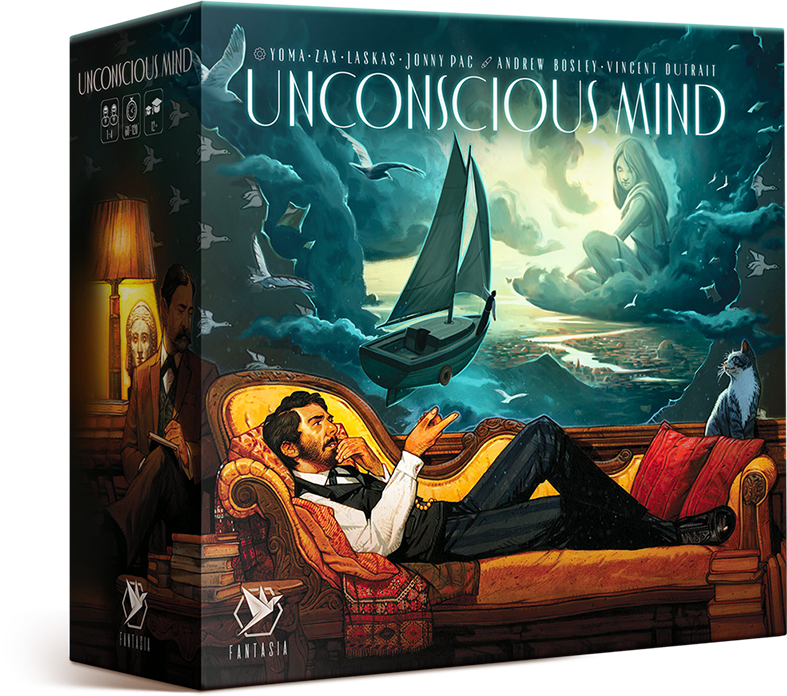
Freud Would Have Loved This Game (And That Is Not Entirely a Compliment)
We need to talk about Unconscious Mind. Not because it is the best Euro game of the year, though it is certainly in the conversation, but because it is the most audacious. In a hobby increasingly saturated with games about trading goods in medieval Europe and building farms in the countryside, Thundergryph Games has delivered a heavy worker placement game about psychoanalysis. You read that correctly. You are placing workers to analyze patients, develop therapeutic theories, publish academic papers, and navigate the professional rivalries between Freud, Jung, and their contemporaries. It is weird. It is brilliant. It is absolutely not for everyone. And we kind of love it.
Overview
Designed by Giorgio De Michele and Dario Massarenti and published by Thundergryph Games, Unconscious Mind casts one to four players as pioneering psychoanalysts in early twentieth-century Vienna. The game takes place during the formative years of psychoanalytic theory, when competing schools of thought were battling for legitimacy and the very notion of the unconscious mind was revolutionary. Each player develops their own therapeutic approach, treats patients, publishes their findings, and builds their reputation within the nascent field of psychology.
The game plays over a series of rounds, with each round representing a period of professional development. At its core, this is a medium-to-heavy Euro game with worker placement as its primary mechanism, supplemented by engine building, resource management, and a spatial element that represents the layers of the unconscious mind. It plays in ninety to one hundred twenty minutes, supports one to four players with a dedicated solo mode, and retails for around sixty dollars. The production values from Thundergryph are characteristically high, with premium components and striking artwork that immediately sets the game apart on any shelf.
Gameplay and Mechanics
The worker placement in Unconscious Mind operates on two interconnected levels, which is where the design really distinguishes itself. On the surface level, you have a traditional action selection board where you place your analysts to perform standard Euro game actions: gaining resources, acquiring patient cards, publishing papers for victory points, and advancing along various tracks that represent your professional reputation and theoretical development. This layer is familiar to anyone who has played Viticulture, Architects of the West Kingdom, or any number of worker placement games.
The deeper layer, quite literally, is where the game earns its name. Each player has a personal board representing the mind of their current patient, divided into conscious, preconscious, and unconscious layers. As you treat patients, you are mechanically moving tokens deeper into these layers, uncovering repressed memories, resolving traumas, and developing insights that fuel your theoretical framework. The deeper you push into the unconscious, the more powerful the rewards, but the more resources and actions it requires. This spatial puzzle within the larger worker placement game creates a satisfying dual-layer decision space that feels genuinely novel.
The theoretical framework system is another standout feature. As you treat patients and publish findings, you develop a unique school of thought represented by a card tableau. Different theoretical cards synergize with different approaches to treatment, creating emergent strategies that feel thematically coherent. A player focusing on dream analysis might develop a very different engine than one pursuing behavioral observation or free association techniques. These are not just mechanical differences with thematic labels slapped on top. The designers have clearly done their research, and the gameplay mechanics genuinely reflect the intellectual differences between historical approaches to psychoanalysis.
Patient cards are the primary source of victory points, and each patient presents a unique combination of symptoms, required treatments, and potential breakthroughs. Successfully treating a patient requires committing workers over multiple rounds, managing specific resources like empathy tokens and theoretical insights, and navigating the spatial puzzle of their unconscious mind. The sense of investment in each patient is remarkable. When you finally resolve a complex case after several rounds of careful work, the payoff is both mechanically rewarding and narratively satisfying in a way that feels rare in Euro game design.
The interaction between players is primarily indirect, operating through competition for action spaces, patient cards, and positions on the reputation tracks. There is a conference mechanism where players can present their findings and gain bonuses based on their relative standing, which creates some interesting timing decisions. However, if you are looking for direct conflict or negotiation, Unconscious Mind will disappoint. This is very much a parallel optimization puzzle where you are competing for limited resources rather than directly interfering with each other's plans.
Presentation
Thundergryph Games has built a reputation for producing visually striking games, and Unconscious Mind is no exception. The art direction is stunning, with a rich palette of deep purples, midnight blues, and warm golds that evoke both the intellectual atmosphere of fin-de-siecle Vienna and the mysterious depths of the human psyche. The patient cards feature portrait illustrations that are haunting and empathetic, treating their subjects with dignity rather than sensationalism. The main board is a feast for the eyes, with art nouveau-influenced design elements that feel period-appropriate without being kitsch.
Component quality is excellent throughout. The wooden tokens are shaped and printed with care, the cardboard is thick and durable, and the personal player boards are multi-layered with recessed slots for tracking the layers of the unconscious. The insert is well-designed, keeping everything organized and reducing setup time. The overall tactile experience is premium and matches the intellectual ambitions of the design.
The rulebook, however, is where the presentation stumbles. It is dense, sometimes poorly organized, and occasionally ambiguous on edge cases that come up frequently in play. Our first game required multiple pauses to debate rule interpretations, and we ended up consulting online forums for clarification on several points. A player aid card would have been enormously helpful and is strangely absent from the box. The learning curve is steep not because the underlying systems are unreasonably complex, but because the rulebook does not communicate them as clearly as it should.
Content and Value
At sixty dollars, Unconscious Mind offers substantial content. The patient card deck is large enough that you will not see every case in a single game, and the theoretical framework cards provide meaningful variety in strategic approaches. The solo mode is well-designed, using an automa opponent that creates genuine competition for action spaces without slowing the game down with complex automation. The different player counts all feel viable, though we found the game most engaging at three players where competition for spaces is tight without being suffocating.
Replayability is moderate. The variable patient cards and theoretical frameworks ensure that no two games are identical, and the depth of the strategic decisions means you will continue to find new optimizations for many plays. However, the overall arc of the game tends to follow similar patterns once you understand the key strategies, and the lack of strong player interaction means the social dynamics do not vary as much between sessions as they might in more interactive designs. We estimate most groups will get ten to fifteen deeply engaging plays before the experience starts to feel familiar, which is a reasonable return for the price point.
What Works and What Doesn't
Pros
- Unique and bold theme
- Deep strategic gameplay
- Beautiful production values
- Strong thematic integration
Cons
- Theme may alienate some
- Rulebook is dense
- Steep learning curve
- Limited interaction between players
Unconscious Mind succeeds most dramatically in its thematic integration. This is not a game where you could swap the theme for something else without changing the experience. The mechanics of exploring the layers of a patient's psyche, developing competing theoretical frameworks, and building professional reputation are deeply intertwined with the game's subject matter. The production quality reinforces this at every turn, creating an atmosphere that is intellectually stimulating and aesthetically gorgeous.
The weaknesses are real but predictable for this type of design. The theme will genuinely put some players off, not because it is handled poorly but because not everyone wants to spend two hours engaging with psychoanalytic theory as entertainment. The rulebook needs improvement, and the learning curve means your first game will likely be a stumbling exploration rather than a satisfying strategic experience. And the low interaction means that players who crave table talk, negotiation, or direct competition will find the experience isolating despite the shared action space.
Final Verdict
Unconscious Mind is a game that knows exactly what it wants to be and executes that vision with remarkable confidence. It is a deep, thematically rich Euro game that offers a genuinely unique experience in a market flooded with familiar themes and mechanisms. The dual-layer gameplay, combining traditional worker placement with an innovative spatial puzzle representing the unconscious mind, provides strategic depth that will satisfy experienced gamers looking for something new. The production quality is outstanding, and the thematic integration is among the best we have seen in the Euro genre. It is held back by a challenging rulebook, limited player interaction, and a theme that will inevitably narrow its audience. But for those who connect with what Unconscious Mind is offering, it is an exceptional experience that lingers in the mind long after the box is closed. We recommend it for experienced Euro gamers who value thematic depth and are ready for something boldly different.