Opening Hook
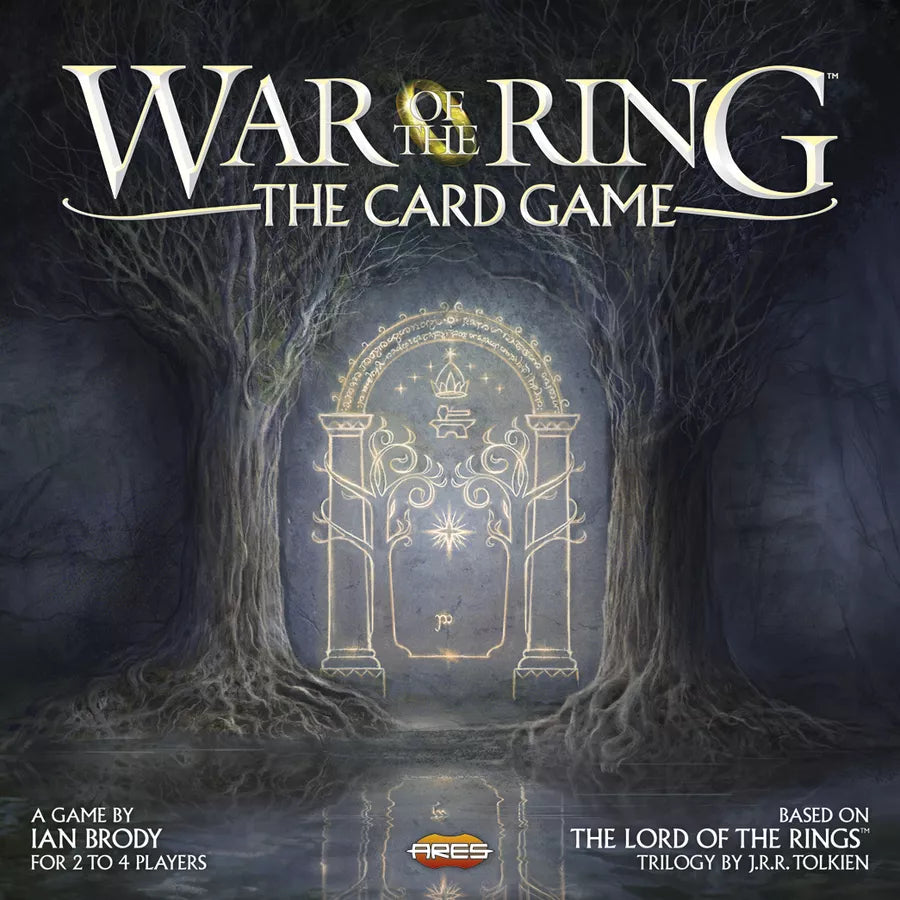
The original War of the Ring board game is one of the greatest tabletop experiences ever designed — a sprawling, four-hour epic that perfectly captures the sweeping conflict of Tolkien's The Lord of the Rings. It is also, frankly, a beast to get to the table. Between the massive board, hundreds of plastic miniatures, and a rulebook that demands multiple readings, it is the kind of game that many people admire from afar but rarely actually play. War of the Ring: The Card Game exists to solve that problem, and while it does not — and should not — replace its big sibling, it carves out its own identity as a compelling strategic card game that captures more of Middle-earth's grandeur than any card game has a right to.
Overview
Designed by Ian Brody and published by Ares Games, War of the Ring: The Card Game is a standalone card-driven strategy game for two to four players. In the standard two-player mode, one player controls the Free Peoples (Gandalf, Aragorn, the Fellowship) while the other commands the Shadow (Sauron, Saruman, the forces of Mordor and Isengard). The game can also be played with three or four players by splitting each side between two people, with one player controlling the military campaigns and the other managing the Fellowship's quest or the Shadow's corruption efforts. The core conflict mirrors the original: the Free Peoples win by destroying the One Ring or achieving military victories, while the Shadow wins by corrupting the Ring-bearer or conquering enough of Middle-earth.
The game was first released in 2023 and has continued to build a dedicated following through 2025, buoyed by expansion packs that add new cards and scenarios. It occupies an interesting niche — heavier than most card games, lighter than most war games, and dripping with thematic Tolkien flavor throughout.
Gameplay & Mechanics
The game is played over a series of rounds, each representing a chapter of the war. Each round, players simultaneously select cards from their hands to play into several battleground paths that represent key locations from the story: Rohan, Gondor, the Lonely Mountain, and the path to Mordor. Cards represent characters, armies, events, and items from Tolkien's world, and each card has multiple possible uses — it can be played for its face effect, committed to a battleground for its combat strength, or discarded to fuel special abilities. This multi-use card design creates agonizing decisions every turn: do you play Gandalf for his powerful event ability, or commit him to the defense of Gondor where his combat strength is desperately needed?
The path mechanic is where the game captures the dual narrative of The Lord of the Rings most effectively. While military battles rage across the various paths, the Fellowship is making its way toward Mount Doom on a separate track. The Free Peoples player must balance between committing resources to the military fronts and advancing the Fellowship, while the Shadow player must decide between military conquest and efforts to corrupt Frodo. This tug-of-war between the two victory conditions creates a dynamic, shifting strategic landscape that feels genuinely Tolkien-esque — the military conflicts are a distraction, a necessary sacrifice to buy the Ring-bearer time, just as they are in the source material.
Combat resolution is handled through card comparison and special abilities, with some dice rolling for uncertainty. Each battleground resolves independently, and the side that commits the most total strength wins that path, scoring victory points and potentially triggering powerful event effects. The iconography on cards is dense but consistent — after a game or two, you learn to quickly evaluate cards and plan your rounds efficiently.
The four-player variant deserves mention because it adds a layer of team coordination that the two-player game lacks. When two players share a side, they must divide responsibilities and communicate strategy, which introduces a cooperative element that can be tremendously enjoyable. The Shadow side, in particular, benefits from having one player focused purely on military domination while the other orchestrates the corruption of the Ring-bearer through Nazgul and dark influence cards.
Presentation
Visually, War of the Ring: The Card Game is gorgeous. The card illustrations are drawn from a combination of original artwork and classic Tolkien-inspired imagery, and the quality is consistently high. Each character card feels like a small piece of art worth examining, from the determined gaze of Aragorn at Helm's Deep to the looming menace of the Witch-King. The path boards are beautifully illustrated with landscapes that evoke the geography of Middle-earth, and the overall table presence, while more modest than the original board game, is still impressive for a card game.
The component quality is solid — the cards are well-printed on decent stock, the tokens are sturdy, and the box insert accommodates sleeved cards if you are the type to protect your investment. The rulebook, however, is the weakest link in the presentation. While comprehensive, it is organized in a way that makes learning the game from scratch more difficult than it needs to be. Several edge cases and timing questions arise during play that the rulebook addresses ambiguously at best. Ares Games has published an extensive FAQ that resolves most issues, but ideally these clarifications would have been incorporated into the rulebook itself. We strongly recommend watching a video tutorial before your first game.
Content & Value
At approximately forty dollars, War of the Ring: The Card Game offers strong value for Tolkien fans and strategy gamers alike. A single game runs ninety minutes to two hours, which hits a sweet spot for most gaming sessions. The base game includes enough card variety for dozens of plays before strategies start to feel stale, and the expansion packs — which add new characters, events, and alternate scenarios — significantly extend the game's lifespan. There is also a solo variant that pits a single player against an automated Shadow opponent, though we found this mode functional rather than exciting.
The real value here is in the narrative moments the game generates. Because the cards represent specific characters and events from Tolkien's work, every game tells a recognizable but unique version of the War of the Ring. In one memorable session, Boromir survived the breaking of the Fellowship and led the defense of Minas Tirith, while Frodo was corrupted just one step from Mount Doom. In another, the Ents destroyed Isengard early and freed up Rohan to march east, securing a military victory before the Fellowship had even reached Mordor. These emergent stories are what keep us coming back, and they emerge naturally from the game's mechanics rather than feeling scripted.
What Works & What Doesn't
Pros
- Captures epic Tolkien scope
- More accessible than the board game
- Dramatic swings and tension
- Beautiful card illustrations
Cons
- Not a replacement for the board game
- Can feel swingy
- Setup takes time
- Rulebook needs FAQ support
The swinginess is the most divisive element. Because powerful event cards can dramatically shift the balance of a battleground in a single play, there are moments where a carefully planned strategy gets demolished by a well-timed card from your opponent. Some players find this thrilling — it mirrors the unpredictability of war and the thin margin between victory and defeat in Tolkien's story. Others find it frustrating, particularly when a game that felt locked up swings on a single card reveal. We land on the side of enjoyment — the swings create narrative peaks and valleys that make every game memorable — but we understand why competitive-minded players might find them excessive.
Final Verdict
War of the Ring: The Card Game is not the definitive War of the Ring experience — the original board game still holds that crown and likely always will. What it is, however, is a remarkably successful distillation of the themes, tension, and narrative drama of Tolkien's war into a format that can be played in an evening without dedicating a dining table for an entire weekend. It rewards knowledge of the source material, generates compelling stories, and offers enough strategic depth to sustain dozens of plays. If you are a Tolkien fan who has always been intimidated by the original board game, this is your entry point. If you are a War of the Ring veteran looking for a quicker fix, this scratches the itch admirably. It is not perfect — the rulebook needs work and the swinginess will not appeal to everyone — but when it fires on all cylinders, there is a moment where the Fellowship reaches Mount Doom with corruption at maximum, the military fronts are crumbling, and everything hangs on a single card play — that is pure Middle-earth magic, and no card game does it better.