Opening Hook
When Stonemaier Games announced that Wingspan would be getting a spiritual successor themed around dragons, the board gaming world collectively held its breath. Wingspan is one of the most commercially successful hobby board games of the past decade, a game that transcended the niche and brought engine building to kitchen tables that had never seen anything more complex than Monopoly. Replacing its beloved birds with dragons was either a stroke of genius or a catastrophic miscalculation. After spending weeks excavating caves and hatching wyrms across dozens of plays, we can report that Wyrmspan lands somewhere more interesting than either extreme. It is a genuinely good game that struggles to escape the enormous shadow of its predecessor, offering enough mechanical innovation to justify its existence while never quite convincing us that it needed to exist at all.
Overview
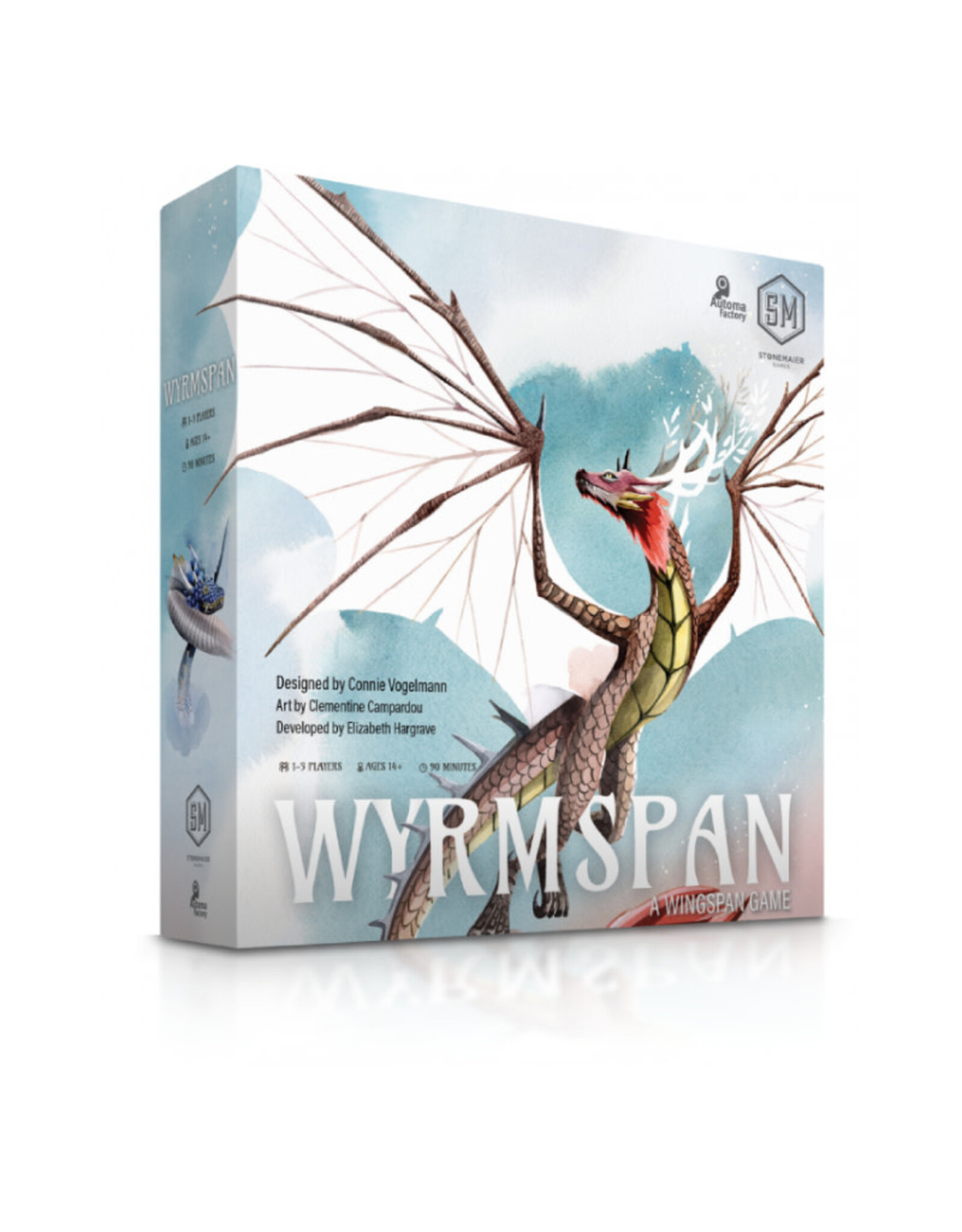
Wyrmspan is a one-to-five player engine-building card game designed by Connie Vogelmann and published by Stonemaier Games in early 2025. Where Wingspan asked players to attract birds to a wildlife preserve, Wyrmspan tasks them with excavating a network of caves and populating them with dragons. The core structure will be immediately familiar to anyone who has played Wingspan: you play dragon cards from your hand into a personal tableau, spending resources to do so, and each dragon triggers abilities that generate resources, draw cards, or score points. The twist is that instead of three horizontal habitats, Wyrmspan presents a spatial cave system where the placement and adjacency of your dragons matters. Vogelmann, who previously designed the Oceania expansion for Wingspan, brings a deep understanding of the system's strengths and weaknesses to the design. The game retails for roughly fifty-five dollars and supports solo play through an automa system, continuing Stonemaier's commitment to single-player modes across their catalog.
Gameplay and Mechanics
The fundamental action economy of Wyrmspan mirrors Wingspan closely enough that experienced players will feel at home within minutes. On your turn, you choose one of three actions: excavate a new cave space on your player board, entice a dragon from your hand into an excavated cave by paying its resource cost, or explore to gain coins, resources, or cards. Each action activates a chain of abilities on previously placed dragons in the corresponding row, creating the cascading combo engine that made Wingspan so satisfying. The more dragons you have in a given row, the more powerful that row's action becomes, encouraging specialization while the game's end-round goals and personal objectives push you toward diversification.
Where Wyrmspan diverges most meaningfully is in its cave excavation system. Your player board begins mostly covered, and before you can place a dragon, you need to excavate the cave space it will occupy. Excavation costs resources and reveals the terrain beneath, which can grant bonuses or impose placement restrictions. Some caves are crystal caverns that give immediate rewards; others are lava flows that only accept fire-breathing dragons. This spatial element adds a layer of planning that Wingspan lacks entirely. You are not just thinking about which dragons to play and when, but where to dig and how your cave network will develop over the course of the game. It is the single best innovation Wyrmspan brings to the table, and it gives the game a sense of exploration and discovery that the bird-watching theme of Wingspan, charming as it was, never quite achieved.
The dragon cards themselves function similarly to bird cards in Wingspan, each with a unique combination of resource cost, habitat requirement, ability, and point value. There are over two hundred unique dragons in the box, and Vogelmann has done admirable work differentiating them mechanically. Some dragons trigger when activated, others provide passive bonuses, and a handful create powerful once-per-game effects that can reshape your entire strategy if timed correctly. The guild system replaces Wingspan's bonus card objectives, giving players secret scoring conditions related to the types of dragons they collect. Guilds reward specialization in specific dragon families, and drafting them at the start of the game provides an initial strategic direction without locking you into a rigid path.
The resource system has been streamlined compared to Wingspan. Instead of managing eggs, food tokens of various types, and tucked cards, Wyrmspan uses coins as a universal currency alongside a simpler set of resources: meat, crystals, and milk. The reduction in resource variety is a double-edged sword. It makes the game easier to teach and reduces the frustration of being stuck without the specific food type you need, but it also flattens the decision space. In Wingspan, the tension between needing different food types for different birds created interesting dilemmas. In Wyrmspan, coins smooth over those rough edges, and the game loses some strategic texture in the process.
Presentation
If Wyrmspan gets one thing unambiguously right, it is the visual presentation. The dragon artwork is breathtaking, with each of the two hundred-plus cards featuring a unique, meticulously illustrated dragon that ranges from fearsome to whimsical. The art team has created a bestiary that feels cohesive while maintaining incredible variety, and there is genuine delight in discovering each new dragon as you draw cards. The card stock is excellent, the player boards are thick and well-designed, and the resource tokens have a satisfying heft. The cave tiles that you excavate have a tactile quality that makes the physical act of building your cave network genuinely pleasurable.
The graphic design is clean and functional, with clear iconography that communicates dragon abilities at a glance once you learn the symbol language. The rulebook is well-organized and includes ample examples, a significant improvement over some of Stonemaier's earlier efforts. The box includes a quick-start guide for players familiar with Wingspan, which is a thoughtful touch that acknowledges the game's primary audience. The overall production quality meets the high bar that Stonemaier has established, and the package feels premium without being ostentatious. Our only visual complaint is that some of the cave terrain types are difficult to distinguish at a glance, particularly in low lighting conditions, which is a minor accessibility concern.
Content and Value
At fifty-five dollars, Wyrmspan is priced slightly above Wingspan but delivers a comparable amount of content. The two hundred-plus dragon cards ensure that no two games feature the same tableau, and the cave excavation system adds variability that Wingspan's static player boards lack. The solo automa is well-designed and provides a satisfying challenge for single players, with adjustable difficulty that scales from casual to punishing. The game plays well at all player counts from one to five, though we found the sweet spot at two to three players where turns move quickly and the card market refreshes frequently enough to offer meaningful choices.
Replayability is strong thanks to the card variety and the guild system, which encourages different strategic approaches from game to game. The cave tiles add another layer of variability, as the terrain you reveal shapes your options in unpredictable ways. We anticipate that Stonemaier will release expansions, and the design has clear hooks for new content: additional dragon families, new cave terrain types, and alternative guild cards could all extend the game's lifespan considerably. For the base box alone, there is enough content here to sustain dozens of plays before the experience begins to feel repetitive, which is a solid value proposition for a game in this price range.
What Works and What Doesn't
Wyrmspan works best when you engage with it on its own terms rather than measuring it against Wingspan. The cave excavation mechanic is genuinely innovative, adding spatial reasoning to the engine-building formula in a way that creates new types of decisions. The dragon theme, while perhaps more conventional than birds, gives the game a fantasy adventure quality that appeals to a different audience. The solo mode is excellent, the production quality is top-tier, and the streamlined resource system makes the game more accessible without sacrificing meaningful strategic depth.
Where Wyrmspan falters is in its identity crisis. Despite the cave system and the dragon theme, the game feels fundamentally like Wingspan with a fantasy reskin. The core action loop is nearly identical, the engine-building arc follows the same trajectory, and many of the strategic considerations carry over directly. Players who bounced off Wingspan will find little here to change their minds, and players who adore Wingspan may wonder whether they need a second version of essentially the same experience. The dragon theme, while visually stunning, does not permeate the mechanics the way bird behaviors infused Wingspan. Dragons could be replaced with any collectible creature without meaningfully changing how the game plays, and that thematic disconnect is Wyrmspan's most significant weakness.
Pros
- Gorgeous dragon artwork across 200+ unique cards
- Cave excavation adds meaningful spatial depth
- Familiar yet fresh mechanics for Wingspan fans
- Excellent solo mode with adjustable difficulty
Cons
- Feels too similar to Wingspan at its core
- Dragon theme feels surface-level in mechanics
- Less elegant than its predecessor overall
- Some balance concerns with powerful combos
Final Verdict
Wyrmspan is a very good game trapped in an impossible situation. Judged purely on its own merits, it is a polished, beautifully produced engine builder with an innovative cave excavation system and enough strategic depth to reward repeated play. The dragon artwork is stunning, the solo mode is among the best in the hobby, and the streamlined resource system makes it approachable without being simplistic. But Wyrmspan does not exist in a vacuum. It exists in the shadow of Wingspan, and the similarities between the two games are too pronounced to ignore. If you do not own Wingspan and the dragon theme appeals to you, Wyrmspan is an excellent entry point into Stonemaier's engine-building formula. If you already own and love Wingspan, the calculus is harder. Wyrmspan offers enough novelty through its cave system and guild mechanics to justify a purchase for dedicated fans, but it is not a replacement, and it is not a revelation. It is a confident, well-crafted companion piece that proves the Wingspan formula has legs while leaving us wondering what a bolder departure might have looked like. We recommend it with the caveat that managing expectations is essential: come for the dragons, stay for the caves, and try not to spend the whole time thinking about birds.