Opening Hook
There is a moment in Balatro — maybe your fifth run, maybe your fiftieth — where the numbers on screen stop making sense in the best possible way. You play a seemingly modest three-of-a-kind, but thanks to a chain of Joker cards you have been carefully curating over the past three blinds, that humble hand explodes into a cascade of multipliers that sends your score rocketing past a million. The screen flashes, chips scatter, and your brain floods with the same dopamine hit that keeps people feeding slot machines in Las Vegas. Except here, you earned that rush through genuine strategic decision-making, and that distinction is what makes Balatro one of the most remarkable indie games we have ever played. LocalThunk, the solo developer behind this phenomenon, has taken the language of poker and bent it into something entirely new — a roguelike deckbuilder where the rules of the game are perpetually up for negotiation.
Overview
Balatro is a single-player roguelike deckbuilder created by a solo developer known as LocalThunk and published by Playstack. Originally released in early 2024, the game rapidly became a cultural sensation, sweeping award ceremonies and lodging itself firmly in the "just one more run" category of games that devour entire evenings. By early 2025, with a mobile port, ongoing updates, and a thriving community of players sharing absurd score screenshots, Balatro has only cemented its position as one of the defining indie games of the decade.
The premise is deceptively simple: you have a standard 52-card poker deck, and you play poker hands to score points against increasingly demanding blind targets. Beat the blind, advance to the next ante, and keep going until the eight ante or until the game crushes you. What transforms this from a casual poker sim into a mind-bending strategic experience is the Joker system — collectible modifier cards that fundamentally alter how your hands score, stack, and interact. It is poker as you have never imagined it.
Gameplay and Mechanics
At its core, Balatro asks you to score enough chips to defeat a series of blinds across eight antes of escalating difficulty. Each round, you draw a hand of cards and can play poker hands — pairs, straights, flushes, full houses, and so on — to generate chips and multipliers. You also have a limited number of discards to reshape your hand before committing. So far, so straightforward.
The genius arrives with the Joker cards. You can hold up to five Jokers at a time (expandable with certain upgrades), and each one modifies your scoring in wildly different ways. Some are straightforward, like adding a flat multiplier to every hand. Others are conditional: bonus chips if your hand contains a heart, or multiplied scoring if you play exactly four cards. Then there are the truly unhinged Jokers that break the game wide open — ones that square your multiplier, or that retrigger specific cards, or that scale infinitely based on how many times you have discarded this run. The interplay between these Jokers is where Balatro becomes a genuine puzzle game wearing poker's skin.
Between rounds, you visit a shop where you spend your earnings on new Jokers, planet cards (which permanently upgrade specific hand types), tarot cards (which modify individual playing cards), and spectral cards (which offer powerful but risky transformations). The economy management here is critical. Do you save money for the interest bonus, or do you invest in a Joker that might synergize perfectly with your existing setup? Every purchase is a calculated gamble, which feels thematically perfect for a poker game.
The deck itself is yours to sculpt. Through tarots and spectrals, you can enhance cards with bonus chips, turn them into glass cards that multiply scoring but risk shattering, seal them with special effects, or even delete cards entirely to thin your deck for more consistent draws. Advanced players will talk about creating "flush decks" with only one suit, or building around steel cards and the right Joker to create infinite scaling loops. The depth here is extraordinary, and it reveals itself gradually across dozens of hours.
What makes the roguelike structure work so well is that no two runs play the same way. The Jokers you are offered dictate the strategy you pursue, and learning to read the game's economy and pivot your approach is the skill ceiling that keeps experienced players coming back. Early runs might feel lucky or unlucky, but as your understanding deepens, you begin to see the matrix — recognizing which Joker combinations are worth chasing and which are traps.
Presentation
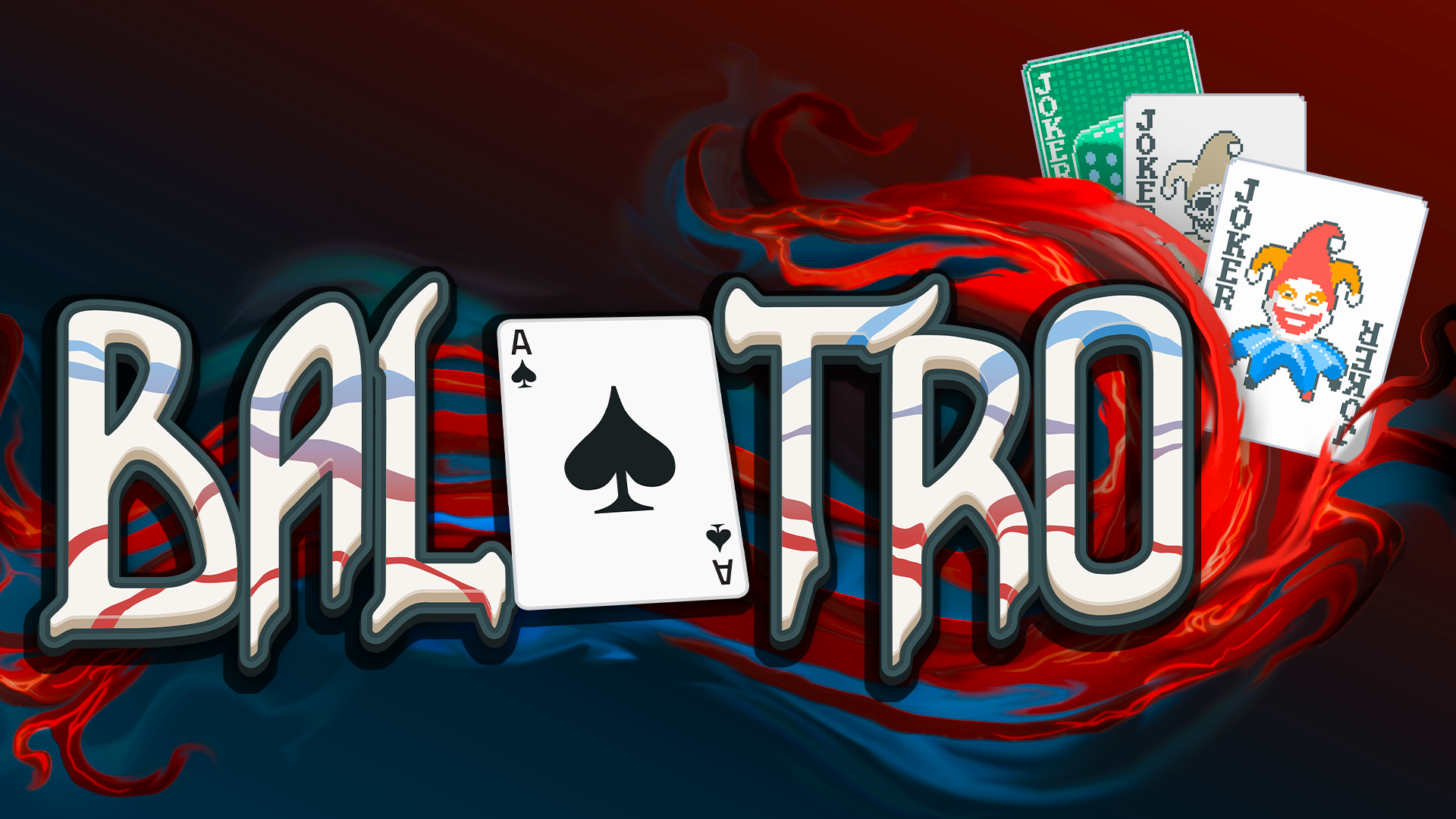
Balatro's visual identity is instantly recognizable: a retro CRT scanline aesthetic with vibrant colors that pop against dark backgrounds. The playing cards have a clean, almost minimalist design, while the Joker cards burst with personality and color. Every hand you play triggers a satisfying cascade of scoring animations — chips flying, multipliers stacking, numbers climbing — all set against a pulsing psychedelic background that shifts with the game's intensity. It is a visual style that will polarize some players; the CRT filter and the almost hallucinatory backgrounds are not for everyone, but they give Balatro an unmistakable identity that no other game shares.
The sound design deserves special recognition. The electronic soundtrack perfectly complements the hypnotic flow of play, building in intensity as your scores climb higher. Each scoring phase has distinct audio feedback — the chunky thud of base chips, the satisfying ding of multipliers stacking, and the glorious crescendo when a hand scores astronomically. It is a masterclass in using audio to reinforce the dopamine loop, and we found ourselves playing with headphones specifically to soak in these details. The UI, while dense with information, is surprisingly readable once you learn its language, with smart color coding and clear iconography that communicates complex modifier chains at a glance.
Content and Value
At $14.99, Balatro is one of the most absurd value propositions in gaming. We clocked over 80 hours before writing this review, and the desire to play more has not diminished in the slightest. The base game offers multiple difficulty levels, challenge decks that modify the starting rules in dramatic ways, and a sticker system that adds additional modifiers to completed decks. There are over 150 Jokers to discover, each one opening new strategic possibilities and combo routes.
The mobile port, which arrived in late 2024 and continued to be refined into 2025, is exemplary. The touch controls feel natural, the UI scales beautifully to smaller screens, and the session-based nature of runs makes it perfect for on-the-go play. We found ourselves completing runs during commutes, lunch breaks, and — we admit with some embarrassment — during meetings that could have been emails. Cross-platform save support would be a welcome addition, but the mobile version stands perfectly on its own. LocalThunk has also been responsive with updates, adding new Jokers, balancing existing ones, and listening to community feedback, which gives us confidence in the game's long-term health.
What Works and What Does Not
Almost everything about Balatro works. The core loop is immaculate — tight, strategic, and endlessly variable. The Joker system is one of the most elegant deckbuilding mechanics we have encountered, and the way the game teaches you its depth through repeated play rather than tutorials is masterful game design. The price point is generous, the mobile port is excellent, and the community around the game is vibrant and creative.
Where Balatro stumbles — and this is a minor criticism given the overall quality — is in its late-game balance. The highest difficulty stakes often come down to finding specific Joker combinations, and runs can feel doomed if the shop does not offer the right pieces. There is also very little in the way of narrative or thematic progression; you are playing poker against blinds, and that is it. Some players will crave a meta-story or unlockable lore, but Balatro is unapologetically focused on its mechanical depth. The visual style, while distinctive, can strain the eyes during extended sessions, and the CRT filter does not appeal to everyone. These are minor blemishes on an otherwise exceptional game.
Pros
- Endlessly replayable
- Brilliant Joker system
- Satisfying score explosions
- Works perfectly on mobile
Cons
- Can be hard to put down
- Late-game balance relies on luck
- Minimal narrative
- Visual style is polarizing
Final Verdict
Balatro is that rare game that takes a concept everyone thinks they understand — poker — and reveals an entirely new dimension hiding within it. LocalThunk has created something genuinely special: a roguelike deckbuilder that is simultaneously accessible enough for casual players to enjoy in short sessions and deep enough for strategic minds to spend hundreds of hours optimizing. The Joker system is a stroke of design brilliance, the scoring feedback is among the most satisfying in gaming, and the value at $14.99 borders on absurd. Yes, the late-game can lean on luck, and the CRT aesthetic is not universally loved, but these are footnotes in an otherwise masterful experience. Whether you play it on PC during marathon sessions or on your phone during a lunch break, Balatro will sink its hooks into you and refuse to let go. It is, without reservation, one of the best indie games of 2025 and a deserving masterpiece. We give Balatro a 9.2 out of 10.