The Long-Awaited Leap to Feudal Japan
Fans have been asking Ubisoft for a feudal Japan Assassin's Creed since roughly the moment they first climbed a tower in the original game. Nearly two decades later, Assassin's Creed Shadows has finally delivered on that promise, and the result is a game that is at once breathtaking and frustrating, ambitious and familiar, exactly what we asked for and somehow less than we hoped. Shadows is a gorgeous, sprawling open-world experience set in one of history's most fascinating periods, and when it is firing on all cylinders — crouching on a temple rooftop at dusk, cherry blossoms drifting past as you plan your approach to a heavily guarded compound — it makes a strong case for being the best Assassin's Creed since Origins. But it is also weighed down by the same bloat and repetition that has plagued this franchise for years, and no amount of beautiful scenery can fully disguise the fact that Ubisoft is still struggling to find the right balance between scope and substance.
Overview
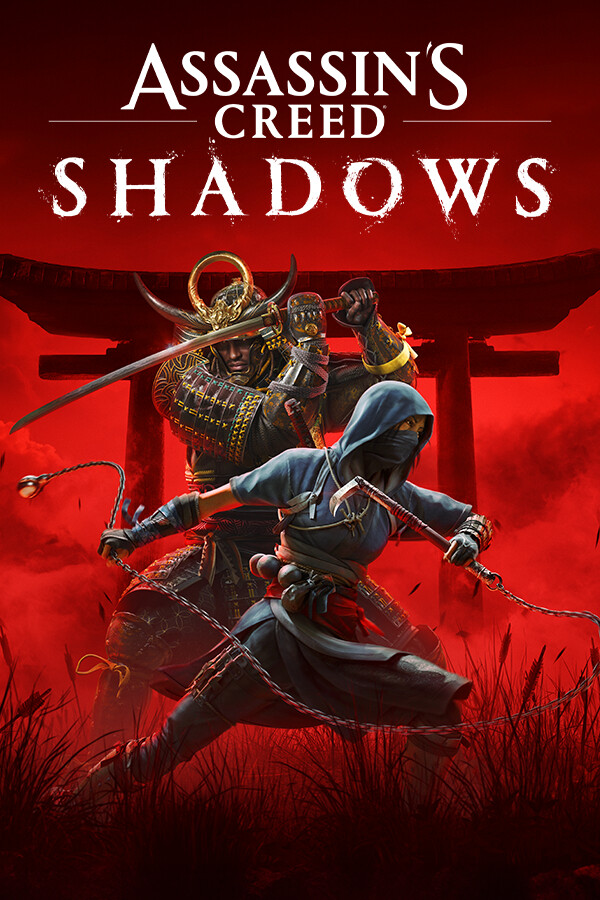
Developed by Ubisoft Quebec, the team behind Assassin's Creed Odyssey, Shadows is set during the Azuchi-Momoyama period of Japanese history, a time of warfare, political upheaval, and cultural transformation. The game features two playable protagonists: Naoe, a shinobi trained in the Hidden Ones' traditions, and Yasuke, the historical African samurai who served under Oda Nobunaga. Players can switch between the two characters freely in the open world and are occasionally forced to play as one or the other during story missions. The dual-protagonist structure is Shadows' most interesting narrative conceit, offering two fundamentally different perspectives on the same historical events. Naoe operates in the shadows, using stealth and subterfuge, while Yasuke is a force of nature in direct combat, cutting through enemies with the authority of a trained warrior. Their intersecting storylines explore themes of identity, belonging, and the moral compromises of war, and while the writing does not always match its ambitions, the framework is compelling.
Gameplay and Mechanics
The dual-protagonist system extends beyond narrative into gameplay in meaningful ways. Naoe plays like a return to the franchise's stealth roots. She can crouch, use a grappling hook for vertical traversal, deploy smoke bombs and shuriken, and perform one-hit stealth kills from virtually any position. Her gameplay sections are the closest the series has come to recapturing the social stealth and environmental awareness that defined the Ezio trilogy. We found ourselves planning approaches, studying patrol patterns, and executing multi-step infiltrations with a satisfaction that recent entries in the franchise had largely abandoned. The stealth AI, while not perfect, is significantly improved over Valhalla and Odyssey, with enemies that react more realistically to sound, light, and the discovery of fallen comrades.
Yasuke, by contrast, is built for direct confrontation. His combat system borrows elements from action games like Ghost of Tsushima and Nioh, with a stance system that lets him switch between different fighting styles mid-combat. There is a parry window, a guard-break mechanic, and a rage meter that, when filled, allows Yasuke to enter a devastating power state. The combat is weighty and visceral, with excellent animation work that makes every sword strike feel impactful. However, it also exposes a tension at the heart of Shadows' design. When you are playing as Yasuke, you are essentially playing a different genre of game than when you are playing as Naoe, and the open-world activities do not always accommodate both playstyles equally. Some outposts and fortresses are clearly designed for stealth infiltration and feel awkward to brute-force with Yasuke, while others are built around combat encounters that make Naoe's toolkit feel underpowered.
The open world itself is enormous, encompassing a significant portion of feudal Japan across multiple distinct regions. The seasonal system is the game's most visually impressive feature. The world transitions through spring, summer, autumn, and winter in real time as you progress through the story, and these changes are not merely cosmetic. Snow affects traversal speed and noise levels, spring floods open new waterway routes, and autumn foliage provides different cover opportunities than summer's dense canopy. It is a technically impressive system that makes the world feel alive in ways that static open worlds cannot match.
Unfortunately, the sheer size of that world works against it. Shadows suffers from the same content bloat that has plagued Ubisoft's open-world games for years. The map is littered with question marks, collectibles, side activities, and points of interest that range from genuinely engaging mini-narratives to rote busywork that exists primarily to pad the playtime counter. We found ourselves gravitating toward the main story and the more substantial side quests while ignoring the dozens of bandit camps, resource-gathering nodes, and repetitive shrine puzzles that populate every region. The game is at its best when it is focused, and at its worst when it is trying to convince you that there is always something else to do.
Presentation
When it comes to visual spectacle, Assassin's Creed Shadows is often stunning. The Anvil engine has been pushed to impressive heights, rendering a feudal Japan that is rich in detail and atmosphere. Cities like Kyoto and Osaka bustle with life, their streets filled with merchants, monks, samurai, and civilians going about daily routines that create a convincing illusion of a lived-in world. The architectural detail is remarkable, from the intricate woodwork of castle interiors to the serene beauty of garden temples to the imposing stone walls of fortified compounds. The seasonal transitions are the visual highlight, transforming familiar landscapes into something new with each passing season in ways that consistently surprised us even thirty hours in.
The character models and animation work are strong, particularly during cutscenes where the dual protagonists' performances are delivered with conviction. Naoe's actress brings a quiet intensity to the role that complements the character's lethal efficiency, while Yasuke's portrayal captures both the physical power and emotional vulnerability of a man navigating a world that views him as an outsider. The soundtrack blends traditional Japanese instrumentation with the series' signature orchestral sweep, and the ambient sound design is excellent, filling every environment with the sounds of wind through bamboo, distant temple bells, and the constant backdrop of a world in conflict.
Technically, however, Shadows has problems. Our review was conducted on PS5, where we encountered frequent frame rate drops in densely populated areas, texture pop-in that was occasionally severe, and several instances of NPCs clipping through geometry or getting stuck in animation loops. One main quest had a scripting bug that required us to reload a checkpoint. These issues are not game-breaking, but they are persistent enough to undermine the sense of immersion that the art direction works so hard to create. Ubisoft has acknowledged these problems and promised patches, but at launch, the technical state is below what we expect from a major first-party release.
Content and Value
There is no shortage of content in Assassin's Creed Shadows. The main story takes roughly forty hours to complete, and a thorough exploration of side content can push the total well past eighty. Whether all of that content is worthwhile is another question. The main quest and the more substantial side missions, designated as "Tales" in the game's parlance, are generally well-written and offer interesting vignettes of life during the Sengoku period. We particularly enjoyed a questline involving a retired shinobi whose past catches up with him, and another centered on a village caught between rival warlords that offered genuinely difficult moral choices. But for every memorable quest, there are three or four that amount to "go here, kill these people, collect this item," and the game's reluctance to trim the fat is its most consistent weakness.
The gear system is extensive, with dozens of weapons and armor sets that can be upgraded through multiple tiers using resources gathered throughout the world. Each protagonist has their own equipment loadout and skill tree, which adds variety but also means you are managing two separate progression systems simultaneously. The crafting is functional if unremarkable, and the economy feels well-balanced, with enough resources to engage with the upgrade systems without grinding but not so many that upgrades feel trivial. At sixty-nine ninety-nine, the value is there in terms of raw hours, but we would have preferred a tighter, more focused thirty-hour experience over the sprawling but uneven eighty-hour offering we received.
What Works and What Doesn't
What works is the setting, full stop. Feudal Japan is a magnificent canvas for Assassin's Creed, and Ubisoft Quebec has rendered it with love and attention to detail that is evident in every shrine, every castle, and every rain-soaked bamboo forest. The dual-protagonist system adds genuine variety when the game leans into the differences between Naoe and Yasuke, and the seasonal world changes are a remarkable technical achievement. The stealth gameplay, particularly with Naoe, represents the franchise's best work in years. What does not work is the open-world structure, which remains bloated despite years of criticism. The side activities are frequently repetitive, the map is overwhelming, and the technical issues at launch are a disappointment. The story, while ambitious in its dual-perspective structure, suffers from pacing problems in its second half, where narrative momentum stalls as the game funnels you through a series of region-by-region liberation sequences that feel mechanical. The modern-day framing story, as ever, adds almost nothing of value.
Pros
- Stunning feudal Japan setting rendered with exceptional detail
- Dual protagonist system adds genuine gameplay variety
- Improved stealth gameplay that returns to franchise roots
- Seasonal world changes are technically and visually impressive
Cons
- Bloated open world with too much repetitive filler content
- Repetitive side activities that pad playtime without adding substance
- Technical issues at launch including frame drops and bugs
- Story pacing becomes uneven in the second half
Final Verdict
Assassin's Creed Shadows is a great game trapped inside a bloated one. When it focuses on what it does best — atmospheric stealth infiltration with Naoe, visceral samurai combat with Yasuke, and the sheer visual splendor of its seasonal feudal Japan — it is among the finest entries in the franchise's long history. But Ubisoft's insistence on filling every corner of its massive map with content, regardless of quality, continues to be the series' most frustrating habit. We wanted to love Shadows unreservedly, and there were long stretches where we did. Crouching on a snow-covered rooftop in winter Kyoto, planning a perfect stealth run through a Tokugawa stronghold, remains one of the most atmospheric experiences we have had in any open-world game. But those moments are diluted by hours of middling busywork and a story that loses its way when it should be building to a crescendo. If you can approach Shadows with discipline, focusing on the main quest and the best side content while ignoring the map-marker deluge, you will find a great action-adventure game. If you feel compelled to see everything, you may find your enthusiasm waning long before the credits roll. Feudal Japan deserved an Assassin's Creed game, and Shadows mostly delivers, but mostly is the operative word.