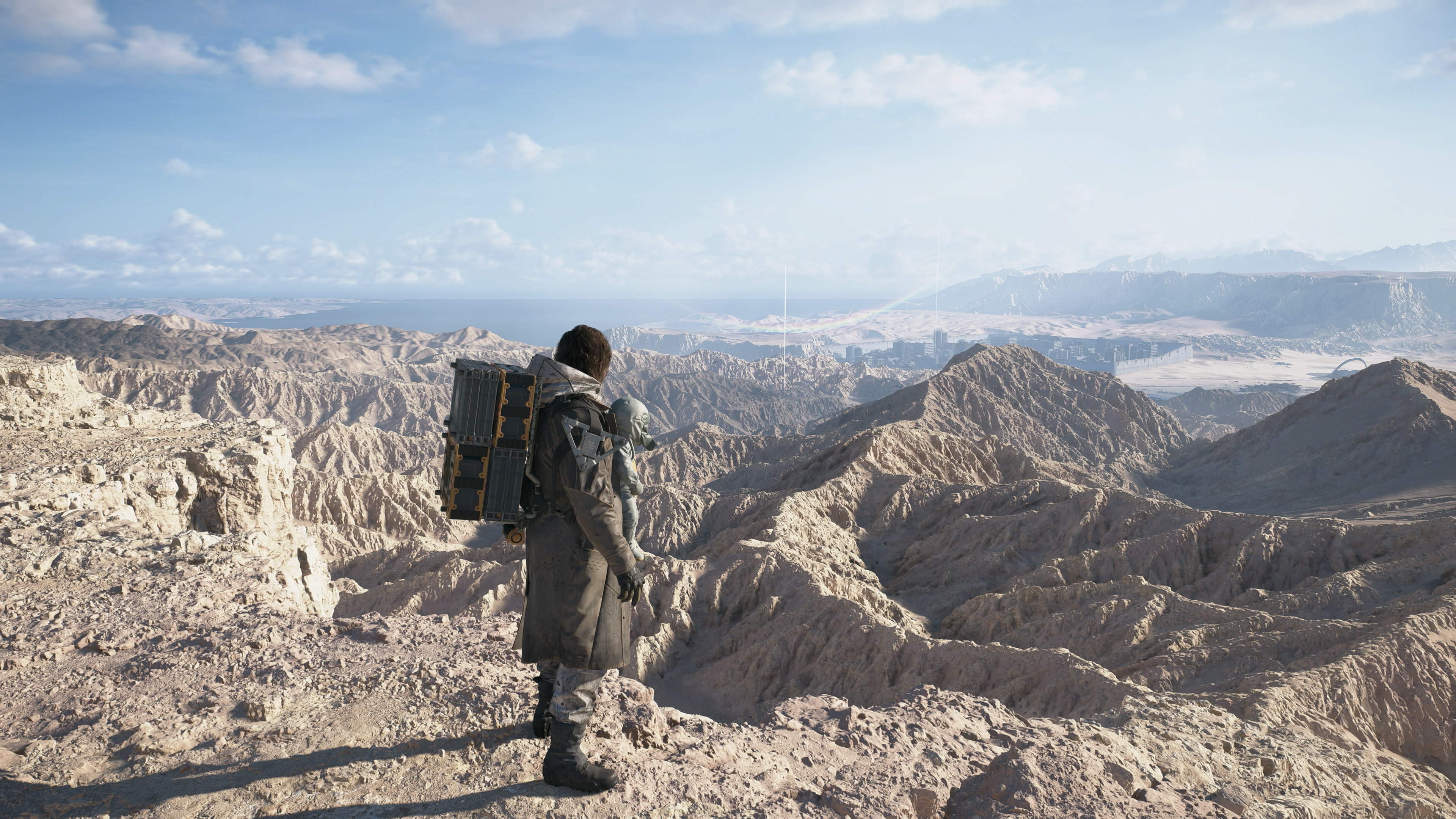
Walking Into the Unknown, Again
There is something profoundly Kojima about asking players to walk. Not run, not dash, not fast-travel through a waypoint-littered open world, but walk. Death Stranding 2: On the Beach doubles down on every philosophical impulse and mechanical idiosyncrasy that made its predecessor one of the most divisive games of the last decade, and we mean that as a sincere compliment. This is not a sequel designed by committee or focus-tested into submission. It is Hideo Kojima at his most unbridled, delivering a follow-up that is stranger, more emotionally resonant, and far more ambitious in scope than the original. If you bounced off Death Stranding in 2019, On the Beach is unlikely to change your mind. But for those of us who found something transcendent in Sam Porter Bridges' lonely deliveries across a shattered America, this sequel feels like a vindication.
Overview
Death Stranding 2: On the Beach picks up several years after the events of the first game. Sam, once again portrayed with remarkable nuance by Norman Reedus, is pulled back into a world on the brink of another extinction event. The UCA is fractured, new factions have emerged, and the Beach itself has begun to bleed into reality in terrifying new ways. Kojima Productions has expanded the narrative scope considerably, introducing a cast of new characters played by Elle Fanning, Shioli Kutsuna, and Troy Baker in a returning but dramatically different role. The story spans multiple continents this time, moving beyond the American landscape into uncharted territory both literally and thematically. At its heart, this is still a game about connection, about the invisible threads that bind people across distance and ideology, but it asks harder questions this time and is not always comfortable with the answers it finds.
Gameplay and Mechanics
The core loop of Death Stranding 2 will feel immediately familiar to returning players: you accept deliveries, plan your route, manage your cargo, and traverse hostile terrain while contending with BTs, MULEs, and the ever-present threat of timefall. What has changed is the depth and variety layered on top of that foundation. The traversal system has been massively expanded. Sam now has access to a broader range of vehicles, including a hovercraft that handles beautifully on water and a mountain-capable mech suit that transforms steep cliff faces from impassable barriers into thrilling vertical challenges. The rope mechanics from the first game have been reworked into a full climbing system, and there are moments where scaling a rain-slicked mountain pass with cargo swaying on your back reaches a kind of meditative intensity that few other games can match.
Combat, which was arguably the weakest element of the original, has received significant attention. Sam can now engage in melee combat with a fluidity that suggests Kojima Productions studied a few action games during development. There is a parry system, a dodge roll, and a satisfying array of non-lethal weapons that feel distinct and purposeful. Boss encounters are more elaborate and cinematic, weaving narrative setpieces into multi-phase battles that demand both mechanical skill and creative problem-solving. The BT encounters, in particular, have evolved beyond the hold-your-breath stealth sections of the first game into something more dynamic and unpredictable. We found ourselves genuinely tense during these sequences in a way the original rarely achieved after its opening hours.
The strand system, which allows players to build structures and leave equipment for other players in an asynchronous multiplayer framework, returns with new layers. You can now leave audio messages, build collaborative shelters that multiple players contribute to over time, and even construct entire road networks cooperatively. There is something quietly beautiful about cresting a hill and discovering that another player, someone you will never meet, built a bridge over the exact chasm that was about to ruin your delivery. Kojima calls it connection. We call it one of the most elegant multiplayer systems in modern gaming.
Presentation
On a purely technical level, Death Stranding 2 is one of the most impressive PS5 titles we have seen. The Decima engine, already capable of producing stunning vistas in the first game and Horizon Forbidden West, has been pushed to new heights. Environments range from ash-covered wastelands to lush, overgrown ruins to alien landscapes that defy easy description, and every one of them is rendered with a level of detail that rewards slow, deliberate observation. The facial animation during cutscenes is extraordinary. Norman Reedus and Elle Fanning deliver performances that rank among the best in the medium, and the engine captures every microexpression with unsettling fidelity.
The sound design deserves special mention. Ludvig Forssell returns as composer, blending ambient electronic textures with orchestral swells that perfectly mirror the game's emotional cadence. The licensed soundtrack, as with the first game, is impeccably curated. There are moments where a Low Roar track or a new piece from Chvrches will kick in as you crest a ridge overlooking a vast, empty landscape, and the effect is genuinely transporting. The spatial audio on PS5 is also outstanding, with timefall pattering against different surfaces in ways that feel physically present through the DualSense haptics.
Content and Value
Death Stranding 2 is a long game. Our main story playthrough clocked in at roughly forty-five hours, but that was with a fairly focused approach to side content. Completionists who want to five-star every facility, build every road, and collect every memory chip are looking at well over a hundred hours. The question, as always with Kojima games, is whether the length is justified. For the most part, we think it is. The story has enough twists and revelations to sustain momentum across its runtime, and the new environments introduced in the back half of the game are among the most visually striking locations we have explored in any open-world title. There are, however, stretches in the first ten hours where the game is clearly more interested in establishing its themes and mechanics than in providing immediate gratification. Players who struggled with the original game's pacing should know that On the Beach asks for the same patience, even if it ultimately rewards it more generously.
At sixty-nine ninety-nine, the price point is standard for a first-party PlayStation exclusive, and the sheer volume of content here justifies it. There is no season pass, no microtransactions, and no live-service hooks. This is a complete, self-contained experience, and in 2025, that feels like a statement in itself.
What Works and What Doesn't
What works is almost everything that made the original special, refined and expanded with clear purpose. The traversal is better, the world is more varied, the performances are stronger, and the strand system has matured into something genuinely innovative. The new characters are compelling, particularly Elle Fanning's Rainy, whose arc provides some of the game's most emotionally devastating moments. What does not work is familiar territory for Kojima critics. The cutscenes, while brilliantly acted and directed, are frequently long enough to test even a patient viewer's endurance. There are codec-call equivalents that dump lore and exposition for minutes at a stretch. The opening hours, as mentioned, are deliberately slow in a way that will alienate some players before the game has a chance to show its full hand. And while the combat has improved, it still feels secondary to the traversal in a way that can make certain action-heavy sequences feel at odds with the game's meditative core.
Pros
- Expanded traversal mechanics that deepen the core loop
- Stellar performances from the entire cast
- Hauntingly beautiful world with incredible visual fidelity
- Improved combat variety and boss encounters
Cons
- Still not for everyone — deeply polarizing design philosophy
- Exposition-heavy cutscenes that test patience
- Slow opening hours before the game finds its rhythm
Final Verdict
Death Stranding 2: On the Beach is exactly the game Hideo Kojima wanted to make, for better and for worse. It is a sprawling, meditative, frequently baffling, and occasionally breathtaking experience that refuses to compromise its vision for the sake of broader appeal. We respect that enormously, even when the game is testing our patience with its twentieth consecutive cutscene about the nature of human connection. For players who connected with the original, this is a deeper, richer, and more emotionally rewarding journey. For newcomers, it remains a tough sell, but one we encourage you to try. There is nothing else in gaming that feels quite like this, and in an industry increasingly dominated by safe sequels and live-service formulas, Death Stranding 2 stands apart as something genuinely, stubbornly unique. It is not perfect, but it is unforgettable, and sometimes that matters more.