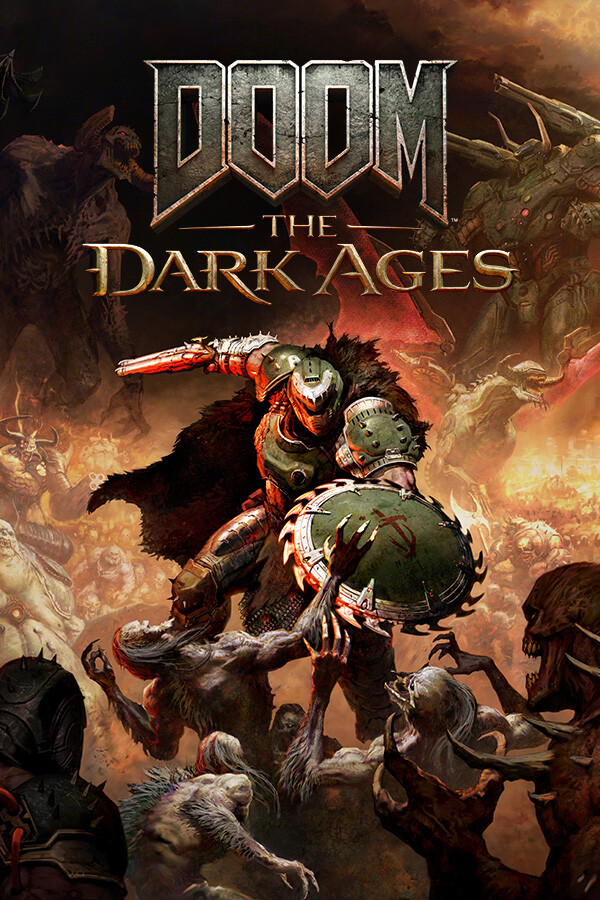
Rip and Tear Through the Ages
There is a beautiful simplicity to the promise of DOOM: The Dark Ages. Take the most relentlessly aggressive first-person shooter on the planet and transplant it to a medieval dark fantasy setting. Give the Doom Slayer a shield, a flail, and a thirty-foot-tall mech suit. Let him ride a dragon. On paper, it sounds like a twelve-year-old's fever dream, and in practice, it plays like one in the absolute best sense. id Software has done it again, delivering a game that is so supremely confident in its identity and so meticulously crafted in its execution that it makes the competition look like they are standing still. The Dark Ages is loud, fast, violent, and utterly magnificent, a prequel that proves the Slayer's legend was forged in blood and hellfire long before the events of DOOM 2016.
Overview
DOOM: The Dark Ages serves as a prequel to the rebooted DOOM timeline, telling the origin story of the Doom Slayer during his time as a warrior in the Sentinel armies of Argent D'Nur. Set in a medieval-fantasy version of the DOOM universe, the game sees the Slayer fighting through besieged castles, hellscaped battlefields, and eldritch dungeons as he wages war against the forces of Hell during the first demonic incursions. Developed by id Software and published by Bethesda Softworks, The Dark Ages launched in May 2025 across PS5, Xbox Series X, and PC, marking the first time a mainline DOOM title has been available on PlayStation since the reboot. The game uses id Tech 8 and is one of the most technically impressive shooters ever made.
Gameplay and Mechanics
The core combat loop in The Dark Ages is the best id Software has ever created, and that is not a statement we make lightly given the absurd quality bar set by DOOM Eternal. The fundamental philosophy remains the same: never stop moving, manage resources through aggression, and chain glory kills, flame belches, and chainsaw executions to maintain your health, armor, and ammo supplies. What The Dark Ages adds to this formula is a melee layer that transforms the rhythm of combat entirely. The Slayer's shield is not a defensive tool; it is a weapon. Parrying a demon's attack at the right moment reflects damage back and staggers nearby enemies, creating openings for devastating follow-up combos with the flail or the new Sentinel warhammer.
This melee integration means that combat constantly oscillates between ranged and close-quarters engagement in a way that feels organic and exhilarating. You might open a fight by staggering a Hell Knight with a precisely timed shield parry, switch to the super shotgun for a point-blank blast, dash to a distant Imp to chainsaw it for ammo, then launch back into the fray with a flail swing that clears a crowd. The flow state that this game produces is unmatched in the genre. Every encounter is a puzzle of violence, and every solution is satisfying.
The mech and dragon segments deserve special attention because they could have been throwaway gimmicks and instead are genuine highlights. The Atlan mech sections give the Slayer access to building-sized fists and shoulder-mounted cannons, turning arena fights into kaiju-scale brawls against colossal demons. These segments are perfectly paced, appearing just often enough to feel special without overstaying their welcome. The dragon combat, where the Slayer rides a cybernetically enhanced dragon through aerial battles against flying demons, is similarly excellent. The controls are intuitive, the speed is thrilling, and the visual spectacle of raining fire down on demonic armies while dodging return volleys is the kind of power fantasy that only id Software could execute with this level of polish.
Presentation
The Dark Ages is a visual powerhouse. id Tech 8 delivers some of the most impressive real-time rendering we have seen, with environments that range from towering Gothic cathedrals bathed in stained-glass light to hellish wastelands of molten rock and bone architecture. The art direction is the star here, marrying DOOM's signature industrial-hell aesthetic with medieval fantasy in a way that feels cohesive rather than gimmicky. Castle interiors are detailed with crumbling stonework and arcane machinery, while the Hell-corrupted zones outside pulse with organic horror that recalls the best of H.R. Giger and Zdzislaw Beksinski.
The soundtrack is, predictably, phenomenal. Mick Gordon did not return for this entry, but the new composers have clearly studied his work and built upon it, blending heavy metal riffs with orchestral brass and choral elements that suit the medieval setting perfectly. Combat music dynamically responds to the intensity of encounters, building from ominous drones to face-melting crescendos as the action escalates. Sound design is equally impressive, with every weapon and melee strike carrying visceral audio weight. Performance is excellent across all platforms, with the PC version in particular benefiting from id's legendary optimization prowess, running smoothly even on mid-range hardware.
Content and Value
The campaign runs approximately twelve to fifteen hours on standard difficulty, which places it on the shorter side compared to many modern AAA releases. However, every one of those hours is packed with content that earns its place. There is virtually no filler in The Dark Ages. Each level is a meticulously designed combat arena connected by exploration segments that hide secrets, upgrades, and lore collectibles. The game also includes six ultra-challenging "Unholy Trials" that function as endgame content, remixing encounters with modifier modifiers and leaderboard support for score-chasers.
At seventy dollars, the value depends on your appetite for replayability. Higher difficulty settings genuinely transform the experience, requiring mastery of every system rather than brute-force aggression. The score-attack potential of each level is enormous, and completionists will find enough secrets and challenges to extend the runtime significantly. An arcade mode unlocked after finishing the campaign adds further replay value with curated encounter chains and global leaderboards. There is no multiplayer, and frankly, the game does not need it. This is a focused, confident single-player experience that knows exactly what it wants to be.
What Works and What Doesn't
The Dark Ages is at its best when it lets you loose in its arena encounters and trusts you to figure out the optimal dance of destruction. The melee additions are genuinely transformative, giving the combat a new dimension that feels essential rather than grafted on. The mech and dragon segments are spectacular set pieces that deliver on their premise with polish and restraint. The visual design is the series' best, and the soundtrack is a worthy successor to the DOOM 2016 and Eternal scores that preceded it. id Software has proven once again that they are the undisputed masters of the first-person shooter.
The story, unfortunately, takes a backseat to the action in a way that even fans of DOOM's deliberately minimal storytelling may find underwhelming. The lore of the Sentinels and the first Hell war has always been one of the more interesting threads in the rebooted universe, and The Dark Ages touches on it without ever diving deep enough to satisfy. Some platforming sections between combat arenas also feel like pacing speed bumps, with first-person jumping puzzles that lack the precision and satisfaction of the combat. The campaign's length, while packed with quality, may feel slight for players expecting a forty-hour epic.
Pros
- Incredible combat flow
- Medieval setting is inspired
- Mech and dragon segments rule
- Phenomenal soundtrack
Cons
- Story takes a backseat
- Some platforming sections frustrate
- Short campaign length
Final Verdict
DOOM: The Dark Ages is id Software operating at the peak of their craft. The addition of melee combat to the series' already peerless shooting mechanics creates an experience that is richer, more varied, and more viscerally satisfying than anything the franchise has delivered before. The medieval setting is not a gimmick but a genuine creative evolution that opens up new possibilities for combat design, visual storytelling, and sheer spectacle. The mech battles and dragon flights are moments of pure gaming joy that rank among the year's best sequences in any genre. A thin story and occasionally frustrating platforming are minor blemishes on what is otherwise a masterclass in first-person action game design. If you have a pulse and a controller, DOOM: The Dark Ages demands your attention. The Slayer's legend has never burned brighter.