Opening Hook
Your village is starving. It is late autumn, the granary is nearly empty, and the ox teams you sent to plow the northern fields arrived two weeks too late to plant a viable crop. To the east, a rival lord's banner-men are massing at the border, drawn by the scent of weakness. You have twelve families, a half-built church, a single blacksmith who has not yet finished your militia's spears, and a decision to make: do you spend your last reserves of regional wealth hiring mercenaries to defend the border, or do you invest in a hunting camp to stave off famine and pray the enemy does not march? This is Manor Lords at its best, a game that transforms mundane medieval logistics into nail-biting drama. Built almost entirely by a single developer, Greg Styczeń of Slavic Magic, Manor Lords is one of the most impressive and immersive strategy games we have played in years. It is also, in the way of all ambitious projects from tiny teams, a game that occasionally reaches beyond its grasp.
Overview
Manor Lords began its life as one of the most wishlisted games on Steam, generating enormous hype during its Early Access period that began in April 2024. After a year of updates, community feedback, and relentless refinement, the game launched its 1.0 version on April 20, 2025, for PC and Xbox Series X, published by Hooded Horse. At its core, Manor Lords is a medieval city builder with real-time tactical battles, blending the economic depth of games like Banished and Anno with the military strategy of Total War. You play as a feudal lord tasked with developing a small settlement into a thriving medieval town while defending your territory against rival lords and managing the complex needs of your growing population. What sets Manor Lords apart from its contemporaries is its commitment to historical authenticity. The burgage plot system, which governs how residential lots are laid out, is based on actual medieval urban planning. Crop rotation, seasonal labor cycles, and trade route economics all reflect genuine historical practices. The result is a game that feels less like a strategy abstraction and more like a living, breathing medieval simulation.
Gameplay and Mechanics
The city-building layer of Manor Lords is where the game truly excels. Rather than plopping down predetermined buildings on a grid, you draw burgage plots along roads, and your settlers build homes that organically fill the allocated space. Behind each home, you can assign backyard extensions like vegetting gardens, chicken coops, apple orchards, or goat pens, each providing supplementary resources. The visual result is a town that looks authentically medieval, with winding streets, varied rooflines, and a sense of organic growth that grid-based builders cannot replicate. It is deeply satisfying to zoom out and admire a settlement that you did not so much design as cultivate.
The economic systems are layered and interconnected in ways that reward careful planning. Raw materials must be processed through production chains: sheep provide wool, which goes to a weaver's workshop to become cloth, which can be sold at market or exported via trade routes for regional wealth. Timber must be logged, transported to a sawpit, and cut into planks before it can be used for construction. Iron ore must be smelted before the blacksmith can forge tools or weapons. Every resource has a journey, and managing those journeys efficiently is the core challenge. Labor allocation is seasonal and contextual: your farmers work the fields in spring and summer, but in winter they can be redirected to logging, mining, or construction. Getting this seasonal rhythm right is essential, and the game does a wonderful job of making you feel the weight of each decision through its systems rather than through artificial difficulty spikes.
The military component is ambitious but less refined. When rival lords threaten your territory, you raise your militia from your civilian population, equipping them with whatever arms and armor your smiths have produced. Battles play out in real time with a Total War-like camera, allowing you to position units, manage formations, and execute flanking maneuvers. The combat is visually impressive, with individual soldiers clashing in brutal melee animations that convey the chaos and violence of medieval warfare. However, the AI commanding enemy forces is predictable and often exploitable. Once you identify the pattern of how enemy armies approach, you can reliably bait them into disadvantageous positions. More frustratingly, your own units sometimes struggle with pathfinding on uneven terrain, getting stuck on fences or taking unnecessarily long routes to engage. These issues are not game-breaking, but they prevent the military layer from reaching the heights of the economic simulation.
Presentation
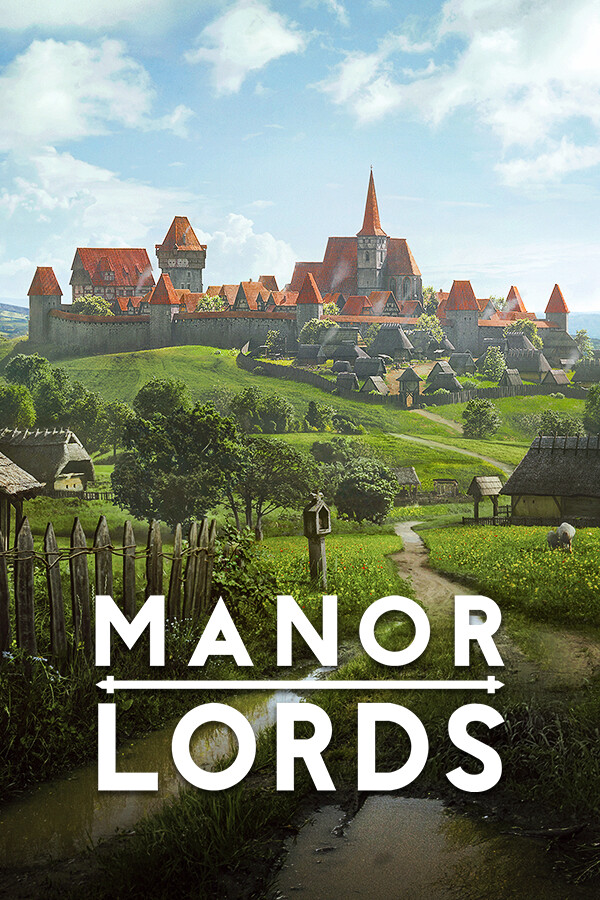
Manor Lords is one of the most visually striking strategy games ever made. The Unreal Engine 4-powered environments are breathtakingly beautiful, with rolling hills, dense forests, and atmospheric weather effects that shift dynamically with the seasons. Winter transforms your settlement under a blanket of snow, with villagers huddled around fires and breath visible in the cold air. Autumn paints the forests in warm golds and reds. Spring brings blossoming trees and the bustle of plowing season. The attention to detail is extraordinary for any game, let alone one made primarily by a single person. Individual villagers go about their daily routines, carrying goods between buildings, tending livestock, and gathering at the town center. The sense of a living community is palpable.
The sound design is understated but effective, with ambient sounds of village life creating an immersive atmosphere. Hammers ring from the smithy, chickens cluck in the background, and church bells toll to mark the passage of time. The musical score is sparse, leaning on period-appropriate instrumentation that swells during battles and recedes into gentle ambience during peaceful building phases. The UI, which received significant improvements during Early Access, is now clean and functional, though it can still feel overwhelming for newcomers. There is a lot of information to parse, from resource stockpiles and production rates to approval ratings and trade prices, and the game could do a better job of surfacing the most critical data at a glance. A more robust tutorial would also help, as the current one covers the basics but leaves many of the deeper systems for the player to discover through trial and error.
Content and Value
At $39.99, Manor Lords offers excellent value for strategy enthusiasts. A single campaign scenario can easily consume 20 to 30 hours, and the game includes multiple map configurations and difficulty settings that encourage replaying with different approaches. The sandbox mode, which removes the military pressure entirely and lets you focus on pure city building, is a relaxing and surprisingly addictive alternative. The game's modding community, already active during Early Access, has produced dozens of quality-of-life improvements and content additions, from new building types to enhanced AI behaviors. Slavic Magic has committed to continued development, with a public roadmap outlining planned features including diplomatic options, expanded trade mechanics, and cooperative multiplayer. However, it is worth noting that the 1.0 release, while substantially more complete than the Early Access version, still has gaps. Late-game content thins out noticeably once your settlement reaches a certain size, and there are only a handful of rival lord scenarios to contend with. The game needs more variety in its threats and objectives to sustain engagement across multiple full playthroughs.
What Works and What Does Not
Manor Lords succeeds magnificently as a medieval city-building simulation. The organic settlement growth, the interconnected economic chains, and the seasonal labor management create a deeply engaging strategic experience that rewards patience and planning. The visual presentation is stunning, and the sense of historical authenticity adds a layer of immersion that few strategy games achieve. Where the game falters is in its military component, which is visually impressive but strategically shallow due to predictable enemy AI and occasional pathfinding issues. The late game also needs more content to sustain the experience, and the learning curve, while appropriate for the genre, could be smoothed with better onboarding. These shortcomings are understandable given the scope of the project and the size of the development team, and they are likely to be addressed in future updates.
Pros
- Gorgeous medieval aesthetic with stunning seasonal visuals
- Deep city-building systems with organic settlement growth
- Real-time battles are visually engaging and exciting
- Remarkable achievement for a solo developer
Cons
- Still evolving from Early Access with some rough edges
- Limited late-game content and scenario variety
- Military AI needs work and can be exploited
- Steep learning curve with insufficient tutorial
Final Verdict
Manor Lords is a triumph of vision and dedication. What Greg Styczeń has accomplished as essentially a solo developer is nothing short of extraordinary. The game delivers a medieval city-building experience of remarkable depth and beauty, one that captures the texture of feudal life in ways that far larger studios have never managed. The economic simulation is engrossing, the visual presentation is best-in-class for the genre, and the organic growth of your settlement provides a satisfaction that few strategy games can match. Yes, the military AI needs improvement. Yes, the late game needs more content. Yes, the learning curve can be daunting. But these are growing pains for a game that has already proven it can evolve. If you have ever dreamed of building a medieval village from a handful of families into a thriving town, of managing the delicate balance between prosperity and survival, Manor Lords is the game you have been waiting for. It is excellent now, and with continued development, it has the potential to become legendary.