Opening Hook
Josef Fares has built his career on a simple but powerful conviction: playing games with another person is fundamentally more interesting than playing alone. With A Way Out and It Takes Two, he proved that co-op games could be more than just single-player experiences with a second controller plugged in. Split Fiction, Hazelight Studios' third co-op exclusive, is the purest distillation of that philosophy yet -- a game that treats its two-player requirement not as a limitation but as an infinite canvas for creativity. Over the course of roughly twelve hours, we played through a racing game, a stealth game, a rhythm game, a top-down twin-stick shooter, a snowboarding game, and at least a dozen other genres we did not see coming. It is an experience that constantly defies expectations, and one that reminded us why we fell in love with cooperative gaming in the first place.
Overview
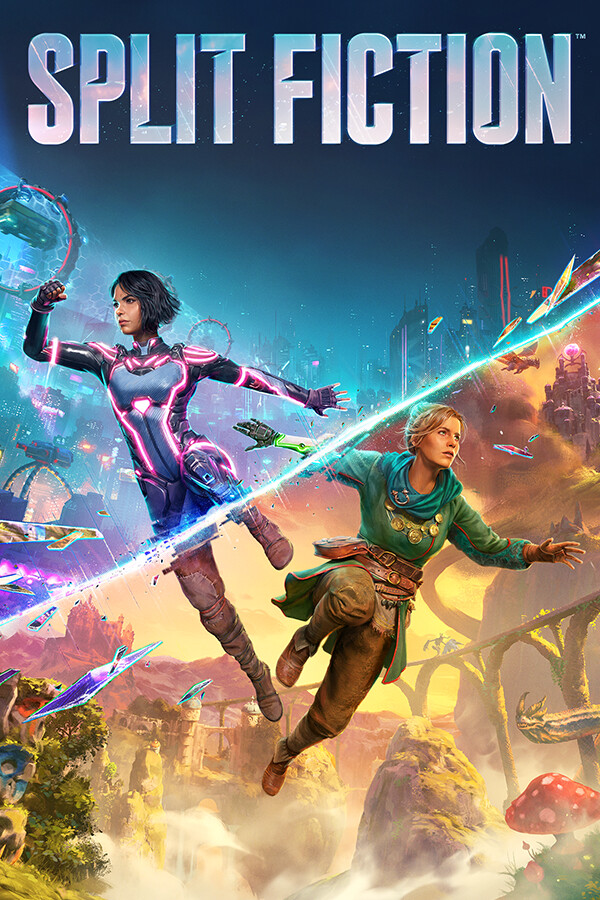
Split Fiction was developed by Hazelight Studios and published by Electronic Arts, releasing on March 6, 2025, for PS5, Xbox Series X, and PC. The game follows Mio and Zoe, two aspiring fiction writers whose minds become trapped inside an experimental machine that merges their stories together. Mio writes science fiction; Zoe writes fantasy. When the machine malfunctions, their two wildly different fictional worlds begin collapsing into one another, and the only way to escape is to play through the increasingly chaotic narrative mashup together. It is a premise tailor-made for the kind of genre-hopping gameplay that Hazelight has become known for, and the studio exploits it with relentless enthusiasm. Like all Hazelight games, Split Fiction is exclusively co-op -- there is no single-player option -- and it once again includes the generous Friend's Pass feature, meaning only one player needs to own the game.
Gameplay & Mechanics
The genius of Split Fiction lies in its refusal to settle into any single gameplay style for more than a few minutes at a time. One chapter might have you and your partner infiltrating a cyberpunk megacorporation using stealth mechanics and hacking tools, while the next drops you into a fantasy dragon-riding sequence where one player steers the dragon and the other fires spells at pursuing enemies. The transitions between genres are handled with a confidence that borders on showing off -- the game does not ease you into new mechanics so much as throw you into them headfirst, trusting that the intuitive controls and clear visual language will get you up to speed within seconds. And remarkably, it almost always works.
The core mechanical throughline is a split-screen system that dynamically adjusts based on what each player is doing. Sometimes you share a screen, sometimes you are in completely different gameplay scenarios that need to synchronize at key moments, and occasionally the screen itself becomes part of the puzzle -- one player's actions literally reshaping the other player's environment. There is a gravity puzzle sequence in the game's middle act that ranks among the most cleverly designed co-op challenges we have ever encountered, requiring both players to coordinate spatial reasoning across two different orientations of the same room.
The variety is astonishing. Over the course of the campaign, we counted no fewer than fifteen distinct gameplay styles, from traditional third-person action platforming to top-down dungeon crawling to a surprisingly polished kart racing segment. Not every style lands with equal grace -- a few of the mini-game-style sequences feel more like proof-of-concept prototypes than fully realized gameplay, particularly a brief rhythm game section where the timing window feels slightly off and a tower defense segment that overstays its welcome. But the hit rate is remarkably high, and the constant novelty means that even when a particular section does not fully click, you know something entirely different is just around the corner.
Presentation
Split Fiction is a visually ambitious game that leverages its dual-world premise to create some stunning environmental contrasts. Mio's sci-fi worlds are sleek and chrome-plated, filled with neon cityscapes, space stations, and alien landscapes rendered in cool blues and purples. Zoe's fantasy worlds are warm and organic, with enchanted forests, crumbling castles, and mystical creatures painted in golds and greens. When these two aesthetics collide -- which happens with increasing frequency as the story progresses -- the results are often breathtaking. A late-game sequence set in a world where fantasy vines are consuming a sci-fi city is one of the most visually striking environments we have seen this year.
The character animation is excellent, particularly during the many scripted co-op action sequences where Mio and Zoe move in coordinated ways that feel choreographed yet responsive. The soundtrack matches the genre-shifting gameplay beat for beat, transitioning from synth-heavy electronica to sweeping orchestral fantasy with impressive fluidity. Voice performances for Mio and Zoe are charming and carry genuine chemistry -- their bickering-to-bonding arc is predictable but effective. The only presentation weak spot is that some of the shorter gameplay segments lack the visual polish of the main chapters, looking slightly rougher in terms of texture quality and lighting.
Content & Value
At $49.99, Split Fiction is priced $10 below the new standard, and with the Friend's Pass, the effective cost is even lower for co-op partners. The main campaign runs approximately 10 to 12 hours, which is a solid length for a game that maintains this level of creative density. There are optional challenge chapters hidden throughout the story that add another 3 to 4 hours for completionists, and each chapter tracks various performance metrics that encourage replayability for those who want to perfect their runs.
That said, replayability is where Split Fiction shows its most significant weakness. Unlike It Takes Two, which had enough mechanical depth in its individual chapters to warrant revisiting, many of Split Fiction's segments are designed around surprise and first-impression novelty. Once you know what genre twist is coming next, the magic diminishes somewhat. We replayed several chapters and found them enjoyable but noticeably less exciting the second time through. The game is aware of this to some degree -- there are branching paths in a few chapters that change the gameplay style depending on which route each player takes -- but it is not enough to fully offset the one-and-done nature of the core experience. Still, for the asking price, one outstanding playthrough is more than enough to justify the investment.
What Works & What Doesn't
What works is the sheer creative ambition and the consistency with which Hazelight delivers on it. Split Fiction is a game that feels like it was made by a studio brimming with ideas and the talent to execute them. The genre variety is staggering, the co-op mechanics are consistently clever, and the narrative framework gives all the chaos a satisfying through-line. The Friend's Pass remains one of the most consumer-friendly features in gaming, and the $49.99 price point makes this an easy recommendation for anyone with a co-op partner.
What does not work as well is the inevitable inconsistency that comes with trying to be everything at once. Some of the shorter gameplay segments feel undercooked -- fun as a one-off surprise but lacking the polish that would make them memorable on their own merits. The pacing occasionally stumbles when the game tries to squeeze in story beats between action sequences, and a few emotional moments land with less impact than intended because you are still mentally processing the wild gameplay shift that just happened. These are minor complaints in the grand scheme of a game that gets far more right than wrong, but they keep Split Fiction from reaching the same heights as its predecessor.
Pros
- Endlessly creative level design that constantly surprises
- Genre variety keeps the experience perpetually fresh
- Friend's Pass is a generous and consumer-friendly feature
- Strong narrative hook that ties the chaos together
Cons
- Some mini-game segments feel undercooked
- Replayability is limited by the novelty-driven design
- A few pacing issues between action and story beats
Final Verdict
Split Fiction is another triumph for Hazelight Studios and further proof that Josef Fares and his team are the undisputed masters of cooperative game design. It is a game that respects your time, respects your wallet, and above all respects the fundamental joy of sharing a gaming experience with another person. The genre-hopping conceit is executed with breathtaking confidence, delivering surprise after surprise across a campaign that never stops inventing new ways to play. It falls just short of It Takes Two's near-perfection due to some inconsistency in its shorter segments and limited replay value, but those are small blemishes on what is otherwise one of the best co-op games ever made. If you have someone to play with, play this. If you do not, find someone. Split Fiction is worth the effort.